
Aquablation,
does it really help with Improved moderate-to-severe urinary symptoms from benign prostatic hyperplasia as much as TURP while reducing ejaculatory dysfunction?
research showsAquablation is rated B because it improved moderate-to-severe urinary symptoms from benign prostatic hyperplasia as much as TURP while reducing procedure-related ejaculatory dysfunction. The double-blind active-controlled WATER trial randomized 184 men, of whom 181 underwent treatment, and showed noninferior IPSS improvement at six months. In five-year follow-up of the same cohort, IPSS improvement was -15.1 versus -13.2 points and procedure-related ejaculatory dysfunction was 7% versus 25%. The evidence nevertheless comes from long-term follow-up of one small manufacturer-supported randomized trial, with limited independent confirmation against other operations, supporting B with 65 points.
ads claimMarketing may claim that robotic execution makes the procedure bloodless, fully preserves sexual function, or is superior to TURP in every respect. Evidence supports noninferior urinary symptom relief and a lower risk of ejaculatory dysfunction, not zero dysfunction, superior erectile function, or absence of bleeding.
Useful facts when choosing a product
- Aquablation is a transurethral operation that uses ultrasound imaging and robotic guidance to remove prostate tissue with a high-velocity, heat-free saline waterjet.
- Direct WATER comparative evidence primarily concerns men with moderate-to-severe symptoms and prostate volumes of 30 to 80 mL. Separate single-arm evidence addresses larger prostates.
- The procedure requires anesthesia, operating-room care, and catheterization, and ejaculation is not preserved in every patient. Prostate size, anatomy, and anticoagulant use require surgical risk assessment.
- Hematuria, bleeding, clot retention, urinary infection, urethral stricture, incontinence, and retreatment can occur, and bleeding requiring transfusion is possible.
Chamgap Semantic Classification Code
Candidate index · review held
P.aquablation.procedural.moderate-to-severe-urinary-symptoms-from-benign-prostatic-hyperplasia-as-much-as-turp-while-reducing-ejaculatory-dysfunction.reduce.activeProcedures, devices and tests > Aquablation > Procedural > moderate-to-severe urinary symptoms from benign prostatic hyperplasia as much as TURP while reducing ejaculatory dysfunction > Reduction claim > Active comparator
An automated migration candidate, not an issued permanent code; exact claim scope remains under review. This machine-generated migration candidate helps retrieval but is not a permanent assignment. The original verdict ID and URL remain authoritative.
What the research actually shows
WATER was a double-blind active-controlled trial that randomized 184 men with moderate-to-severe lower urinary tract symptoms and prostate volumes of 30 to 80 mL to robot-guided waterjet resection or TURP; three withdrew before treatment, leaving 181 treated. Six-month IPSS decreases were 16.9 versus 15.1 points and met noninferiority; the composite safety event at three months occurred in 26% versus 42%. The original report found anejaculation in 10% versus 36% of sexually active men, while the five-year report described procedure-related ejaculatory dysfunction in 7% versus 25%. Five-year IPSS improvements were 15.1 versus 13.2 points. The reported 51% lower risk of secondary BPH therapy through five years was an ancillary result with few events in the same cohort.
Why this is classified as B (65)
Treatment-target IPSS symptoms were noninferior to TURP at six months and remained improved by 15.1 versus 13.2 points at five years, while ejaculatory dysfunction was 7% versus 25%. These are clinically meaningful symptom and safety outcomes, but reliance on one manufacturer-supported active-controlled trial with 184 randomized and 181 treated limits the verdict to lower-middle B with 65 points.
Counterpoint. Aquablation can be a reasonable operation for an appropriately selected patient who places high value on preserving ejaculation. Bleeding risk, surgeon experience, prostate anatomy, retreatment, and alternatives such as TURP or HoLEP should be compared.
Rejudgment record. Cross-check applied — Patient-reported symptoms that are themselves treatment targets, such as pain, sleep, bowel function, IRLS, IIEF or SEP, and depression or anxiety scales, are not surrogates. Treated IPSS as a treatment-target symptom outcome and credited noninferiority to TURP plus less ejaculatory dysfunction, while applying B because evidence rests on one manufacturer-supported active-controlled trial and follow-up of the same cohort
Sub-claim grades by effect
This ingredient is marketed for several effects. A single overall grade blends strong and weak claims together, so each effect is graded separately here. The overall grade reflects the strongest disconfirming or core claim.
| Effect (sub-claim) | Grade | Basis |
|---|---|---|
| Improved moderate-to-severe urinary symptoms from benign prostatic hyperplasia | B | Six-month IPSS improvement was noninferior to TURP and remained 15.1 versus 13.2 points at five years. |
| Reduced procedure-related ejaculatory dysfunction versus TURP | B | The five-year report found 7% versus 25%, but this comes from one manufacturer-supported trial. |
| Reduced long-term need for medication restart or reoperation | C | A 51% lower risk of secondary BPH therapy was reported through five years, but it was based on few events in the same small cohort. |
Cross-check — AI research and Codex final gate
Evidence Table
| Study | Design | Sample | Funding | Endpoint | Result | Weight |
|---|---|---|---|---|---|---|
| Gilling P et al. 2018, WATER | Multicenter double-blind randomized active-controlled trial versus TURP | 184 randomized and 181 treated; prostate volumes of 30 to 80 mL | Supported by PROCEPT BioRobotics; multiple investigator financial relationships | Six-month IPSS noninferiority and three-month composite operative safety | IPSS decreased by 16.9 versus 15.1 points and met noninferiority; composite safety events were 26% versus 42%, and anejaculation among sexually active men was 10% versus 36%. | Key direct active-controlled randomized trial |
| Gilling PJ et al. 2022, WATER five-year follow-up | Five-year comparative follow-up of the original randomized cohort | 184 originally randomized and 181 treated | Device-manufacturer-sponsored extension study | Five-year IPSS, urinary flow, ejaculatory dysfunction, and secondary BPH therapy | Five-year IPSS improvement was 15.1 versus 13.2 points, procedure-related ejaculatory dysfunction was 7% versus 25%, and secondary BPH therapy risk was reported as 51% lower. | Durability support limited by reuse of the same cohort |
| Hwang EC et al. 2019 Cochrane review | Systematic review | One eligible randomized trial with 184 randomized participants; 181 in the safety analysis | Academic Cochrane review; the included trial was manufacturer supported | Urinary symptoms, quality of life, serious adverse events, sexual function, and retreatment | Aquablation probably produced similar urinary symptom improvement to TURP, but certainty was low or very low for several outcomes including ejaculatory function and retreatment. | Confirmation of dependence on a single trial |
Receipt — 3 References
All 3 cited sources were verified for existence at the original page (as of 2026-07-24).
Final verification and publication gate: Codex · Evidence date: 2026-07-24 · Corrections: none
Cite this verdict
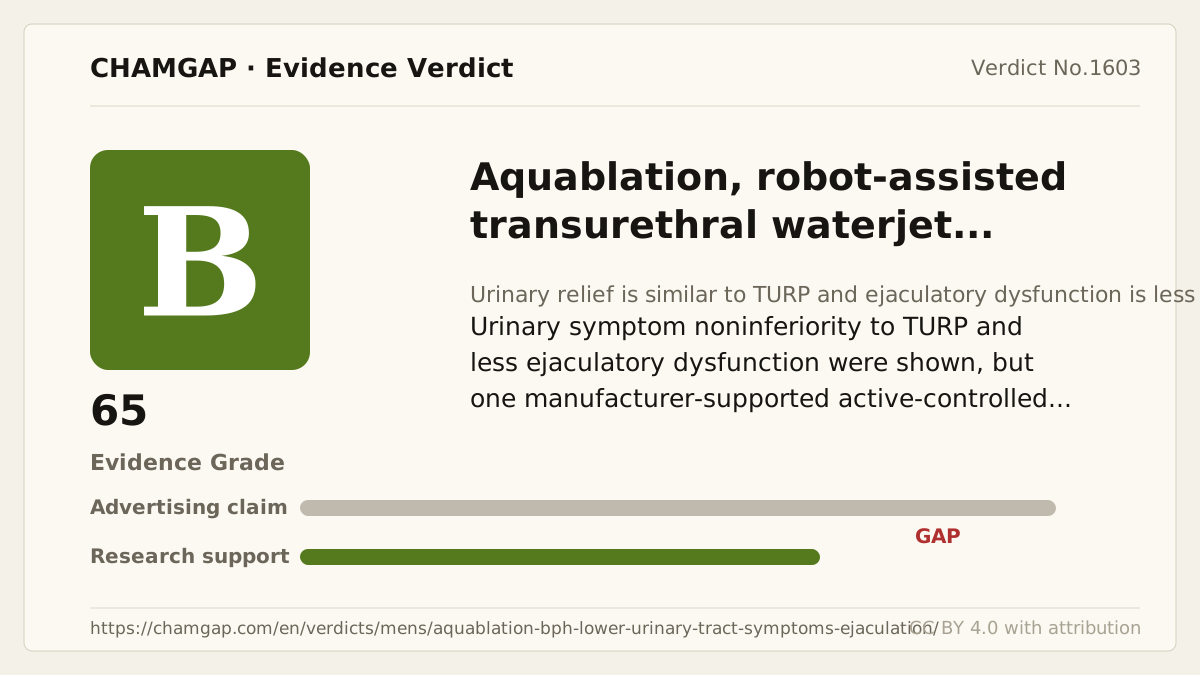
[Chamgap] Aquablation x improved BPH urinary symptoms with less ejaculatory dysfunction — Evidence Grade B·65. 3 cited sources checked. Source: https://chamgap.com/en/verdicts/mens/aquablation-bph-lower-urinary-tract-symptoms-ejaculation/ · CC BY 4.0CC BY 4.0 — free to use with attribution; do not distort grades, numbers, or verdict meaning.
What this document does and does not do
Chamgap is an information source. It reports what research has and has not confirmed; it does not tell readers what to take or buy. That decision belongs to readers and, when needed, medical or legal professionals. This verdict reflects literature available up to the search date and may change as new research appears. Nothing here is medical advice.