
Apalutamide,
does it really help with Prolonged overall survival and radiographic progression-free survival when added to androgen-deprivation therapy in metastatic castration-sensitive prostate cancer?
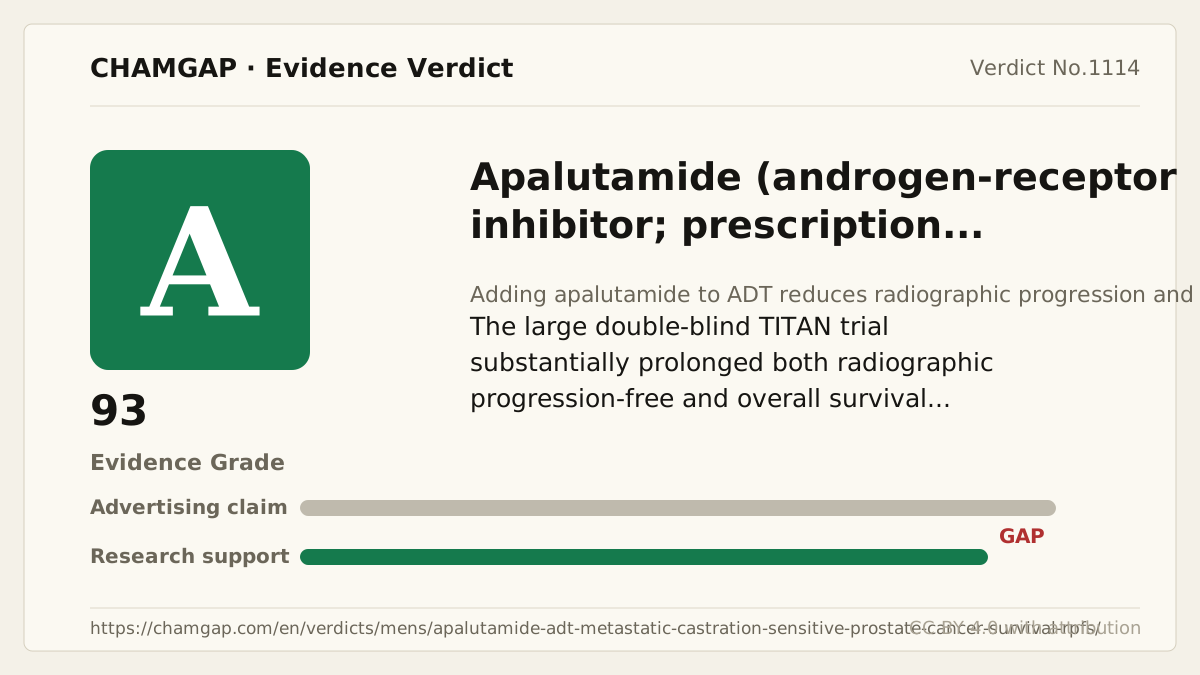
research showsApalutamide is rated B because a large double-blind randomized trial showed that adding it to androgen-deprivation therapy prolongs overall survival and radiographic progression-free survival in metastatic castration-sensitive prostate cancer. TITAN randomized 1,052 participants; at the first analysis, 24-month radiographic progression-free survival was 68.2% versus 47.5%, with a hazard ratio of 0.48 for progression or death. At the approximately four-year final analysis, the hazard ratio for death was 0.65 (95% CI 0.53 to 0.79; P<0.0001) and 48-month overall survival was 65.1% versus 51.8%. However, both cited papers are the interim and final analyses of the single TITAN trial, reporting the same 1,052 participants; no trial by different investigators or funders replicating this result was identified, and a single confirmatory trial caps the grade at B. Although manufacturer-funded, this is a large prescription-oncology trial with a hard endpoint, so the manufacturer-only ceiling does not apply. Rash, falls, fractures, hypothyroidism, and rare seizure are separated under safety.
ads claimMarketing can make a 35% reduction in the hazard of death sound like every person's absolute probability of death falls by 35 percentage points or that the cancer is cured. The hazard ratio describes relative event rates over follow-up, the 48-month absolute survival difference was 13.3 percentage points, and apalutamide is added to rather than substituted for ADT.
Useful facts when choosing a product
- Erleada is a prescription androgen-receptor inhibitor; in metastatic castration-sensitive prostate cancer, apalutamide 240 mg is taken once daily while androgen-deprivation therapy continues.
- Rash, fatigue, hypertension, falls, fractures, weight loss, and hypothyroidism can occur, so skin, blood pressure, thyroid function, bone health, and fall risk require regular assessment.
- Seizure is rare but serious; treatment should be stopped and urgent medical care obtained if a seizure occurs, and driving or hazardous work should be discussed according to individual risk.
- Apalutamide induces several drug-metabolizing enzymes and transporters and can lower exposure to other medicines, so all prescriptions and supplements, including anticoagulants and antiseizure medicines, need interaction review.
Chamgap Semantic Classification Code
Candidate index · review held
M.apalutamide.UNK.prolonged-overall-survival-and-radiographic-progression-free-survival-when-added-to-androgen-deprivation-therapy-in-metastatic-castration-sensitive-prostate-cancer.assess.MULTIMedicinal interventions > Apalutamide > Unknown > Prolonged overall survival and radiographic progression-free survival when added to androgen-deprivation therapy in metastatic castration-sensitive prostate cancer > Association or change assessment > Multiple: primary unresolved
An automated migration candidate, not an issued permanent code; exact claim scope remains under review. This machine-generated migration candidate helps retrieval but is not a permanent assignment. The original verdict ID and URL remain authoritative.
What the research actually shows
Chi and the TITAN Investigators randomly and double-blindly assigned 1,052 people with metastatic castration-sensitive prostate cancer to apalutamide 240 mg daily plus ADT or placebo plus ADT. At a median follow-up of 22.7 months, 24-month radiographic progression-free survival was 68.2% versus 47.5%, with a hazard ratio of 0.48 (95% CI 0.39 to 0.60; P<0.001); 24-month overall survival was 82.4% versus 73.5%, with a death hazard ratio of 0.67. The 2021 final analysis by Chi and colleagues evaluated 405 deaths at a median follow-up of about 44 months and reported an intention-to-treat death hazard ratio of 0.65 (95% CI 0.53 to 0.79; P<0.0001) and 48-month survival of 65.1% versus 51.8%. Adjustment for placebo crossover gave a hazard ratio of 0.52, but this verdict uses the more conservative intention-to-treat value of 0.65. Authorization reflects the trial, but the grade rests on survival and progression results rather than authorization itself.
Why this is classified as B (72)
The 1,052-person double-blind phase 3 trial showed a radiographic progression-free survival hazard ratio of 0.48 and improved overall survival, sustained at about four years with a death hazard ratio of 0.65 and a 13.3-percentage-point absolute survival difference. The endpoint is directly hard, the effect is large, and the confidence intervals are precise. However, the two cited papers are the interim and final analyses of the same 1,052-participant TITAN trial, so there is only one confirmatory trial and no replication by different investigators or funders was identified. Under the axis-2 R1 ceiling the grade is B with 72 points. Manufacturer sponsorship is recorded, but the manufacturer ceiling does not apply to a large hard-endpoint prescription-oncology trial, and safety remains separate.
Counterpoint. Because this treatment is combined with ADT, disease burden, prior docetaxel, cardiovascular and bone health, drug interactions, and patient preferences should be assessed jointly by the oncology and urology team.
Rejudgment record. New verdict — Credited the prespecified coprimary radiographic progression-free survival and the direct hard endpoint of overall survival in the 1,052-person double-blind phase 3 TITAN trial, but applied the axis-2 R1 ceiling of B because the two cited papers are the interim and final analyses of the same trial and no replication by different investigators or funders was identified. Funding is manufacturer-only (I0), but the axis-3 ceiling does not apply to a large hard-endpoint prescription trial
| Endpoint | H | Hard endpoint - actual events such as death |
| Replication | R1 | Single confirmatory trial |
| Independence | I0 | Evidence comes only from manufacturer studies |
| Effect size | E+ | Meets the clinically important threshold |
Stored derived and displayed grades match; this is not a current recalculation or validity check (B).
Sub-claim grades by effect
This ingredient is marketed for several effects. A single overall grade blends strong and weak claims together, so each effect is graded separately here. The overall grade reflects the strongest disconfirming or core claim.
| Effect (sub-claim) | Grade | Basis |
|---|---|---|
| Prolongation of overall survival when added to ADT | A | The final TITAN intention-to-treat analysis improved the direct hard endpoint, with a death hazard ratio of 0.65 and a 13.3-percentage-point absolute survival difference at 48 months. |
| Prolongation of radiographic progression-free survival when added to ADT | A | The prespecified coprimary endpoint showed a progression-or-death hazard ratio of 0.48 and 24-month radiographic progression-free survival of 68.2% versus 47.5%. |
Cross-check — AI research and Codex final gate
Evidence Table
| Study | Design | Sample | Funding | Endpoint | Result | Weight |
|---|---|---|---|---|---|---|
| Chi KN et al.; TITAN Investigators 2019 | Multinational phase 3 randomized double-blind placebo-controlled trial | 1,052 participants with metastatic castration-sensitive prostate cancer | Janssen Research & Development | Coprimary overall survival and radiographic progression-free survival | Twenty-four-month radiographic progression-free survival was 68.2% versus 47.5%, with a progression-or-death hazard ratio of 0.48 (95% CI 0.39 to 0.60; P<0.001); the initial death hazard ratio was 0.67 (95% CI 0.51 to 0.89). | Large pivotal evidence with a direct hard endpoint |
| Chi KN et al. 2021 TITAN final analysis | Prespecified final overall-survival analysis of the randomized phase 3 trial | 1,052 participants, 405 deaths, and median follow-up of approximately 44 months | Janssen Research & Development | Final overall survival, 48-month survival, and crossover-adjusted analysis | The intention-to-treat death hazard ratio was 0.65 (95% CI 0.53 to 0.79; P<0.0001), 48-month survival was 65.1% versus 51.8%, and the crossover-adjusted hazard ratio was 0.52. | Confirmatory long-term overall-survival evidence |
Receipt — 2 References
All 2 cited sources were verified for existence at the original page (as of 2026-07-22).
Final verification and publication gate: Codex · Evidence date: 2026-07-22 · Corrections: 1
Correction log — 1
Corrections applied to this verdict, in chronological order. Changes are logged, not erased.
- 2026-08-08 · Grade correction for unmet independent-replication requirement — The two cited papers were treated as separate trials, but both are the interim and final analyses of TITAN (NCT02489318) in the same 1,052 participants. An A grade at Chamgap requires axis-2 R2: multiple randomized trials by different investigators and funders pointing the same way. No trial by different investigators or funders replicating the survival benefit of apalutamide plus ADT versus ADT was identified (LACOG-0415 is a phase 2 trial with different comparators and Janssen funding). With a single confirmatory trial, axis 2 is R1 and the ceiling is B. The axes are recorded as H, R1, I0, E+, B1, giving 72 points for three strength axes. The effect itself (final overall-survival hazard ratio 0.65) is not disputed. Identified in the 2026-08-08 internal audit, which screened all 151 A-grade verdicts for repeated first authors and then confirmed this case by Codex cross-verification and source checking. (grade A→B)
Cite this verdict
[Chamgap] Apalutamide x prolonged overall and radiographic progression-free survival in metastatic castration-sensitive prostate cancer — Evidence Grade B·72. 2 cited sources checked. Source: https://chamgap.com/en/verdicts/mens/apalutamide-adt-metastatic-castration-sensitive-prostate-cancer-survival-rpfs/ · CC BY 4.0CC BY 4.0 — free to use with attribution; do not distort grades, numbers, or verdict meaning.
What this document does and does not do
Chamgap is an information source. It reports what research has and has not confirmed; it does not tell readers what to take or buy. That decision belongs to readers and, when needed, medical or legal professionals. This verdict reflects literature available up to the search date and may change as new research appears. Nothing here is medical advice.