
Intracavernosal alprostadil,
does it really help with Induction of an erection sufficient for intercourse when PDE5 inhibitors are unsuitable or inadequate?
research showsIntracavernosal alprostadil is rated B because it directly induces erections sufficient for intercourse in erectile dysfunction. Every dose outperformed placebo in a dose-response trial, and in a six-month self-injection study, sexual activity was possible after 94% of injections while patients and partners rated it satisfactory after 87% and 86%. Function is the treatment goal itself, and multiple studies support use, but older manufacturer-sponsored evidence, invasiveness, penile pain, and priapism limit the score to 70.
ads claimA reliable erection does not mean universal, risk-free, or natural response. Professional titration and injection training are required, and an erection lasting four hours is an emergency.
Useful facts when choosing a product
- Caverject is a prescription intracavernosal injection for erectile dysfunction; a clinician should titrate the lowest effective dose and teach correct injection technique.
- Use generally should not exceed once in 24 hours or three times per week, with the individual prescription and product label taking priority.
- Penile pain, injection-site hematoma, priapism, cavernosal fibrosis, and nodules can occur, requiring periodic penile examination.
- An erection lasting four hours or longer requires immediate emergency care to prevent tissue damage and permanent loss of erectile function.
Chamgap Semantic Classification Code
Candidate index · review held
M.alprostadil.UNK.induction-of-an-erection-sufficient-for-intercourse-when-pde5-inhibitors-are-unsuitable-or-inadequate.assess.MULTIMedicinal interventions > Alprostadil > Unknown > Induction of an erection sufficient for intercourse when PDE5 inhibitors are unsuitable or inadequate > Association or change assessment > Multiple: primary unresolved
An automated migration candidate, not an issued permanent code; exact claim scope remains under review. This machine-generated migration candidate helps retrieval but is not a permanent assignment. The original verdict ID and URL remain authoritative.
What the research actually shows
The Alprostadil Study Group led by Linet and Ogrinc conducted three studies across multiple erectile-dysfunction etiologies. In a 296-man placebo-controlled dose-response study, every 2.5-to-20-microgram dose outperformed placebo with a dose response. In a 683-man six-month self-injection study, sexual activity was possible after 94% of injections and was rated satisfactory after 87% by patients and 86% by partners. A randomized crossover trial in 111 men found intercourse-sufficient erections after 82.5% of intracavernosal administrations versus 53.0% with intraurethral alprostadil. Modern guidance recommends counseling on intracavernosal injection when PDE5 inhibitors fail, are contraindicated, or are not preferred.
Why this is classified as B (68)
Placebo-controlled dose response, six-month self-injection data, and comparative evidence consistently support intercourse-sufficient erections and sexual activity. Because function is the direct treatment goal, the result merits B, while older manufacturer data, invasiveness, pain, priapism, and fibrosis give 70 points.
Counterpoint. Intracavernosal injection can produce high response rates after oral-drug failure but best suits patients able to perform injections and respond to emergencies.
Rejudgment record. Cross-check applied — Applied B because placebo-controlled dose response, extended self-injection, and comparative evidence consistently improved erections sufficient for intercourse and sexual activity, which are the direct functional treatment goals
Sub-claim grades by effect
This ingredient is marketed for several effects. A single overall grade blends strong and weak claims together, so each effect is graded separately here. The overall grade reflects the strongest disconfirming or core claim.
| Effect (sub-claim) | Grade | Basis |
|---|---|---|
| Induction of an erection sufficient for intercourse | B | Every dose outperformed placebo in dose-response testing with high clinical response rates. |
| Satisfactory sexual activity after self-injection | B | Sexual activity was possible after 94% of injections over six months, with high patient and partner satisfaction. |
| Alternative functional treatment when oral PDE5 inhibitors are unsuitable or inadequate | B | Its different mechanism and route make it a guideline-supported option, although injection training and risk management are required. |
Cross-check — AI research and Codex final gate
Evidence Table
| Study | Design | Sample | Funding | Endpoint | Result | Weight |
|---|---|---|---|---|---|---|
| Alprostadil Study Group (Linet OI and Ogrinc FG). 1996 | Multicenter prospective placebo-controlled dose-response, dose-finding, and six-month self-injection studies | 296, 201, and 683 men | Upjohn development program | Erection rigidity, feasibility of sexual activity, and patient and partner satisfaction | Every dose outperformed placebo, and sexual activity was possible after 94% of injections in the six-month study. | Pivotal direct functional-efficacy evidence |
| Shabsigh R et al. randomized crossover comparison. 2000 | Multicenter randomized crossover active-comparator trial | 111 men | Product-development study as reported | Erection sufficient for intercourse and patient preference | Intercourse-sufficient erections occurred after 82.5% of intracavernosal versus 53.0% of intraurethral administrations. | Supportive randomized route comparison |
Receipt — 3 References
All 3 cited sources were verified for existence at the original page (as of 2026-07-23).
Final verification and publication gate: Codex · Evidence date: 2026-07-23 · Corrections: none
Cite this verdict
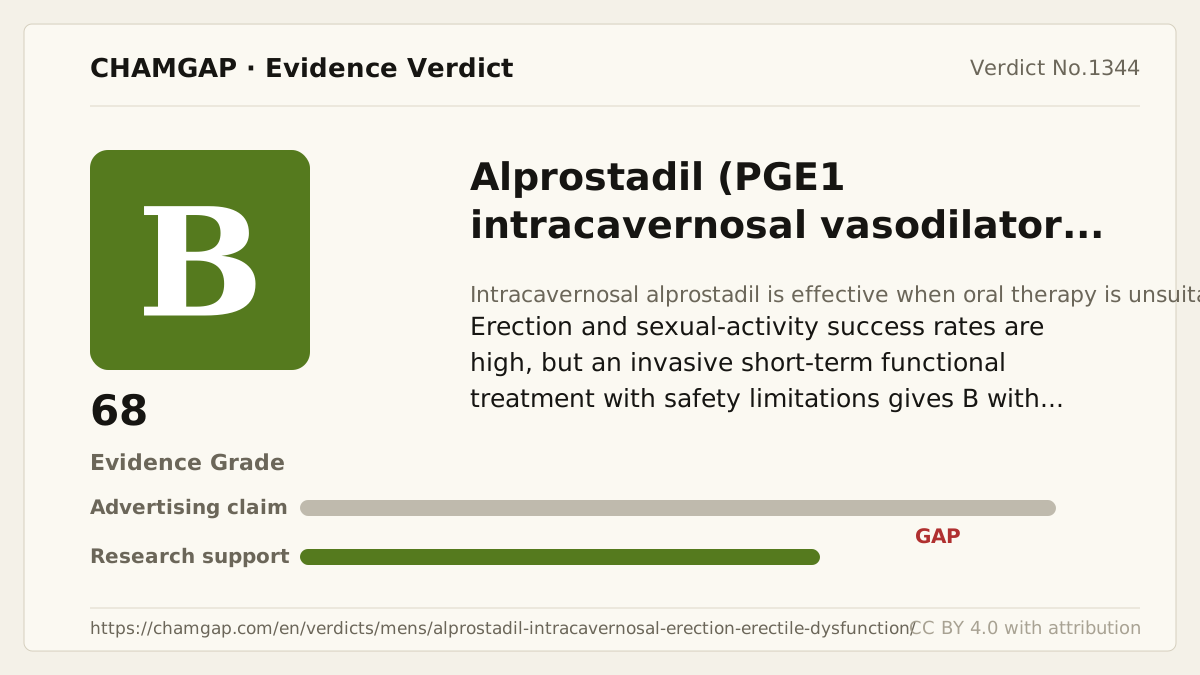
[Chamgap] Intracavernosal alprostadil x erection sufficient for intercourse — Evidence Grade B·68. 3 cited sources checked. Source: https://chamgap.com/en/verdicts/mens/alprostadil-intracavernosal-erection-erectile-dysfunction/ · CC BY 4.0CC BY 4.0 — free to use with attribution; do not distort grades, numbers, or verdict meaning.
What this document does and does not do
Chamgap is an information source. It reports what research has and has not confirmed; it does not tell readers what to take or buy. That decision belongs to readers and, when needed, medical or legal professionals. This verdict reflects literature available up to the search date and may change as new research appears. Nothing here is medical advice.