
Alfuzosin extended release,
does it really help with Improved lower urinary tract symptoms, urinary bother, and quality of life in benign prostatic hyperplasia?
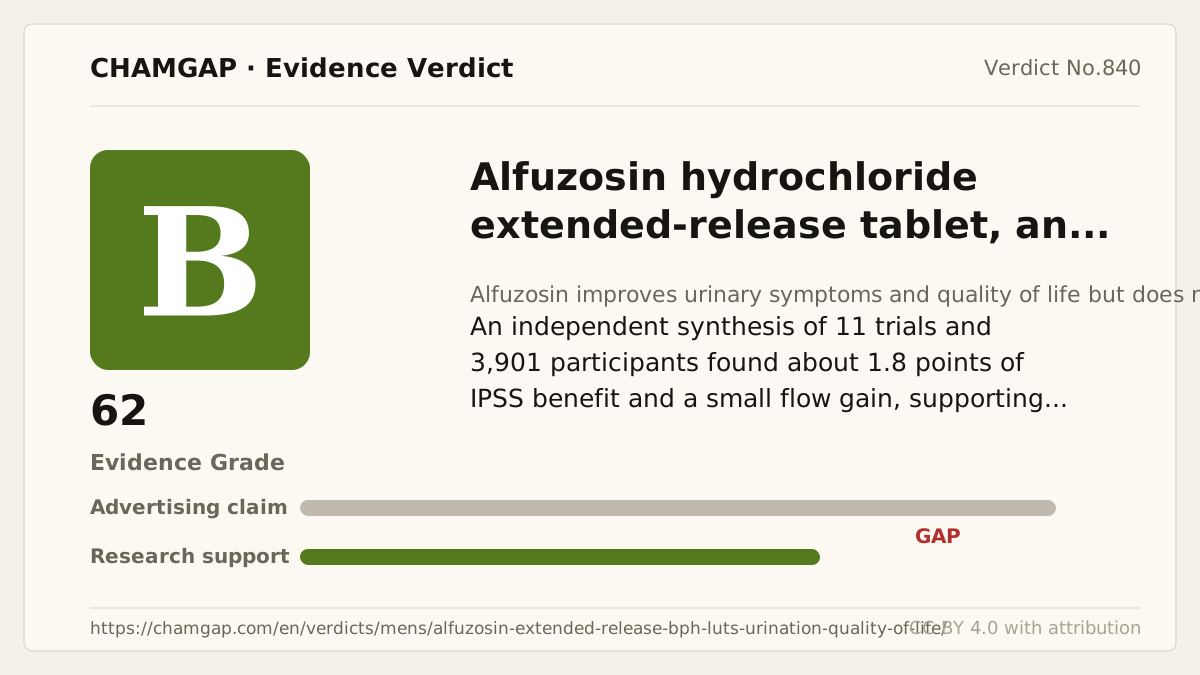
research showsAlfuzosin extended release receives B with 62 points. An independent synthesis of 11 randomized trials and 3,901 participants found an average IPSS improvement of about 1.8 points over placebo and a small increase in peak urinary flow. The effect is modest and the main symptom measure is patient reported, but alpha-blocker relief of lower urinary tract symptoms is established across trials and independent meta-analysis, supporting the lower end of B. Alfuzosin does not shrink the prostate, and the 1,522-person two-year ALTESS trial did not significantly reduce acute urinary retention or surgery.
ads claimAlfuzosin relieves symptoms by reducing smooth-muscle tension around the bladder outlet and prostate; it does not shrink an enlarged prostate or prevent prostate cancer. Broad language about treating the prostate exceeds the evidence if interpreted as disease modification or guaranteed prevention of surgery.
Useful facts when choosing a product
- Alfuzosin extended release is a prescription alpha-1 blocker that reduces smooth-muscle tone in the prostate and bladder neck; it is not a 5-alpha-reductase inhibitor that shrinks prostate tissue.
- A 10-mg extended-release product is generally taken once daily immediately after the same meal and swallowed whole, because crushing or chewing can disrupt extended release; the prescription and product label take priority.
- Dizziness, orthostatic hypotension, and syncope matter especially at initiation, and other blood-pressure medicines, nitrates, or phosphodiesterase-5 inhibitors can amplify hypotension.
- Because intraoperative floppy iris syndrome can occur during cataract surgery, the ophthalmic surgeon should be told about current or past alfuzosin exposure.
Chamgap Semantic Classification Code
Candidate index · review held
UNK.alfuzosin-hydrochloride-extended-release-tablet.UNK.lower-urinary-tract-symptoms-urinary-bother-and-quality-of-life-in-benign-prostatic-hyperplasia.reduce.placeboUnknown > Alfuzosin hydrochloride extended-release tablet > Unknown > lower urinary tract symptoms, urinary bother, and quality of life in benign prostatic hyperplasia > Reduction claim > Placebo
An automated migration candidate, not an issued permanent code; exact claim scope remains under review. This machine-generated migration candidate helps retrieval but is not a permanent assignment. The original verdict ID and URL remain authoritative.
What the research actually shows
The 447-person ALFORTI trial and Roehrborn's 536-person North American trial found that alfuzosin 10 mg improved IPSS and peak flow over placebo. The independent systematic review by MacDonald and Wilt synthesized 11 randomized trials with 3,901 participants and found about 1.8 points of IPSS benefit over placebo plus a small peak-flow gain. This supports established lower urinary tract symptom relief, although effect size is modest and the main symptom score is patient reported. In contrast, the two-year 1,522-person ALTESS trial reduced a composite including symptom deterioration but did not significantly prevent acute urinary retention or BPH surgery.
Why this is classified as B (62)
An independent synthesis of 11 randomized trials and 3,901 participants found about 1.8 points of IPSS improvement over placebo and a small peak-flow gain, establishing alpha-blocker lower urinary tract symptom relief. Modest effect size, a patient-reported main endpoint, no prostate shrinkage, and null prevention of acute retention and surgery place the verdict at B with 62 points. Hypotension and floppy iris risk remain separate safety issues.
Counterpoint. Watchful waiting and lifestyle measures are options for mild symptoms, while a large prostate or high progression risk may call for a 5-alpha-reductase inhibitor or another strategy in clinical care.
Rejudgment record. New verdict — Rated established alpha-blocker symptom efficacy at B because an independent synthesis of 11 randomized trials and 3,901 participants found about 1.8 points of IPSS benefit over placebo and a small peak-flow gain, while accounting for modest effect size, the patient-reported endpoint, and null prevention of acute retention or surgery in a 1,522-person long-term trial
Sub-claim grades by effect
This ingredient is marketed for several effects. A single overall grade blends strong and weak claims together, so each effect is graded separately here. The overall grade reflects the strongest disconfirming or core claim.
| Effect (sub-claim) | Grade | Basis |
|---|---|---|
| Improved BPH lower urinary tract symptoms, urinary bother, and quality of life | B | Several placebo-controlled trials with hundreds of participants and a systematic review repeatedly improved IPSS, flow, and quality of life. |
| Prevention of acute urinary retention and progression to surgery | D | A 1,522-person long-term trial did not significantly reduce acute retention or surgery, meeting the large human null-evidence criterion for D. |
| Reduction in prostate size | F | Alfuzosin relaxes smooth muscle and is not a prostate-shrinking drug, so this claim is inconsistent with its pharmacology and clinical evidence. |
Cross-check — AI research and Codex final gate
Evidence Table
| Study | Design | Sample | Funding | Endpoint | Result | Weight |
|---|---|---|---|---|---|---|
| van Kerrebroeck P et al. 2000 ALFORTI | Three-month multicenter randomized double-blind placebo-controlled dose trial | 447 men with symptomatic benign prostatic hyperplasia | Alfuzosin formulation-development trial in an industry-sponsored context | IPSS, peak urinary flow, quality of life, and blood-pressure safety | Once-daily 10 mg improved symptoms and flow, with IPSS change -6.9 versus -4.9 for placebo (p=0.005). | Key direct randomized trial |
| Roehrborn CG. 2001 | Three-month North American randomized double-blind placebo-controlled dose trial | 536 men with clinical benign prostatic hyperplasia and lower urinary tract symptoms | Industry phase 3 formulation-development trial | IPSS, peak flow, quality of life, orthostatic hypotension, and ejaculatory disorders | Ten milligrams improved IPSS by -3.6 versus -1.6 for placebo (p=0.001), with significant flow and quality-of-life benefit and no added benefit at 15 mg. | Key replicated direct randomized trial |
| MacDonald R and Wilt TJ. 2005 | Systematic review and meta-analysis of randomized alfuzosin trials | Eleven randomized trials with 3,901 participants | United States Veterans Affairs and academic review | IPSS, peak flow, withdrawal, dizziness, and hypotension | Alfuzosin improved IPSS by about 1.8 points over placebo and produced a small peak-flow gain, but the effect size was modest. | Key synthesis |
| Roehrborn CG et al. 2006 ALTESS | Two-year multicenter randomized double-blind placebo-controlled progression trial | 1,522 men with benign prostatic hyperplasia at risk of progression | Sanofi-Aventis development trial | Composite progression of acute urinary retention, BPH surgery, or IPSS deterioration | The composite including symptom deterioration was reduced, but acute urinary retention and BPH-related surgery were not significantly reduced. | Large long-term evidence limiting claim expansion |
Receipt — 5 References
All 5 cited sources were verified for existence at the original page (as of 2026-07-20).
Final verification and publication gate: Codex · Evidence date: 2026-07-20 · Corrections: none
Cite this verdict
[Chamgap] Alfuzosin extended release x improved BPH lower urinary tract symptoms, urinary bother, and quality of life — Evidence Grade B·62. 5 cited sources checked. Source: https://chamgap.com/en/verdicts/mens/alfuzosin-extended-release-bph-luts-urination-quality-of-life/ · CC BY 4.0CC BY 4.0 — free to use with attribution; do not distort grades, numbers, or verdict meaning.
What this document does and does not do
Chamgap is an information source. It reports what research has and has not confirmed; it does not tell readers what to take or buy. That decision belongs to readers and, when needed, medical or legal professionals. This verdict reflects literature available up to the search date and may change as new research appears. Nothing here is medical advice.