
Ursodeoxycholic acid,
does it really help with Improvement of liver histology and fibrosis in MASH/NASH?
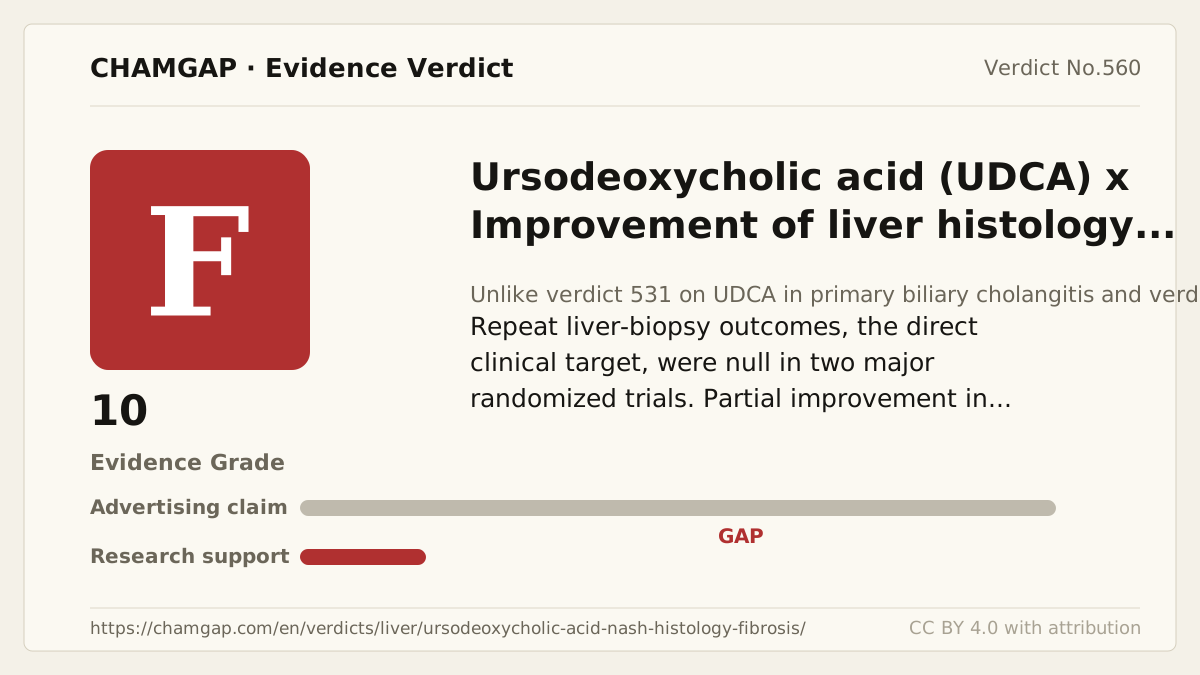
research showsNo. Placebo-controlled randomized trials of standard-dose and high-dose UDCA repeatedly failed to improve overall NASH histology or fibrosis. Some studies lowered liver enzymes such as ALT, but those changes do not substitute for histologic treatment efficacy. UDCA efficacy in primary biliary cholangitis is a separate disease claim.
ads claimAn improvement in liver enzymes should not be relabeled as treatment of steatohepatitis or reversal of fibrosis. The Ursa brand, regulatory or guideline recognition in primary biliary cholangitis, and widespread low-dose nonprescription availability do not support histologic efficacy in MASH.
Useful facts when choosing a product
- Oral UDCA products, including the Ursa brand, are widely distributed in South Korea as prescription and some nonprescription medicines.
- Unlike general liver-support products with roughly 50–100 mg per dose, NASH trials used approximately 13–15, 23–28, or 28–35 mg/kg/day, but higher dosing did not establish biopsy-proven histologic efficacy.
- Common adverse effects include soft stools or diarrhea and gastrointestinal discomfort, and higher doses may increase exposure and the likelihood of adverse effects.
- Complete biliary obstruction is a contraindication, and medical assessment takes priority when acute cholecystitis or cholangitis or recurrent biliary colic is suspected. Other bile-acid-binding drugs or aluminum-containing antacids may impair absorption, requiring dose spacing and medication review.
Chamgap Semantic Classification Code
Candidate index · review held
UNK.ursodeoxycholic-acid.UNK.liver-histology-and-fibrosis-in-mash-nash.improve.placeboUnknown > Ursodeoxycholic acid > Unknown > liver histology and fibrosis in MASH/NASH > Improvement claim > Placebo
An automated migration candidate, not an issued permanent code; exact claim scope remains under review. This machine-generated migration candidate helps retrieval but is not a permanent assignment. The original verdict ID and URL remain authoritative.
What the research actually shows
Any renewed claim for UDCA as a MASH treatment would require adequately powered independent trials showing prespecified NASH resolution and at least one-stage fibrosis improvement on repeat biopsy, with longer follow-up for clinical events. Current interpretation must prioritize the repeated histologic failures.
Why this is classified as F (10)
The direct claim of NASH histologic and fibrosis improvement was repeatedly null in placebo-controlled standard-dose and high-dose trials, supporting grade F. Liver-enzyme reduction is a separate surrogate subclaim.
Counterpoint. This verdict does not negate UDCA's separate established role in primary biliary cholangitis or its use in selected cholestatic disorders.
Rejudgment record. New verdict — Repeat-biopsy direct endpoints were evaluated separately from liver-enzyme and noninvasive surrogates and from efficacy in primary biliary cholangitis
Sub-claim grades by effect
This ingredient is marketed for several effects. A single overall grade blends strong and weak claims together, so each effect is graded separately here. The overall grade reflects the strongest disconfirming or core claim.
| Effect (sub-claim) | Grade | Basis |
|---|---|---|
| Improvement of liver histology and fibrosis in MASH/NASH | F | Overall histology and fibrosis were repeatedly null in placebo-controlled repeat-biopsy trials at standard and high doses. |
| Improvement of liver-enzyme surrogates such as ALT and GGT | C | Some high-dose trials showed improvement, but results are inconsistent across studies and do not establish better histology or clinical outcomes. |
| Treatment of primary biliary cholangitis | B | Primary biliary cholangitis is a separate disease axis assessed in verdict 531. Efficacy in that condition cannot be transferred to MASH. |
Cross-check — AI research and Codex final gate
Evidence Table
| Study | Design | Sample | Funding | Endpoint | Result | Weight |
|---|---|---|---|---|---|---|
| Lindor et al., randomized trial of standard-dose UDCA in NASH (2004) | Multicenter double-blind randomized trial assigning biopsy-confirmed NASH patients to UDCA 13–15 mg/kg/day or placebo for two years | 174 randomized; 166 analyzed; 126 completed; 107 had paired liver biopsies | Support from U.S. National Institutes of Health sources and provision of study medication were reported | Liver enzymes and steatosis, inflammation, and fibrosis on repeat liver biopsy | UDCA did not significantly improve liver tests or histology versus placebo. Steatosis improved in both groups, while changes in inflammation and fibrosis did not differ between groups. | Direct null evidence from a large, long-duration, placebo-controlled repeat-biopsy trial |
| Leuschner et al., randomized trial of high-dose UDCA in NASH (2010) | Multicenter double-blind randomized trial assigning biopsy-confirmed NASH patients to high-dose UDCA 23–28 mg/kg/day or placebo for 18 months | 185 randomized; 139 had paired liver biopsies | Industry-sponsored trial funded by Dr. Falk Pharma | Primary: overall histology by modified Brunt score; NAS, fibrosis, and biochemical measures | The primary overall histology endpoint was null (p=0.881), as was NAS (p=0.355). Fibrosis did not improve; only limited changes such as lobular inflammation or GGT were observed. | Core repeated refutation showing null histology and fibrosis even at high dose |
| Ratziu et al., randomized biochemical trial of very-high-dose UDCA (2011) | Multicenter double-blind randomized trial assigning biopsy-confirmed NASH patients to UDCA 28–35 mg/kg/day or placebo for 12 months | 126 participants | Industry-sponsored trial funded by Axcan Pharma | Primary: change in ALT; GGT, glucose and insulin measures, and noninvasive markers including FibroTest; no repeat histologic endpoint | ALT fell 28.3% with UDCA versus 1.6% with placebo, with normalization in 24.5% versus 4.8%. Without repeat liver biopsy, the study could not establish improvement in NASH histology or fibrosis. | Shows a positive biochemical surrogate signal but carries low weight for the direct histologic claim |
| AASLD practice guidance for nonalcoholic fatty liver disease (2023) | Professional-society practice guidance synthesizing randomized trials and histologic evidence | Not applicable (guidance) | American Association for the Study of Liver Diseases practice guidance with author disclosures | Histologic benefit and treatment recommendations for NASH | The guidance concluded that UDCA may improve some biochemical measures but lacks meaningful histologic benefit and should not be used to treat NASH. | Supporting synthesis from an independent professional society linking the direct histologic evidence to clinical use |
Receipt — 4 References
All 4 cited sources were verified for existence at the original page (as of 2026-07-18).
Final verification and publication gate: Codex · Evidence date: 2026-07-18 · Corrections: none
Cite this verdict
[Chamgap] Does UDCA improve liver histology and fibrosis in MASH/NASH? — Evidence Grade F·10. 4 cited sources checked. Source: https://chamgap.com/en/verdicts/liver/ursodeoxycholic-acid-nash-histology-fibrosis/ · CC BY 4.0CC BY 4.0 — free to use with attribution; do not distort grades, numbers, or verdict meaning.
What this document does and does not do
Chamgap is an information source. It reports what research has and has not confirmed; it does not tell readers what to take or buy. That decision belongs to readers and, when needed, medical or legal professionals. This verdict reflects literature available up to the search date and may change as new research appears. Nothing here is medical advice.