
16:8 time-restricted eating,
does it really help with Additional liver-fat reduction beyond equal daily calorie restriction?
research showsThe grade is D with 30 points. In an 88-person trial with the same calorie targets in both groups, the between-group difference in intrahepatic triglyceride was -0.2 percentage points at six months (95% CI -2.7 to 2.2) and +1.0 at twelve months (-1.6 to 3.5), both null. The two registration numbers cover the original six-month design and twelve-month extension of the same participants, not two trials.
ads claimA claim that fasting time independently burns more liver fat requires an equal-calorie comparison. This trial found no additional window effect, and improvement shared by both groups should not be marketed as window-specific.
Useful facts when choosing a product
- Calorie targets were identical: 1500-1800 kcal for men and 1200-1500 kcal for women.
- The time-restricted group ate only from 08:00 to 16:00.
- NCT03786523 and NCT04988230 are original and extension registrations of one TREATY-FLD trial.
Chamgap Semantic Classification Code
Candidate index · review held
D.16-8-schedule-restricting-food-intake-to-08-00-16-00.dietary.additional-liver-fat-reduction-beyond-equal-daily-calorie-restriction.reduce.activeDietary patterns and eating practices > 16:8 schedule restricting food intake to 08:00-16:00 > Dietary regimen > Additional liver-fat reduction beyond equal daily calorie restriction > Reduction claim > Active comparator
An automated migration candidate, not an issued permanent code; exact claim scope remains under review. This machine-generated migration candidate helps retrieval but is not a permanent assignment. The original verdict ID and URL remain authoritative.
What the research actually shows
Eighty-eight participants were assigned to time-restricted eating, 45, or daily calorie restriction, 43. The primary model included all 88 assigned participants, while 81 were actually assessed at six months and 74 at twelve months. The between-group differences were -0.2 points (-2.7 to 2.2, P=0.86) at six months and +1.0 (-1.6 to 3.5, P=0.45) at twelve months. The paper explicitly states that NCT03786523 registered the original six-month design and NCT04988230 separately registered extension of the same intervention and participants to twelve months. They are not independent trials. MRI readers were masked and public funding was confirmed, but the sample was below 200 and 14/88 (15.9%) lacked the twelve-month assessment.
Why this is classified as D (30)
A publicly funded randomized trial found both prespecified imaging time points null, but it remains one trial and no validated boundary lets the confidence interval exclude an important added benefit, giving D with 30 points.
Counterpoint. People using glucose-lowering medication, those who are pregnant or breastfeeding, or those with an eating-disorder history or chronic disease need clinical adjustment of meals and medication.
Rejudgment record. Cross-check applied — Cross-checked the JAMA report and both registries for single-trial identity, the primary outcome, time-specific intention-to-treat estimates, assessed denominators, masking, and public funding
| Endpoint | S | Surrogate marker - laboratory or imaging measures |
| Replication | R1 | Single confirmatory trial |
| Independence | I2 | Decisive evidence is publicly or non-profit funded |
| Effect size | E0 | Null |
| Precision | C0 | The confidence interval leaves room for benefit |
Stored derived and displayed grades match; this is not a current recalculation or validity check (D).
Sub-claim grades by effect
This ingredient is marketed for several effects. A single overall grade blends strong and weak claims together, so each effect is graded separately here. The overall grade reflects the strongest disconfirming or core claim.
| Effect (sub-claim) | Grade | Basis |
|---|---|---|
| Additional liver-fat reduction at six months with equal calories | D | The between-group difference was -0.2 points (-2.7 to 2.2). |
| Additional liver-fat reduction at twelve months with equal calories | D | The between-group difference was +1.0 point (-1.6 to 3.5). |
Cross-check — AI research and Codex final gate
Evidence Table
| Study | Design | Sample | Funding | Endpoint | Result | Weight |
|---|---|---|---|---|---|---|
| Wei X, Lin B, Huang Y, Yang S, Huang C, Shi L, Liu D, Zhang P, Lin J, Xu B, Guo D, Li C, He H, Liu S, Xue Y, Xu Y, Zhang H. 2023 | Single-center parallel open-label randomized trial with masked MRI assessment | 88 randomized and included in intention-to-treat analysis (45/43); 81 assessed at six months and 74 at twelve months | Public funding from Chinese national research programs and Southern Medical University | Absolute change in MRI-measured intrahepatic triglyceride content | Six months -0.2 percentage points (95% CI -2.7 to 2.2), P=0.86; twelve months +1.0 (-1.6 to 3.5), P=0.45 | Single independent null equal-calorie active-control trial |
Receipt — 1 References
All 1 cited sources were verified for existence at the original page (as of 2026-08-15).
Final verification and publication gate: Codex · Evidence date: 2026-08-15 · Corrections: none
Cite this verdict
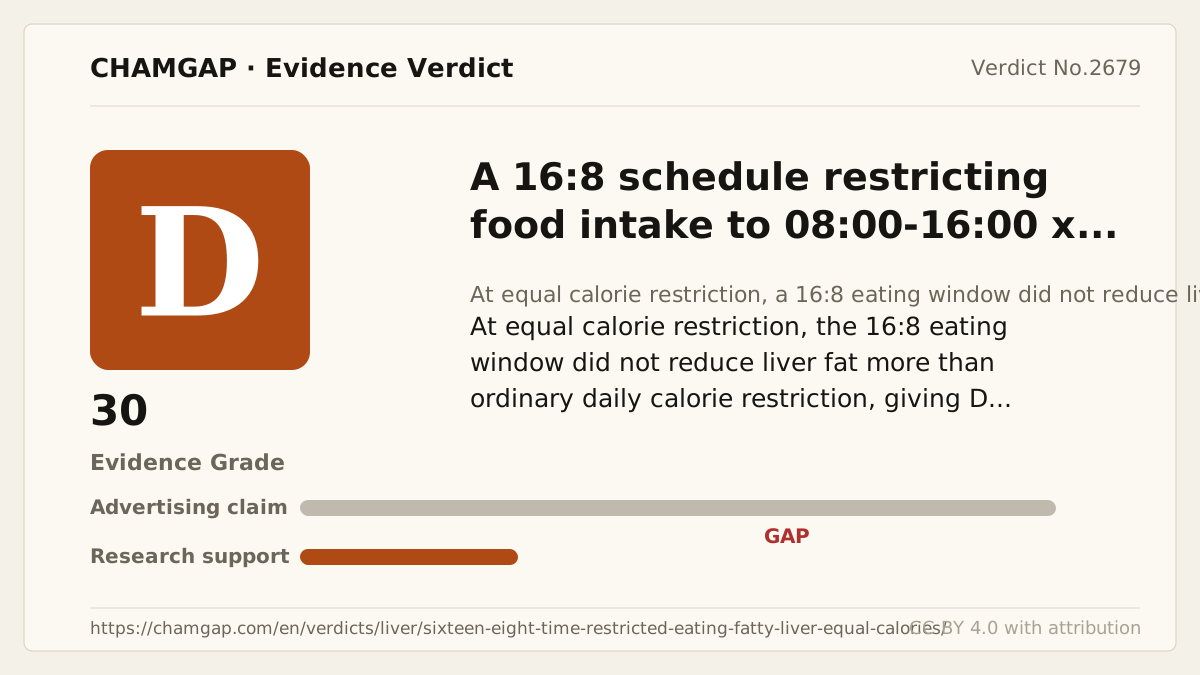
[Chamgap] 16:8 time-restricted eating x additional fatty-liver reduction at equal calories — Evidence Grade D·30. 1 cited sources checked. Source: https://chamgap.com/en/verdicts/liver/sixteen-eight-time-restricted-eating-fatty-liver-equal-calories/ · CC BY 4.0CC BY 4.0 — free to use with attribution; do not distort grades, numbers, or verdict meaning.
What this document does and does not do
Chamgap is an information source. It reports what research has and has not confirmed; it does not tell readers what to take or buy. That decision belongs to readers and, when needed, medical or legal professionals. This verdict reflects literature available up to the search date and may change as new research appears. Nothing here is medical advice.