
Sorafenib,
does it really help with Prolonged overall survival as initial systemic therapy for unresectable advanced hepatocellular carcinoma?
research showsSorafenib is rated A because it prolonged overall survival in previously systemically untreated, unresectable advanced hepatocellular carcinoma. In the 602-patient placebo-controlled phase 3 SHARP trial, median overall survival was 10.7 versus 7.9 months, with a hazard ratio for death of 0.69. A 226-patient Asia-Pacific phase 3 trial replicated the result, with median survival of 6.5 versus 4.2 months and a hazard ratio of 0.68. Preferred first-line care has moved toward immunotherapy combinations, but that change does not erase sorafenib's randomized survival evidence.
ads claimCalling sorafenib the first drug to prolong survival should not be converted into a claim that it remains the best first-line choice for every patient. Modern selection must account for liver function, bleeding risk, immunotherapy contraindications, and access.
Useful facts when choosing a product
- Sorafenib is an oral anticancer drug that inhibits multiple kinases, including VEGFR and RAF signaling; the trial dose was 400 mg twice daily.
- The SHARP and Asia-Pacific evidence came mainly from patients with preserved Child-Pugh A liver function.
- Hand-foot skin reaction, diarrhea, hypertension, fatigue, and weight loss are common, requiring monitoring of liver function, blood pressure, and skin toxicity.
- Immunotherapy combinations are now often preferred first-line options, while sorafenib is selected according to contraindications, access, liver function, and prior therapy.
Chamgap Semantic Classification Code
Candidate index · review held
M.sorafenib.oral.prolonged-overall-survival-as-initial-systemic-therapy-for-unresectable-advanced-hepatocellular-carcinoma.assess.placeboMedicinal interventions > Sorafenib > Oral > Prolonged overall survival as initial systemic therapy for unresectable advanced hepatocellular carcinoma > Association or change assessment > Placebo
An automated migration candidate, not an issued permanent code; exact claim scope remains under review. This machine-generated migration candidate helps retrieval but is not a permanent assignment. The original verdict ID and URL remain authoritative.
What the research actually shows
SHARP assigned 602 patients with advanced hepatocellular carcinoma and no prior systemic therapy to sorafenib 400 mg twice daily or placebo. Overall survival and time to radiologic progression improved, while time to symptomatic progression did not. Cheng's Asia-Pacific trial assigned 226 Child-Pugh A patients in a two-to-one ratio to the same sorafenib dose or placebo and replicated improvements in overall survival and time to progression. The 2023 AASLD practice guidance favors atezolizumab plus bevacizumab or durvalumab plus tremelimumab for eligible Child-Pugh A patients, so sorafenib's present clinical rank has declined.
Why this is classified as A (90)
Independent placebo-controlled phase 3 SHARP and Asia-Pacific trials replicated overall-survival benefit with similar hazard ratios. This ingredient-specific mortality evidence supports A with 90 points; current treatment ranking is recorded separately.
Counterpoint. Modern first-line selection must compare immunotherapy combinations and account for Child-Pugh class, variceal bleeding risk, and immunotherapy contraindications.
Rejudgment record. New verdict — Independent placebo-controlled phase 3 SHARP and Asia-Pacific randomized trials replicated ingredient-specific overall-survival benefit, while present treatment ranking was evaluated separately from the evidence itself
Sub-claim grades by effect
This ingredient is marketed for several effects. A single overall grade blends strong and weak claims together, so each effect is graded separately here. The overall grade reflects the strongest disconfirming or core claim.
| Effect (sub-claim) | Grade | Basis |
|---|---|---|
| Prolonged overall survival in treatment-naive advanced hepatocellular carcinoma | A | The result was replicated in the placebo-controlled phase 3 SHARP and Asia-Pacific trials. |
| Delayed radiologic progression | A | In SHARP, time to radiologic progression increased from 2.8 to 5.5 months. |
| Replicated survival benefit in Asia-Pacific patients | A | Median overall survival was 6.5 versus 4.2 months, with an HR of 0.68. |
Cross-check — AI research and Codex final gate
Evidence Table
| Study | Design | Sample | Funding | Endpoint | Result | Weight |
|---|---|---|---|---|---|---|
| Llovet et al. SHARP 2008 | Multicenter phase 3 randomized double-blind placebo-controlled trial | 602 patients with advanced hepatocellular carcinoma and no previous systemic treatment | Supported by Bayer HealthCare Pharmaceuticals and Onyx Pharmaceuticals | Overall survival and time to symptomatic progression; time to radiologic progression was secondary | Median overall survival was 10.7 versus 7.9 months (HR 0.69, 95% CI 0.55 to 0.87; P<0.001), and time to radiologic progression was 5.5 versus 2.8 months. | Key ingredient-specific overall-survival randomized trial |
| Cheng et al. Asia-Pacific trial 2009 | Multinational phase 3 randomized double-blind placebo-controlled trial | 226 patients with advanced Child-Pugh A hepatocellular carcinoma | Supported by Bayer HealthCare Pharmaceuticals and Onyx Pharmaceuticals | Overall survival and time to progression | Median overall survival was 6.5 versus 4.2 months (HR 0.68, 95% CI 0.50 to 0.93; P=0.014), replicating SHARP's survival direction. | Replicating phase 3 trial in a different region |
Receipt — 3 References
All 3 cited sources were verified for existence at the original page (as of 2026-07-23).
Final verification and publication gate: Codex · Evidence date: 2026-07-23 · Corrections: none
Cite this verdict
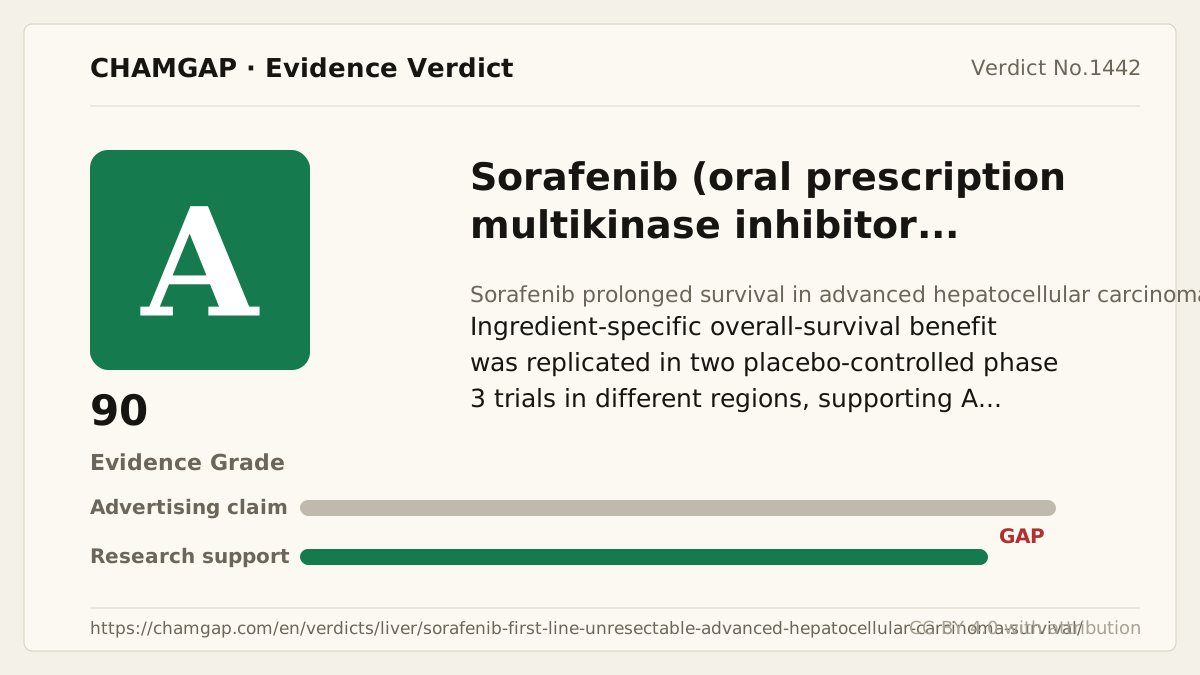
[Chamgap] Sorafenib x prolonged overall survival in treatment-naive advanced hepatocellular carcinoma — Evidence Grade A·90. 3 cited sources checked. Source: https://chamgap.com/en/verdicts/liver/sorafenib-first-line-unresectable-advanced-hepatocellular-carcinoma-survival/ · CC BY 4.0CC BY 4.0 — free to use with attribution; do not distort grades, numbers, or verdict meaning.
What this document does and does not do
Chamgap is an information source. It reports what research has and has not confirmed; it does not tell readers what to take or buy. That decision belongs to readers and, when needed, medical or legal professionals. This verdict reflects literature available up to the search date and may change as new research appears. Nothing here is medical advice.