
Resveratrol,
does it really help with Improvement of liver fat, alanine aminotransferase, aspartate aminotransferase, and histologic fatty liver in metabolic dysfunction-associated or nonalcoholic fatty liver disease?
research showsResveratrol receives a D for efficacy in metabolic dysfunction-associated or nonalcoholic fatty liver disease. A meta-analysis of four randomized trials measuring liver fat by quantitative imaging found an effect size of 0.18 (95% CI -1.08 to 1.43), which did not support a reduction. A five-trial meta-analysis of 216 patients was also null for alanine aminotransferase, at -2.48 IU/L, and aspartate aminotransferase, at -2.90 IU/L. A seven-trial meta-analysis of 302 patients found no overall benefit and reported an increase in alanine aminotransferase. No convincing biopsy evidence establishes improvement in fibrosis, inflammation, or ballooning. The evidence is too small, short, and heterogeneous for stronger refutation, but the current randomized syntheses do not support the claim and warrant D. Short-term safety and product variability are separate from efficacy.
ads claimMarketing expands an antioxidant derived from grapes or red wine and animal fat-oxidation mechanisms into liver detoxification, removal of fatty liver, and liver-cell restoration in people. Antioxidant activity or one liver-enzyme measurement is not the same as improved liver fat, histology, or clinical outcomes.
Useful facts when choosing a product
- Resveratrol is a stilbene polyphenol present in grape skins, but supplements vary in source, trans-resveratrol proportion, dose, and absorption.
- Fatty-liver trials generally used 500 to 3,000 mg daily for eight weeks to six months. Retail products cannot be assumed to have the same material, content, or bioavailability.
- Short trials were generally tolerable, but high doses can cause diarrhea, abdominal discomfort, or nausea. Possible interactions, including with anticoagulant and antiplatelet drugs, should be reviewed before use.
- Resveratrol should not replace weight management, diabetes or lipid treatment, alcohol assessment, or liver care, and normalized enzymes do not automatically establish improved liver fat or histology.
Chamgap Semantic Classification Code
Candidate index · review held
S.resveratrol.UNK.liver-fat-alanine-aminotransferase-aspartate-aminotransferase-and-histologic-fatty-liver-in-metabolic-dysfunction-associated-or-nonalcoholic-fatty-liver-disease.improve.UNKSupplements and nutraceuticals > Resveratrol > Unknown > liver fat, alanine aminotransferase, aspartate aminotransferase, and histologic fatty liver in metabolic dysfunction-associated or nonalcoholic fatty liver disease > Improvement claim > Unknown
An automated migration candidate, not an issued permanent code; exact claim scope remains under review. This machine-generated migration candidate helps retrieval but is not a permanent assignment. The original verdict ID and URL remain authoritative.
What the research actually shows
Kilchoer and colleagues reviewed 20 supplement trials and 1,171 participants in which liver fat was measured by quantitative tomographic imaging; only four resveratrol trials could be meta-analyzed. Liver-fat reduction was not supported, and the evidence was scarce and of limited quality. Wei and colleagues pooled five trials and 216 patients, finding alanine aminotransferase -2.48 IU/L (95% CI -12.30 to 7.34) and aspartate aminotransferase -2.90 IU/L (-9.77 to 3.98). Jakubczyk and colleagues synthesized seven trials and 302 patients using 500 to 3,000 mg daily for 56 to 180 days without confirming efficacy. These studies mainly measured imaging and blood surrogates rather than clinical events or reliably replicated biopsy histology.
Why this is classified as D (28)
Syntheses of four quantitative-imaging liver-fat trials, five liver-enzyme trials with 216 patients, and seven trials with 302 patients did not support consistent benefit. The studies are small and short and lack robust histologic and clinical outcomes, preventing an F, but credible randomized syntheses are null and evidence quality is limited. This yields D with 28 points. Short-term tolerability and product or dose variability remain separate safety issues.
Counterpoint. Reassessment would be appropriate if an adequately powered independent trial of standardized trans-resveratrol jointly demonstrated benefit on magnetic-resonance liver fat, biopsy histology, and long-term clinical outcomes in a defined population.
Rejudgment record. New verdict — Applied D because a four-trial quantitative-imaging liver-fat meta-analysis, a five-trial alanine and aspartate aminotransferase meta-analysis, and an overall seven-trial synthesis did not support consistent resveratrol benefit and biopsy-confirmed histologic efficacy is absent; small subgroup signals were not upgraded, while the limited trial size did not justify the repeated-refutation threshold for F
Sub-claim grades by effect
This ingredient is marketed for several effects. A single overall grade blends strong and weak claims together, so each effect is graded separately here. The overall grade reflects the strongest disconfirming or core claim.
| Effect (sub-claim) | Grade | Basis |
|---|---|---|
| Reduction of liver fat in metabolic dysfunction-associated or nonalcoholic fatty liver disease | D | The four-trial quantitative-imaging meta-analysis was null, with an effect size of 0.18 (95% CI -1.08 to 1.43). |
| Improvement of alanine and aspartate aminotransferase in metabolic dysfunction-associated or nonalcoholic fatty liver disease | D | Neither enzyme decreased significantly across five trials, and a separate seven-trial synthesis reported increased alanine aminotransferase. |
| Histologic improvement of metabolic dysfunction-associated or nonalcoholic fatty liver disease | ? | There is essentially no human efficacy trial directly assessing a histological (biopsy) endpoint, so evidence is absent. The overall D rests on null RCTs for imaging liver fat and liver enzymes. |
Cross-check — AI research and Codex final gate
Evidence Table
| Study | Design | Sample | Funding | Endpoint | Result | Weight |
|---|---|---|---|---|---|---|
| Kilchoer B et al. 2020 | Systematic review and meta-analysis of supplement trials measuring liver fat by quantitative imaging | Twenty trials and 1,171 participants overall; four resveratrol trials | Academic review with mixed funding among included trials | Liver fat by quantitative tomographic imaging | The resveratrol effect size was 0.18 (95% CI -1.08 to 1.43), which did not support reduced liver fat. | Key direct liver-fat synthesis with quality limitations |
| Wei S and Yu X. 2021 | Systematic review and meta-analysis of randomized trials in nonalcoholic fatty liver disease | Five trials and 216 patients | Academic meta-analysis with mixed funding among included trials | Serum alanine and aspartate aminotransferase | Alanine aminotransferase was -2.48 IU/L (P=.62) and aspartate aminotransferase -2.90 IU/L (P=.40); neither was significant. | Key null liver-enzyme synthesis |
| Jakubczyk K et al. 2020 | Meta-analysis of randomized trials in nonalcoholic fatty liver disease | Seven trials and 302 patients; 56 to 180 days | Public support from the Polish Ministry of Science and Higher Education Regional Initiative of Excellence | Liver enzymes, metabolic, inflammatory, and anthropometric measures | No overall benefit was established across analyzed measures, and alanine aminotransferase increased significantly. | Independent corroboration of null efficacy |
Receipt — 3 References
All 3 cited sources were verified for existence at the original page (as of 2026-07-22).
Final verification and publication gate: Codex · Evidence date: 2026-07-22 · Corrections: none
Cite this verdict
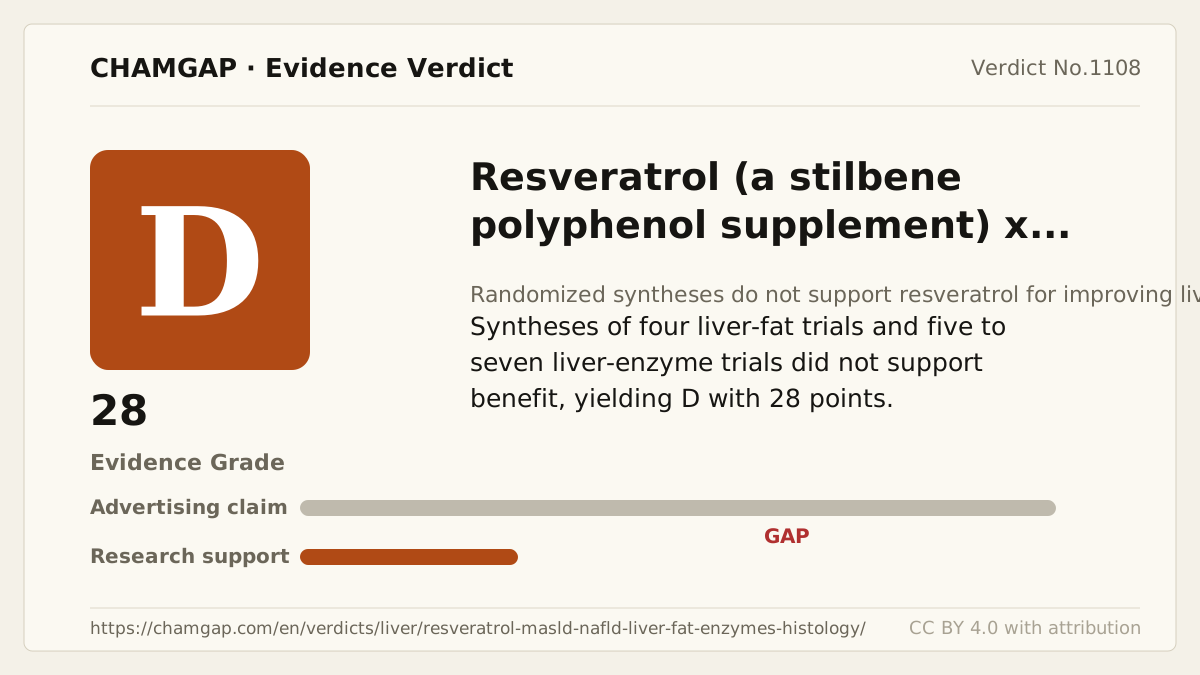
[Chamgap] Resveratrol x improvement of liver fat, liver enzymes, and histology in fatty liver disease — Evidence Grade D·28. 3 cited sources checked. Source: https://chamgap.com/en/verdicts/liver/resveratrol-masld-nafld-liver-fat-enzymes-histology/ · CC BY 4.0CC BY 4.0 — free to use with attribution; do not distort grades, numbers, or verdict meaning.
What this document does and does not do
Chamgap is an information source. It reports what research has and has not confirmed; it does not tell readers what to take or buy. That decision belongs to readers and, when needed, medical or legal professionals. This verdict reflects literature available up to the search date and may change as new research appears. Nothing here is medical advice.