
Regorafenib,
does it really help with Prolonged overall survival in hepatocellular carcinoma that progressed after sorafenib?
research showsRegorafenib prolonged overall survival in hepatocellular carcinoma that progressed during sorafenib treatment, but the grade is B with 72 points. In the 573-participant phase 3 RESORCE trial, it reduced the risk of death by 37% versus placebo (HR 0.63), with median overall survival of 10.6 versus 7.8 months. Progression-free survival also improved from 1.5 to 3.1 months. Because the citations rest on a single trial (repeat reports of the same trial) without replication by different investigators and funders, axis-2 R1 caps the grade at B. Hand-foot skin reaction, hypertension, diarrhea, and hepatotoxicity require separate management.
ads claimMarketing may broaden the claim to all second-line liver cancer, while the evidence directly concerns sorafenib-tolerant patients with preserved liver function whose disease progressed.
Useful facts when choosing a product
- Regorafenib is an oral multitarget kinase inhibitor; RESORCE used 160 mg once daily for the first 21 days of each 28-day cycle.
- Food instructions and dose modification must follow the product label, and toxicity often requires reduction or interruption.
- Hand-foot skin reaction, hypertension, fatigue, diarrhea, and reduced appetite are common, and severe liver injury can occur.
- Liver tests and blood pressure require monitoring, with assessment of bleeding, wound-healing, and interaction risks.
Chamgap Semantic Classification Code
Candidate index · review held
M.regorafenib.oral.prolonged-overall-survival-in-hepatocellular-carcinoma-that-progressed-after-sorafenib.assess.placeboMedicinal interventions > Regorafenib > Oral > Prolonged overall survival in hepatocellular carcinoma that progressed after sorafenib > Association or change assessment > Placebo
An automated migration candidate, not an issued permanent code; exact claim scope remains under review. This machine-generated migration candidate helps retrieval but is not a permanent assignment. The original verdict ID and URL remain authoritative.
What the research actually shows
Bruix and colleagues conducted RESORCE as an international multicenter double-blind phase 3 trial, comparing 379 regorafenib recipients with 194 placebo recipients. Overall and progression-free survival improved consistently, and objective response was 11% versus 4%. Bayer funded the single pivotal trial, but randomization, placebo control, and the mortality endpoint give it high weight.
Why this is classified as B (72)
RESORCE demonstrated overall survival HR 0.63 and a 2.8-month median difference, with consistent progression-free survival HR 0.46. However, the cited evidence is a single trial (repeat reports of the same trial) without replication by different investigators and funders, so axis-2 R1 caps the grade at B with 72 points. Bayer funding does not trigger the axis-3 cap under the large hard-endpoint prescription-drug RCT exception.
Counterpoint. The median survival difference was measured in months and toxicity is substantial; prior sorafenib tolerance, liver function, and performance status determine applicability.
Rejudgment record. New verdict — Ingredient-specific direct evidence from the randomized phase 3 RESORCE comparison of regorafenib versus placebo, with significant gains in overall and progression-free survival — but the citations rest on this single trial (repeat reports of the same trial) without replication by different investigators and funders, so axis-2 R1 caps the grade at B (the axis-3 cap is waived under the large hard-endpoint prescription-drug RCT exception)
| Endpoint | H | Hard endpoint - actual events such as death |
| Replication | R1 | Single confirmatory trial |
| Independence | I0 | Evidence comes only from manufacturer studies |
| Effect size | E+ | Meets the clinically important threshold |
Stored derived and displayed grades match; this is not a current recalculation or validity check (B).
Sub-claim grades by effect
This ingredient is marketed for several effects. A single overall grade blends strong and weak claims together, so each effect is graded separately here. The overall grade reflects the strongest disconfirming or core claim.
| Effect (sub-claim) | Grade | Basis |
|---|---|---|
| Prolonged overall survival | A | 10.6 versus 7.8 months, HR 0.63. |
| Prolonged progression-free survival | A | 3.1 versus 1.5 months, HR 0.46. |
Cross-check — AI research and Codex final gate
Evidence Table
| Study | Design | Sample | Funding | Endpoint | Result | Weight |
|---|---|---|---|---|---|---|
| Bruix J et al. RESORCE 2017 | International multicenter randomized double-blind placebo-controlled phase 3 trial | 573 participants; 379 regorafenib and 194 placebo | Bayer | Overall survival | 10.6 versus 7.8 months, HR 0.63 (95% CI 0.50 to 0.79). | Grade-determining hard endpoint |
| RESORCE progression-free survival analysis | Prespecified secondary endpoint in the same phase 3 trial | 573 participants | Bayer | Progression-free survival | 3.1 versus 1.5 months, HR 0.46 (95% CI 0.37 to 0.56). | Consistency support |
Receipt — 2 References
All 2 cited sources were verified for existence at the original page (as of 2026-08-11).
Final verification and publication gate: Codex · Evidence date: 2026-08-11 · Corrections: 1
Correction log — 1
Corrections applied to this verdict, in chronological order. Changes are logged, not erased.
- 2026-08-11 · Grade correction for unmet independent-replication requirement — Both cited references rest on a single trial, RESORCE (NCT01774344) — the second citation (Pelosof 2018) is not a new trial but a regulatory document in which US FDA reviewers summarized the approval based on that same trial. Chamgap's A requires axis-2 R2 (multiple RCTs by different investigators and funders); no placebo-controlled overall-survival RCT other than RESORCE exists in hepatocellular carcinoma progressing after sorafenib, and REGAIN is a starting-dose comparison funded by the same Bayer, so axis 2 is R1 and the ceiling is B. The axes were recorded as B-H-R1-I0-E+-B1 (the axis-3 cap is waived under the large hard-endpoint prescription-drug RCT exception) and 72 points were assigned. The effect itself (overall survival 10.6 versus 7.8 months, HR 0.63) is not disputed. Confirmed in the 2026-08-11 internal audit (workflow verification plus concordant Codex cross-check). (grade A→B)
Cite this verdict
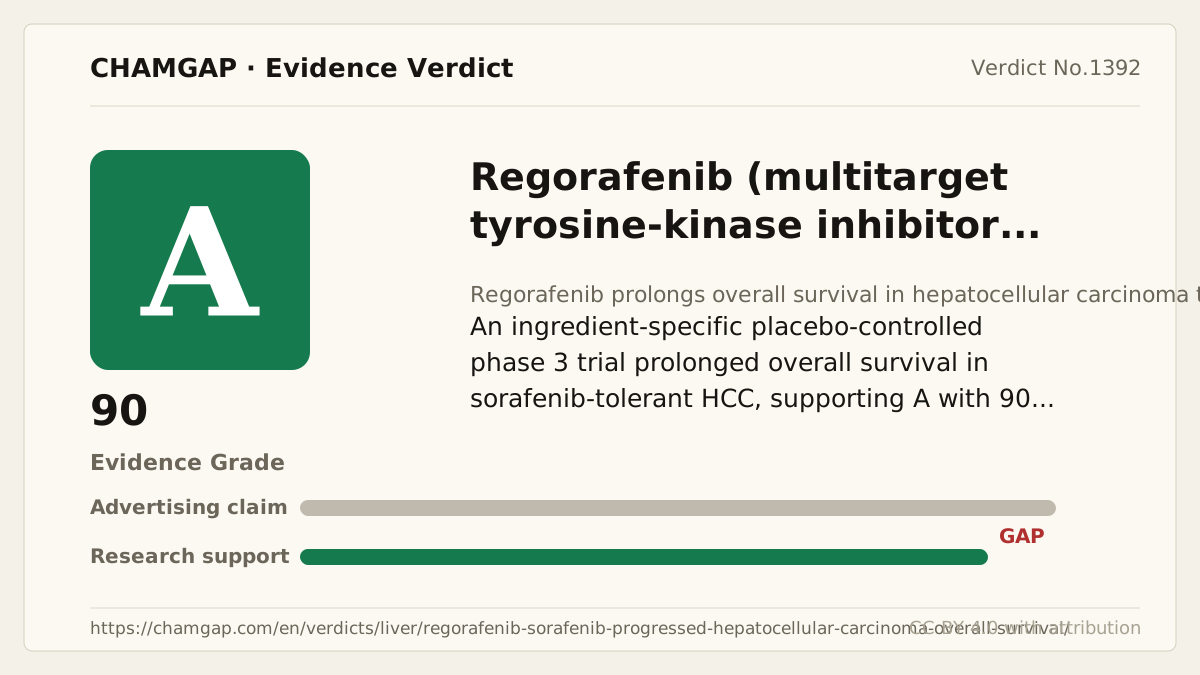
[Chamgap] Regorafenib x prolonged overall survival after sorafenib progression in hepatocellular carcinoma — Evidence Grade B·72. 2 cited sources checked. Source: https://chamgap.com/en/verdicts/liver/regorafenib-sorafenib-progressed-hepatocellular-carcinoma-overall-survival/ · CC BY 4.0CC BY 4.0 — free to use with attribution; do not distort grades, numbers, or verdict meaning.
What this document does and does not do
Chamgap is an information source. It reports what research has and has not confirmed; it does not tell readers what to take or buy. That decision belongs to readers and, when needed, medical or legal professionals. This verdict reflects literature available up to the search date and may change as new research appears. Nothing here is medical advice.