
Maralixibat,
does it really help with Relief of cholestatic pruritus in children with Alagille syndrome?
research showsMaralixibat is rated D. ICONIC enrolled 31 patients and 29 entered withdrawal after 18 weeks of open-label treatment, but the official modified intention-to-treat primary analysis included only 15 selected bile-acid responders, 5 on maralixibat and 10 on placebo. There was no washout, the primary endpoint was serum bile acid rather than pruritus, and two earlier controlled trials missed their primary endpoints, yielding D with 38 points.
ads claimReduced serum bile acids or pruritus must not be expanded into cure, avoidance of transplantation, or longer survival. The small withdrawal design and conflicting evidence must accompany the symptom claim.
Useful facts when choosing a product
- Maralixibat is an oral prescription ileal bile acid transporter inhibitor used for cholestatic pruritus in Alagille syndrome.
- The oral solution is titrated by age and weight; the current label and specialist instructions determine the exact dose.
- Diarrhea, abdominal pain, vomiting, and liver-test abnormalities can occur and require follow-up.
- Deficiency of fat-soluble vitamins A, D, E, and K can worsen, so levels and INR are monitored before and during treatment.
Chamgap Semantic Classification Code
Candidate index · review held
UNK.maralixibat.oral.cholestatic-pruritus-with-alagille-syndrome.relieve.placeboUnknown > Maralixibat > Oral > cholestatic pruritus with Alagille syndrome > Symptom-relief claim > Placebo
An automated migration candidate, not an issued permanent code; exact claim scope remains under review. This machine-generated migration candidate helps retrieval but is not a permanent assignment. The original verdict ID and URL remain authoritative.
What the research actually shows
ICONIC enrolled 31 patients for 18 weeks of open-label treatment and 29 entered the four-week withdrawal phase, but the official modified intention-to-treat primary analysis included only 15 open-label bile-acid responders, 5 on maralixibat and 10 on placebo. There was no washout. The primary endpoint was the surrogate serum bile acid, not pruritus. Two earlier controlled trials missed their primary endpoints, and clinical-event benefit remains unproven.
Why this is classified as D (38)
The no-washout withdrawal analysis included only 15 selected open-label responders and used a surrogate primary endpoint; with two earlier controlled trials missing their primary endpoints, it cannot reverse the prior failures and yields D with 38 points.
Counterpoint. The difficulty of running large independent rare-disease trials does not remove uncertainty.
Rejudgment record. Cross-check applied — Accepted the patient-important pruritus signal but applied rule ①-ⓒ because of a small withdrawal trial and a conflicting earlier failed primary analysis
Sub-claim grades by effect
This ingredient is marketed for several effects. A single overall grade blends strong and weak claims together, so each effect is graded separately here. The overall grade reflects the strongest disconfirming or core claim.
| Effect (sub-claim) | Grade | Basis |
|---|---|---|
| Relief of cholestatic pruritus | D | Pruritus is a treatment target, but the official primary analysis included only 15 selected responders and conflicts with two earlier controlled trials that missed their primary endpoints. |
| Reduced serum bile acids | D | This withdrawal analysis included 15 selected open-label bile-acid responders, and serum bile acid is a surrogate. |
| Improved clinical events such as avoidance of liver transplantation | ? | This has not been demonstrated in randomized trials. |
Cross-check — AI research and Codex final gate
Evidence Table
| Study | Design | Sample | Funding | Endpoint | Result | Weight |
|---|---|---|---|---|---|---|
| Gonzales E et al. 2021 ICONIC | Peer-reviewed original phase 2b placebo-controlled randomized-withdrawal study with open-label extension | 31 enrolled; 29 entered withdrawal; official modified intention-to-treat primary analysis 15 patients (5 maralixibat and 10 placebo) | Mirum Pharmaceuticals | Primary: serum bile acid change during four-week withdrawal among bile acid responders | Primary endpoint met; LS mean difference −117 μmol/L. Pruritus was a positive secondary symptom endpoint. | Pivotal small withdrawal study |
| Shneider BL et al.; Childhood Liver Disease Research Network. 2018 ITCH | Peer-reviewed original double-blind randomized placebo-controlled trial | 37 children | Lumena Pharmaceuticals, an NIH network, and others | Primary: change in ItchRO at week 13 | The first prespecified primary analysis failed; difference −0.47 (95% CI −1.14 to 0.20), p=0.16. | Conflicting direct randomized evidence |
Receipt — 2 References
All 2 cited sources were verified for existence at the original page (as of 2026-07-24).
Final verification and publication gate: Codex · Evidence date: 2026-07-24 · Corrections: none
Cite this verdict
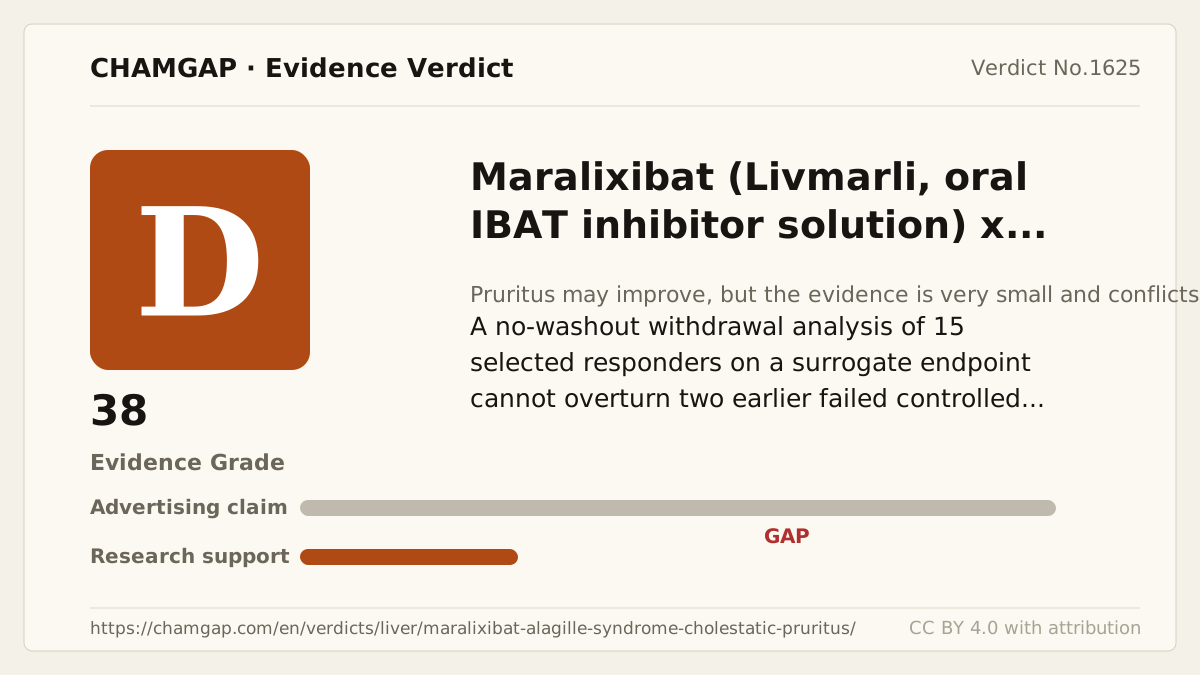
[Chamgap] Maralixibat x relief of cholestatic pruritus in children with Alagille syndrome — Evidence Grade D·38. 2 cited sources checked. Source: https://chamgap.com/en/verdicts/liver/maralixibat-alagille-syndrome-cholestatic-pruritus/ · CC BY 4.0CC BY 4.0 — free to use with attribution; do not distort grades, numbers, or verdict meaning.
What this document does and does not do
Chamgap is an information source. It reports what research has and has not confirmed; it does not tell readers what to take or buy. That decision belongs to readers and, when needed, medical or legal professionals. This verdict reflects literature available up to the search date and may change as new research appears. Nothing here is medical advice.