
L-ornithine L-aspartate,
does it really help with Improvement of cirrhotic hepatic encephalopathy and hyperammonemia?
research showsSome randomized trials signal improved mental-status recovery and lower blood ammonia, but the literature has substantial risk of bias and pharmaceutical support, and the apparent benefit does not persist when analysis is restricted to low-risk-of-bias trials. There is a basis for considering LOLA a clinician-directed adjunct in cirrhotic hepatic encephalopathy, but not for extending the claim to certain efficacy or to general liver health and fatigue.
ads claimBe cautious when trials in cirrhotic hepatic encephalopathy are extended into claims such as general liver detoxification, everyday fatigue relief, or hangover treatment. Single L-ornithine products and the LOLA salt, as well as oral supplements and hospital intravenous formulations, do not share interchangeable evidence.
Useful facts when choosing a product
- Prescription intravenous L-ornithine L-aspartate products are distributed in South Korea, and product information describes hospital dosing up to 40 g per day for hepatic encephalopathy.
- Overseas oral granules commonly contain 3 g per sachet, while intravenous 30 g/day regimens or high oral doses used in trials are not equivalent to ordinary supplements.
- High doses or rapid intravenous administration can cause nausea and vomiting and may require rate adjustment, while overseas product information lists severe renal impairment with serum creatinine above 3 mg/dL as a contraindication.
- Hepatic encephalopathy requires urgent assessment, so LOLA must not replace standard therapy such as lactulose or rifaximin or correction of the underlying cause.
Chamgap Semantic Classification Code
Candidate index · review held
UNK.l-ornithine-l-aspartate.UNK.cirrhotic-hepatic-encephalopathy-and-hyperammonemia.improve.MULTIUnknown > L-ornithine L-aspartate > Unknown > cirrhotic hepatic encephalopathy and hyperammonemia > Improvement claim > Multiple: primary unresolved
An automated migration candidate, not an issued permanent code; exact claim scope remains under review. This machine-generated migration candidate helps retrieval but is not a permanent assignment. The original verdict ID and URL remain authoritative.
What the research actually shows
Adequately powered, independent multicenter double-blind trials should prespecify encephalopathy severity, mortality, recurrence, and hospital stay and evaluate oral and intravenous administration separately. Patient-centered outcomes should accompany ammonia measurements.
Why this is classified as C (55)
Disease-specific randomized trials and a systematic review exist, but certainty is very low and benefit does not persist in low-risk-of-bias evidence, supporting a limited-evidence grade of C.
Counterpoint. This verdict does not exclude possible use as an adjunct to standard therapy for selected severely ill patients under medical supervision.
Rejudgment record. New verdict — Assessment separates disease-specific trials, Cochrane risk-of-bias analysis, clinical outcomes, and the surrogate ammonia endpoint
Sub-claim grades by effect
This ingredient is marketed for several effects. A single overall grade blends strong and weak claims together, so each effect is graded separately here. The overall grade reflects the strongest disconfirming or core claim.
| Effect (sub-claim) | Grade | Basis |
|---|---|---|
| Clinical improvement of cirrhotic hepatic encephalopathy | C | Multiple trials and positive signals exist, but risk of bias is high, the effect disappears in low-risk-of-bias analysis, and later results are mixed. |
| Reduction in blood ammonia | C | Several trials show reductions, but ammonia is a variable surrogate and does not consistently track clinical recovery or survival. |
| Improvement of general liver health or fatigue in healthy people | ? | There is no direct human efficacy evidence that transfers trials in cirrhotic encephalopathy to general liver-health or fatigue claims in healthy people. |
Cross-check — AI research and Codex final gate
Evidence Table
| Study | Design | Sample | Funding | Endpoint | Result | Weight |
|---|---|---|---|---|---|---|
| Goh et al., Cochrane systematic review (2018) | Systematic review of 36 randomized trials comparing LOLA with placebo, no intervention, or other treatments in people with cirrhosis | At least 2,377 randomized participants; 1,375 participants in 22 trials for the hepatic encephalopathy analysis | Among included trials, 17 had pharmaceutical support, three received study product, and ten did not report the source; the review itself was conducted by Cochrane | Mortality, development or improvement of hepatic encephalopathy, serious adverse events, risk-of-bias analysis, and trial sequential analysis | Versus placebo or no intervention, the hepatic encephalopathy signal was RR 0.70 (95% CI 0.59–0.83), but certainty was very low. In the single low-risk-of-bias trial of 63 participants, the effect was absent at RR 0.96 (0.85–1.07), and the information size was insufficient. | Core synthesis evidence: shows both the overall positive signal and its disappearance in the low-bias analysis, limiting the grade ceiling |
| Sidhu et al., double-blind randomized trial of intravenous LOLA (2018) | Double-blind trial at two Indian tertiary hospitals assigning patients with overt hepatic encephalopathy to intravenous LOLA 30 g/day or placebo for five days in addition to standard care | 193 participants (98 LOLA, 95 placebo) | The funding source could not be confirmed from the public abstract and bibliographic record | Primary: improvement in mental status on day 5; secondary: early recovery trajectory, ammonia, and hospital stay | The primary day-5 mental-status outcome was not significantly different. Signals favoring LOLA appeared for recovery during days 1–4, ammonia reduction, and hospital stay. | Important direct clinical trial, but with a null primary endpoint and positive secondary outcomes |
| Jain et al., randomized trial of intravenous LOLA in severe hepatic encephalopathy (2022) | Double-blind trial in grade III–IV hepatic encephalopathy adding continuous intravenous LOLA 30 g/day or placebo for five days to lactulose and rifaximin | 140 participants | Single-team study; the funding source could not be confirmed from the public abstract and bibliographic record | Primary: improvement of at least two encephalopathy grades by day 5; mortality, ammonia, and hospital stay | Day-5 improvement was reported in 92.5% with LOLA versus 66.0% with placebo, and 28-day mortality was 16.4% versus 41.8%. Ammonia and hospital stay also improved. | Large patient-centered positive signal, but the unusually large effect from one study requires independent multicenter replication |
Receipt — 3 References
All 3 cited sources were verified for existence at the original page (as of 2026-07-18).
Final verification and publication gate: Codex · Evidence date: 2026-07-18 · Corrections: none
Cite this verdict
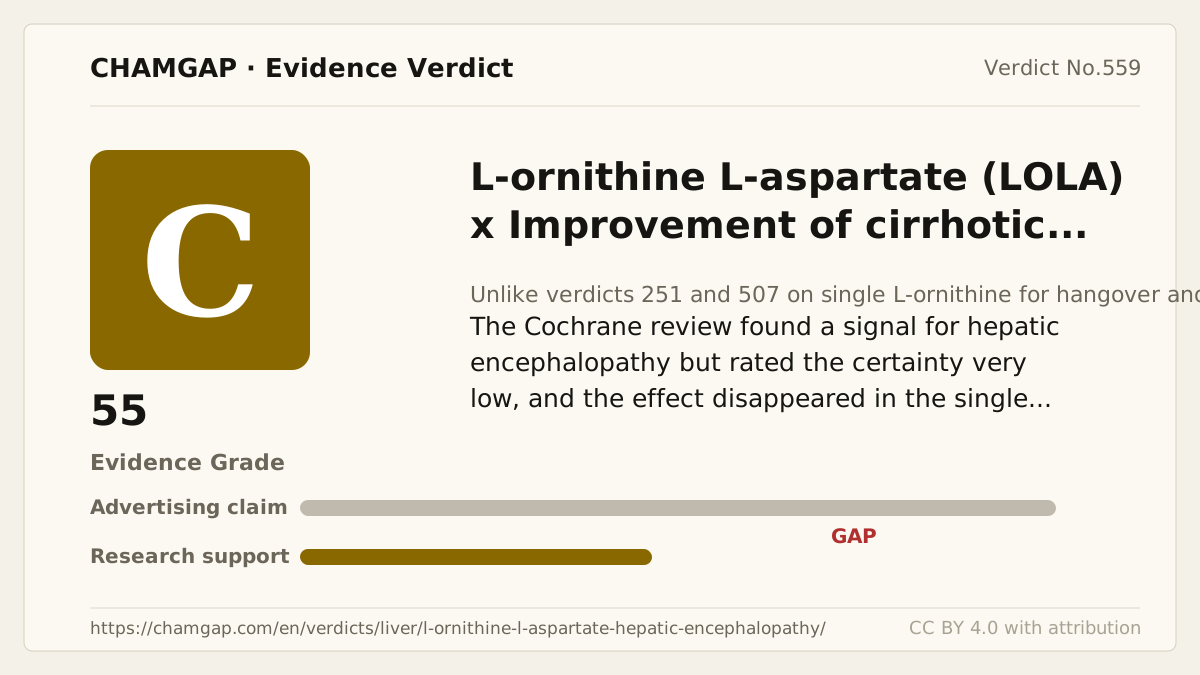
[Chamgap] Does LOLA improve cirrhotic hepatic encephalopathy and hyperammonemia? — Evidence Grade C·55. 3 cited sources checked. Source: https://chamgap.com/en/verdicts/liver/l-ornithine-l-aspartate-hepatic-encephalopathy/ · CC BY 4.0CC BY 4.0 — free to use with attribution; do not distort grades, numbers, or verdict meaning.
What this document does and does not do
Chamgap is an information source. It reports what research has and has not confirmed; it does not tell readers what to take or buy. That decision belongs to readers and, when needed, medical or legal professionals. This verdict reflects literature available up to the search date and may change as new research appears. Nothing here is medical advice.