
100% Korean pear juice, 220 mL,
does it really help with Reduced hangover symptoms after alcohol?
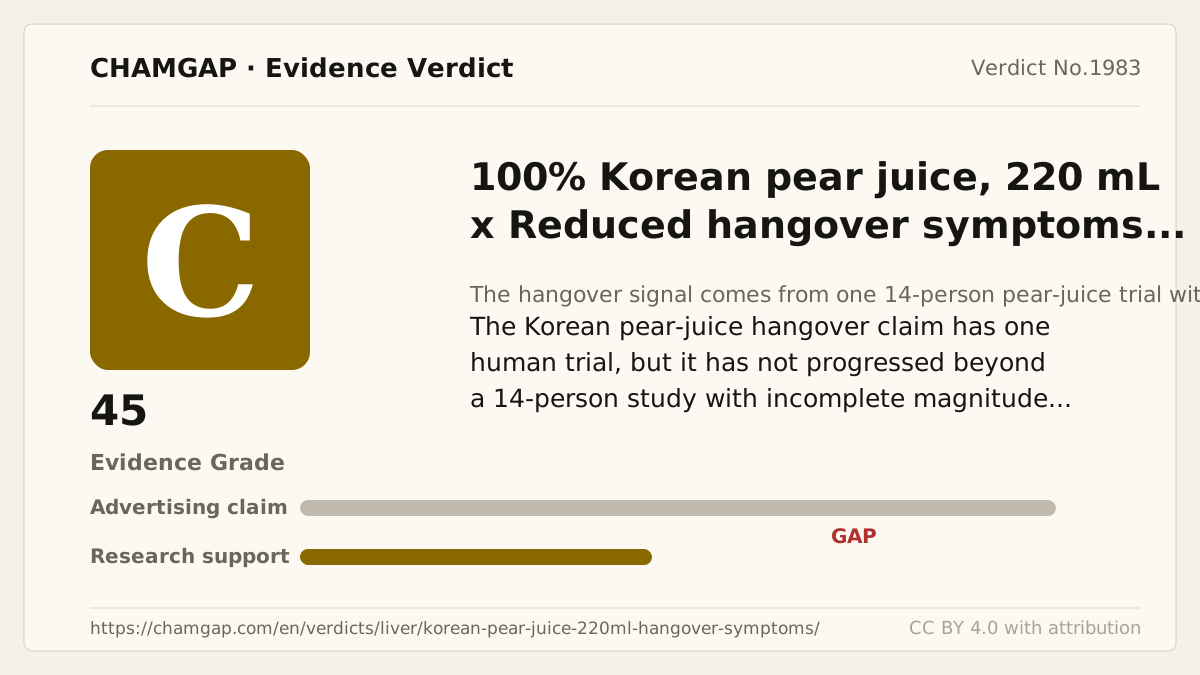
research showsThe verdict is C with 50 points. In a crossover trial completed by 14 healthy young men, 220 mL of 100% Shingo pear juice taken 30 minutes before alcohol lowered total hangover severity by 16% and average symptoms by 21% at 15 hours. The sample was extremely small, and public data did not permit calculation of a between-condition effect size.
ads claimClaims that pear juice helps hangover and cough are widely circulated in Korea. This trial tested 100% juice rather than whole pear and tested prevention before drinking rather than treatment afterward.
Useful facts when choosing a product
- The intervention was 220 mL of 100% juice from Shingo Korean pear, not whole fruit; juicing changes fiber, chewing, and absorption rate.
- All 14 men completed both conditions, but the result cannot automatically generalize to women or other age groups.
- A paper without a public registration number is distinct from proof that no registration exists anywhere; no number was reported here.
Chamgap Semantic Classification Code
Candidate index · review held
F.100-percent-korean-pear-juice.food.hangover-symptoms-after-alcohol.reduce.UNKFoods and beverages > 100% Korean pear juice > Food consumption > hangover symptoms after alcohol > Reduction claim > Unknown
An automated migration candidate, not an issued permanent code; exact claim scope remains under review. This machine-generated migration candidate helps retrieval but is not a permanent assignment. The original verdict ID and URL remain authoritative.
What the research actually shows
Lee and colleagues tested 220 mL of Shingo pear juice 30 minutes before alcohol in 14 healthy young men. No public registration number was reported, so prospective registration and agreement between a registered primary outcome and the paper cannot be verified. PubMed classifies it as non-US government support; no pear grower or juice-company funding was identified. Institutional affiliation is not funding.
Why this is classified as C (50)
The trial measured felt hangover symptoms, but it was one extremely small, short study and exact magnitude could not be calculated. The result is C with 50 points.
Counterpoint. Complete follow-up and a favorable direction justify a larger independently registered replication.
Rejudgment record. Cross-check applied — Cross-checked analyzed sample, timing, symptom results, registration reporting, and funding disclosure against the original index record
| Endpoint | P | Symptom or function itself is the target - including patient reports and performance tests |
| Replication | R1 | Single confirmatory trial |
| Independence | I2 | Decisive evidence is publicly or non-profit funded |
| Effect size | EX | The clinical size of the effect could not be judged |
| Precision | CX | No pooled confidence interval could be confirmed |
Stored derived and displayed grades match; this is not a current recalculation or validity check (C).
Sub-claim grades by effect
This ingredient is marketed for several effects. A single overall grade blends strong and weak claims together, so each effect is graded separately here. The overall grade reflects the strongest disconfirming or core claim.
| Effect (sub-claim) | Grade | Basis |
|---|---|---|
| A 220 mL serving of 100% Korean pear juice reduces hangover symptoms | C | One 14-person trial was positive, but exact magnitude and independent replication are absent. |
Cross-check — AI research and Codex final gate
Evidence Table
| Study | Design | Sample | Funding | Endpoint | Result | Weight |
|---|---|---|---|---|---|---|
| Lee HS et al., Food and Chemical Toxicology, 2013 | Randomized single-blind crossover trial | All 14 healthy young men completed and were analyzed | Indexed as non-US government support; no grower or company funding identified | Total and average hangover severity at 15 hours | Total 16% and average 21% lower, P<0.05; insufficient data to calculate exact magnitude | Direct symptom trial, but extremely small with no reported registration number or calculable exact magnitude |
Receipt — 1 References
All 1 cited sources were verified for existence at the original page (as of 2026-08-02).
Final verification and publication gate: Codex · Evidence date: 2026-08-02 · Corrections: none
Cite this verdict
[Chamgap] 100% Korean pear juice, 220 mL x hangover symptoms — Evidence Grade C·50. 1 cited sources checked. Source: https://chamgap.com/en/verdicts/liver/korean-pear-juice-220ml-hangover-symptoms/ · CC BY 4.0CC BY 4.0 — free to use with attribution; do not distort grades, numbers, or verdict meaning.
What this document does and does not do
Chamgap is an information source. It reports what research has and has not confirmed; it does not tell readers what to take or buy. That decision belongs to readers and, when needed, medical or legal professionals. This verdict reflects literature available up to the search date and may change as new research appears. Nothing here is medical advice.