
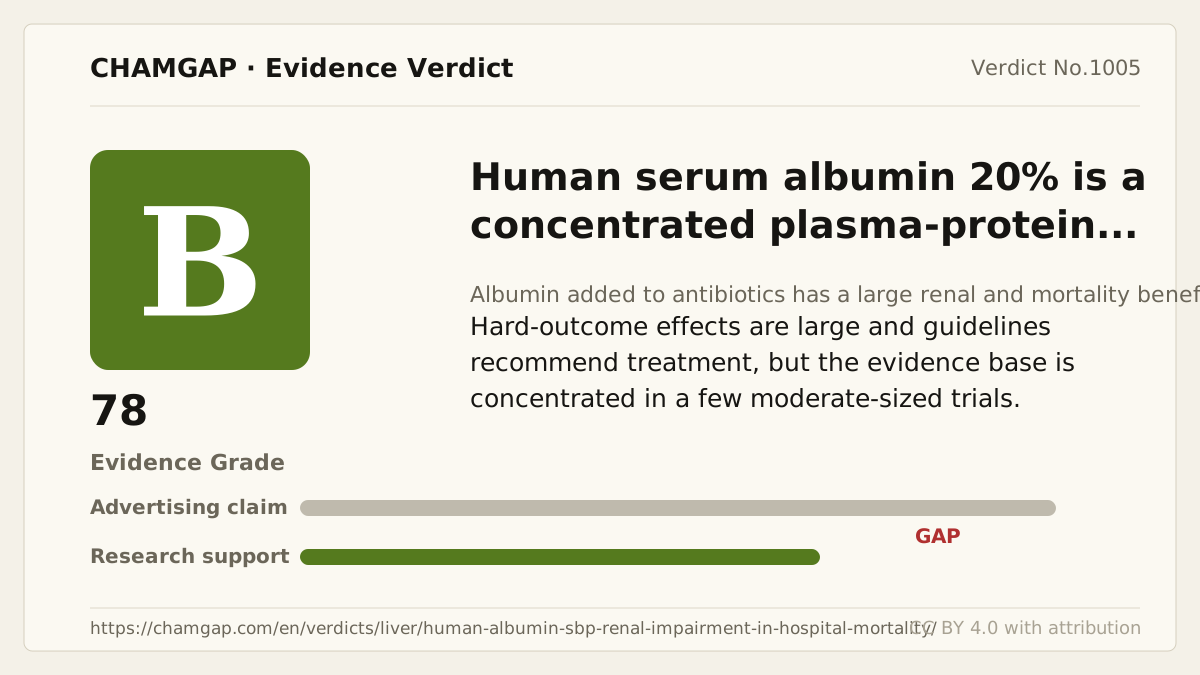
Human serum albumin 20% is a concentrated plasma-protein biologic manufactured from human plasma and administered intravenously by prescription.,
does it really help with The claim is that adding albumin to antibiotics in cirrhosis with spontaneous bacterial peritonitis reduces renal impairment and in-hospital mortality.?
research showsIn the pivotal randomized trial, albumin added to antibiotics markedly reduced renal impairment and in-hospital death versus antibiotics alone, and a meta-analysis of four randomized trials supported both outcomes. The total randomized evidence included 288 patients and the pivotal trial 126, supporting B with 78 points under the strict A criterion.
ads claimThe fact that albumin raises a low laboratory value does not establish the same mortality benefit in every patient with cirrhosis or ascites. This verdict is confined to use with antibiotics for SBP.
Useful facts when choosing a product
- Human albumin 20% is a concentrated plasma-derived product given intravenously in hospital with prescription and fluid-status monitoring.
- The pivotal regimen added 1.5 g/kg at diagnosis and 1.0 g/kg on day three to antibiotic treatment.
- AASLD guidance identifies especially clear benefit in high-risk SBP when blood urea nitrogen exceeds 30 mg/dL, creatinine exceeds 1 mg/dL, or total bilirubin exceeds 5 mg/dL.
- Concentration, excipients, sodium content, and infusion rate can vary by product, and correction of hypoalbuminemia cannot be equated with improved clinical outcomes in SBP.
Chamgap Semantic Classification Code
Candidate index · review held
M.human-serum-albumin-20-percent-is-a-concentrated-plasma-protein-biologic-manufactured-from-human-plasma-and-administered-intravenously-by-prescription.intravenous.the-claim-is-that-adding-albumin-to-antibiotics-in-cirrhosis-with-spontaneous-bacterial-peritonitis-reduces-renal-impairment-and-in-hospital-mortality.reduce.addonMedicinal interventions > Human serum albumin 20% is a concentrated plasma-protein biologic manufactured from human plasma and administered intravenously by prescription. > Intravenous > The claim is that adding albumin to antibiotics in cirrhosis with spontaneous bacterial peritonitis reduces renal impairment and in-hospital mortality. > Reduction claim > Added intervention on common background care
An automated migration candidate, not an issued permanent code; exact claim scope remains under review. This machine-generated migration candidate helps retrieval but is not a permanent assignment. The original verdict ID and URL remain authoritative.
What the research actually shows
Antibiotics plus standard-dose albumin are strongly supported in high-risk SBP. Additional independent trials are needed in low-risk patients, for alternative dosing, and in people at high risk of fluid overload.
Why this is classified as B (78)
Large effects on direct mortality and renal outcomes are supported by a four-RCT meta-analysis and guidance. Sort 1999 had public, non-industry support from the Spanish Health Research Fund and Hospital Clínic, whereas the Salerno 2013 meta-analysis received an unrestricted grant from CSL Behring. With no independent large RCT and one 126-patient pivotal trial dominating 288 randomized patients overall, the result is high B with 78 points rather than A.
Counterpoint. In practice, the evidence is strong enough to support standard care for high-risk SBP. Grade B does not oppose use; it distinguishes this evidence volume and independence from the stricter A threshold.
Rejudgment record. Cross-validation incorporated — The direct renal-impairment and in-hospital mortality effects in Sort 1999, consistency across a four-RCT meta-analysis, and AASLD guidance were weighted highly. Sort had public, non-industry support from the Spanish Health Research Fund and Hospital Clínic, whereas the Salerno meta-analysis received an unrestricted CSL Behring grant. With no independent large RCT and the 126-patient pivotal trial dominating 288 randomized patients overall, the result was fixed at high B with 78 points rather than A.
Sub-claim grades by effect
This ingredient is marketed for several effects. A single overall grade blends strong and weak claims together, so each effect is graded separately here. The overall grade reflects the strongest disconfirming or core claim.
| Effect (sub-claim) | Grade | Basis |
|---|---|---|
| Reduced renal impairment | B | The pivotal RCT showed a reduction from 33% to 10%, and the four-RCT meta-analysis estimated OR 0.21, but the total sample was 288. |
| Reduced in-hospital mortality | B | In-hospital mortality fell from 29% to 10% in the pivotal RCT, reinforced by the overall mortality benefit in meta-analysis. |
| Reduced three-month mortality | B | Three-month mortality fell from 41% to 22% in the pivotal RCT, but this finding comes from a single 126-participant trial. |
Cross-check — AI research and Codex final gate
Evidence Table
| Study | Design | Sample | Funding | Endpoint | Result | Weight |
|---|---|---|---|---|---|---|
| Sort et al. randomized trial of albumin in SBP | Randomized controlled trial assigning patients with cirrhosis and SBP to cefotaxime alone or cefotaxime plus intravenous albumin | 126 participants | Supported by the Spanish Health Research Fund and Hospital Clínic; public, non-industry funding | Renal impairment, in-hospital mortality, and three-month mortality | Renal impairment fell from 33% to 10%, in-hospital mortality from 29% to 10%, and three-month mortality from 41% to 22%. | Pivotal RCT with direct hard outcomes and large effects, but a moderate sample |
| Salerno et al. meta-analysis of randomized trials | Systematic review and meta-analysis of randomized trials comparing albumin plus antibiotics in SBP | Four trials with 288 participants | Supported by an unrestricted grant from CSL Behring | Renal impairment and mortality | Renal impairment was 30.6% versus 8.3% with OR 0.21, and mortality 35.4% versus 16.0% with OR 0.34, without significant heterogeneity. | Reinforces consistency, but total sample is small and industry-supported |
| AASLD 2021 guidance on ascites, SBP, and hepatorenal syndrome | Clinical guidance based on systematic evidence assessment for complications of cirrhosis | Not applicable | American Association for the Study of Liver Diseases | Indication and dosing of albumin added to antibiotics in SBP | For SBP with renal dysfunction or high bilirubin risk, albumin 1.5 g/kg at diagnosis and 1.0 g/kg on day three is recommended with antibiotics. | Strengthens clinical applicability but is not itself an efficacy trial |
Receipt — 3 References
All 3 cited sources were verified for existence at the original page (as of 2026-07-21).
Final verification and publication gate: Codex · Evidence date: 2026-07-21 · Corrections: none
Cite this verdict
[Chamgap] Does human albumin reduce renal impairment and in-hospital mortality in spontaneous bacterial peritonitis? — Evidence Grade B·78. 3 cited sources checked. Source: https://chamgap.com/en/verdicts/liver/human-albumin-sbp-renal-impairment-in-hospital-mortality/ · CC BY 4.0CC BY 4.0 — free to use with attribution; do not distort grades, numbers, or verdict meaning.
What this document does and does not do
Chamgap is an information source. It reports what research has and has not confirmed; it does not tell readers what to take or buy. That decision belongs to readers and, when needed, medical or legal professionals. This verdict reflects literature available up to the search date and may change as new research appears. Nothing here is medical advice.