
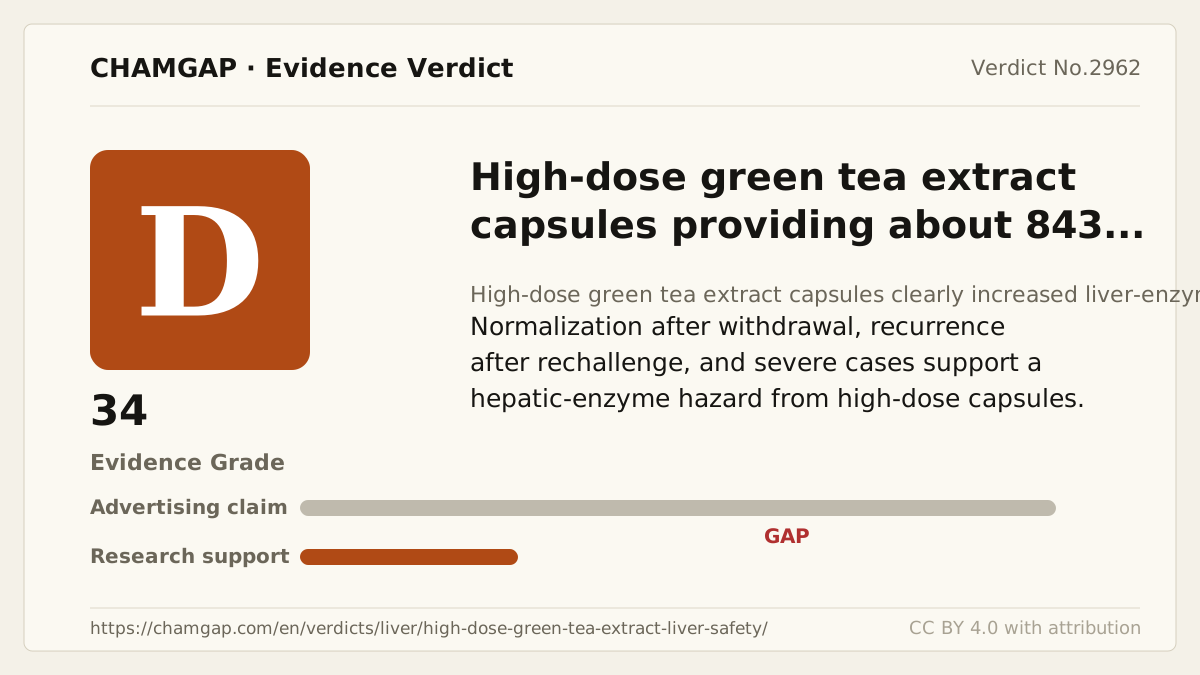
High-dose green tea extract capsules providing about 843 mg EGCG daily for 12 months,
does it really help with No liver burden during long-term use?
research showsGrade D. Among 1,021 postmenopausal women with normal baseline liver enzymes, 26 women (5.1%) receiving extract developed moderate-or-worse liver-function abnormalities, OR 7.0 versus placebo (95% CI 2.4-20.3), P=.0002. The no-liver-burden claim was not supported.
ads claimThis applies to capsule extracts providing at least 800 mg EGCG daily for four months or longer. Brewed green tea and extracts at or below 316 mg daily have not shown the same signal.
Useful facts when choosing a product
- EFSA concluded that at least 800 mg EGCG daily from extracts for four months or longer is associated with ALT and AST elevation in some people.
- Brewed tea and concentrated capsules are different exposures.
- Increased clinical liver failure or death was not established.
Chamgap Semantic Classification Code
Candidate index · review held
S.green-tea-extract-capsules-providing-about-egcg.UNK.no-liver-burden-during-long-term-use.assess.placeboSupplements and nutraceuticals > green tea extract capsules providing about EGCG > Unknown > No liver burden during long-term use > Association or change assessment > Placebo
An automated migration candidate, not an issued permanent code; exact claim scope remains under review. This machine-generated migration candidate helps retrieval but is not a permanent assignment. The original verdict ID and URL remain authoritative.
What the research actually shows
The parent trial's efficacy primary endpoint was breast density; this verdict concerns its prespecified safety analysis of CTCAE grade 2-or-higher liver-function abnormality. The analysis included 1,021 women aged 50-70 with normal baseline enzymes, 513 versus 508, over 12 months. All ALT-elevation events totaled 53 (6.7%) versus 4 (0.7%). One grade 4 case with peak ALT 2,055 U/L, six grade 3 cases, and seven grade 2 cases occurred only with extract. Enzymes normalized on withdrawal and rose on rechallenge. Monitoring was monthly for six months and at months 9 and 12; ALT above 1.5×ULN triggered immediate interruption and grade 3/4 permanent discontinuation. These were safety rules, not a minimum efficacy threshold. NIH/NCI federal grants funded the study. Corban Laboratories manufactured capsules, and Taiyo International and academic laboratories participated in quality testing; manufacturer funding for research, analysis, medical writing, or publication was not reported, and authors reported no conflicts.
Axis 6 B0 evidence ① Allocation concealment: "Randomization was performed by the Investigational Drug Services (IDS) pharmacy at University of Minnesota Medical Center-Fairview. The IDS pharmacy utilized a computer generated randomization scheme using the permuted block method." ② Masking: "In this double-blinded study, study staff, participants, laboratory personnel, and all parties involved with assessment of the study endpoints were blinded to treatment assignment." ③ Analysis population and missing data: "The present analysis examined the effect of GTE consumption on liver injury in 1021 participants (513 in GTE and 508 in placebo arm) with normal baseline levels of liver enzymes." Three participants missing baseline values and 51 withdrawing before the first monthly panel were excluded from the predefined safety population. ④ Prespecified primary endpoint: "Overall, 26 (5.1%) women in GTE developed moderate or more severe abnormalities in any liver function measure during the intervention period." — matches the prespecified safety analysis in registration NCT00917735
Why this is classified as D (34)
A large public 12-month trial found clear enzyme harm and rechallenge response, but exact-condition independent replication is absent, giving D with 34 points.
Counterpoint. The enzyme hazard is clear, but increased liver failure or death was not established.
Rejudgment record. Cross-check applied — Significant liver-enzyme harm and rechallenge response in a 1,021-participant public trial, without exact-condition independent replication
| Endpoint | S | Surrogate marker - laboratory or imaging measures |
| Replication | R1 | Single confirmatory trial |
| Independence | I2 | Decisive evidence is publicly or non-profit funded |
| Effect size | E- | Harm increased in the trials |
| Precision | C0 | The confidence interval leaves room for benefit |
Stored derived and displayed grades match; this is not a current recalculation or validity check (D).
Sub-claim grades by effect
This ingredient is marketed for several effects. A single overall grade blends strong and weak claims together, so each effect is graded separately here. The overall grade reflects the strongest disconfirming or core claim.
| Effect (sub-claim) | Grade | Basis |
|---|---|---|
| Liver-enzyme safety of high-dose capsules | D | Moderate-or-worse abnormalities increased significantly. |
| Increased liver failure or death | ? | The trial did not establish these outcomes. |
Cross-check — AI research and Codex final gate
Evidence Table
| Study | Design | Sample | Funding | Endpoint | Result | Weight |
|---|---|---|---|---|---|---|
| Yu Z et al. 2017 MGTT safety analysis | Prespecified safety analysis of a double-blind placebo-controlled randomized trial | 1,021 women with normal baseline liver enzymes, 513/508 | Federal NIH/NCI grants | CTCAE grade 2-or-higher abnormality in any liver-function measure | 26 women (5.1%), OR 7.0 (95% CI 2.4-20.3), P=.0002; ALT +5.4 U/L and AST +3.8 U/L | Pivotal harm evidence |
Receipt — 2 References
All 2 cited sources were verified for existence at the original page (as of 2026-08-26).
Final verification and publication gate: Codex · Evidence date: 2026-08-26 · Corrections: none
Cite this verdict
[Chamgap] Harm of High-Dose Green Tea Extract for Liver Abnormalities — Evidence Grade D·34. 2 cited sources checked. Source: https://chamgap.com/en/verdicts/liver/high-dose-green-tea-extract-liver-safety/ · CC BY 4.0CC BY 4.0 — free to use with attribution; do not distort grades, numbers, or verdict meaning.
What this document does and does not do
Chamgap is an information source. It reports what research has and has not confirmed; it does not tell readers what to take or buy. That decision belongs to readers and, when needed, medical or legal professionals. This verdict reflects literature available up to the search date and may change as new research appears. Nothing here is medical advice.