
Everolimus,
does it really help with Improved overall survival after sorafenib failure or intolerance in advanced hepatocellular carcinoma?
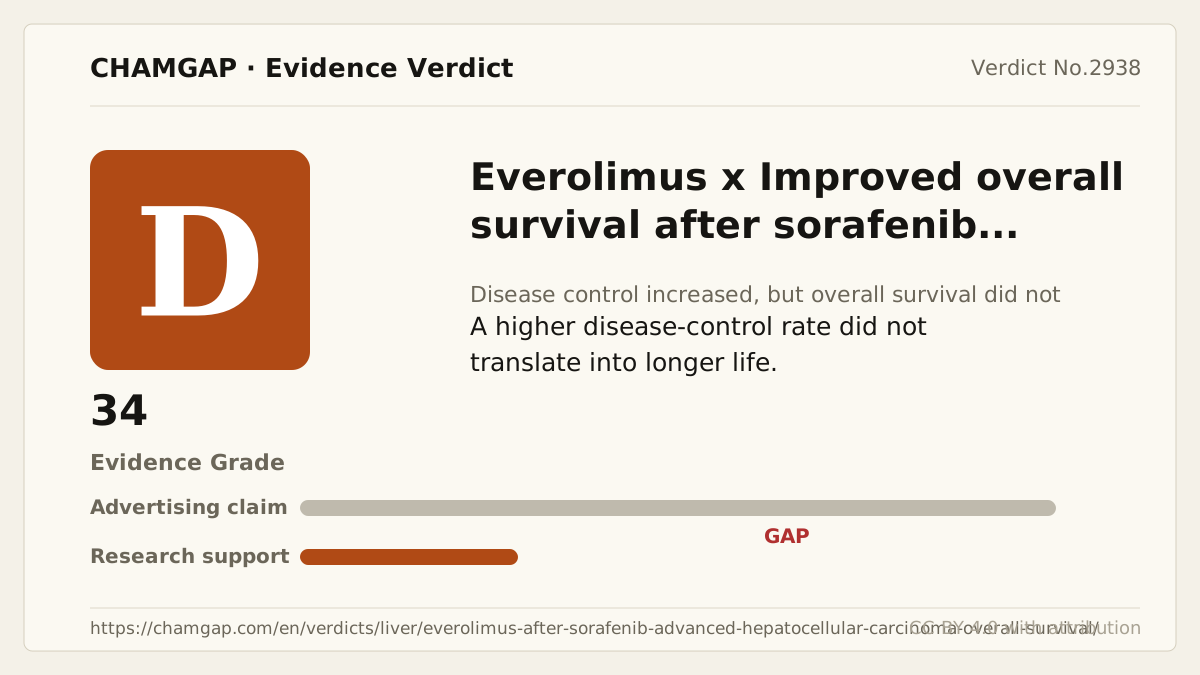
research showsGrade D. In EVOLVE-1, median overall survival was 7.6 versus 7.3 months, with 303/362 (83.7%) versus 151/184 (82.1%) deaths; HR 1.05 (95% CI 0.86 to 1.27; P=.68). Disease control of 56.1% versus 45.1% (P=.01) was secondary after the primary survival endpoint failed.
ads claimTumor response or disease control must not be described as overall survival. The claim that patients lived longer failed.
Useful facts when choosing a product
- Everolimus 7.5 mg daily plus best supportive care was compared with placebo.
- All-grade stomatitis occurred in 39.6% versus 4.9%.
- Central laboratory testing found asymptomatic hepatitis B reactivation in 29 versus 10 patients, with three everolimus discontinuations.
Chamgap Semantic Classification Code
Candidate index · review held
UNK.everolimus.UNK.overall-survival-after-sorafenib-failure-or-intolerance-in-advanced-hepatocellular-carcinoma.improve.placeboUnknown > Everolimus > Unknown > overall survival after sorafenib failure or intolerance in advanced hepatocellular carcinoma > Improvement claim > Placebo
An automated migration candidate, not an issued permanent code; exact claim scope remains under review. This machine-generated migration candidate helps retrieval but is not a permanent assignment. The original verdict ID and URL remain authoritative.
What the research actually shows
EVOLVE-1 assigned 546 Child-Pugh A patients with advanced HCC after sorafenib failure or intolerance in a 2:1 ratio. Novartis Pharmaceuticals sponsored the trial, participated in design, collected data through its system, used its statistical team for analysis, and had employee authors involved in interpretation, writing, and submission. Novartis also paid ApotheCom and supplied study drug and placebo. Axis 6 B0 evidence ① Allocation concealment: patients were "registered using an interactive voice- or web-response system" that randomly allocated treatment. ② Masking: the trial was "randomized, double-blind" and used matching placebo. ③ Analysis and missingness: all 546 randomized patients were "included in the full analysis population". ④ Prespecified primary endpoint: "The primary end point was overall survival" — consistent with NCT01035229
Why this is classified as D (34)
A well-conducted large hard-outcome trial had a null primary survival endpoint, giving D with 34 points. It was one manufacturer-sponsored trial and the interval retained possible benefit.
Counterpoint. The 11-point disease-control difference is real but does not reverse failed survival.
Rejudgment record. Cross-check applied — The prespecified primary overall-survival result in EVOLVE-1
| Endpoint | H | Hard endpoint - actual events such as death |
| Replication | R1 | Single confirmatory trial |
| Independence | I0 | Evidence comes only from manufacturer studies |
| Effect size | E0 | Null |
| Precision | C0 | The confidence interval leaves room for benefit |
Stored derived and displayed grades match; this is not a current recalculation or validity check (D).
Sub-claim grades by effect
This ingredient is marketed for several effects. A single overall grade blends strong and weak claims together, so each effect is graded separately here. The overall grade reflects the strongest disconfirming or core claim.
| Effect (sub-claim) | Grade | Basis |
|---|---|---|
| Improved overall survival | D | The result was null, HR 1.05, P=.68. |
| Increased disease control | C | It was 56.1% versus 45.1%, but secondary after failed primary survival. |
Cross-check — AI research and Codex final gate
Evidence Table
| Study | Design | Sample | Funding | Endpoint | Result | Weight |
|---|---|---|---|---|---|---|
| Zhu AX et al. 2014 EVOLVE-1 | Randomized double-blind placebo-controlled phase 3 trial at 121 centers in 17 countries | 546 randomized and analyzed, 362 versus 184 | Novartis Pharmaceuticals sponsorship, drug and placebo supply, data management, statistical analysis, and writing support | Primary overall survival | Median OS 7.6 vs 7.3 months; 303/362 vs 151/184 deaths; HR 1.05 (95% CI 0.86-1.27), P=.68 | Pivotal large null hard-outcome evidence |
Receipt — 1 References
All 1 cited sources were verified for existence at the original page (as of 2026-08-26).
Final verification and publication gate: Codex · Evidence date: 2026-08-26 · Corrections: none
Cite this verdict
[Chamgap] No Benefit of Everolimus for Overall Survival After Sorafenib Failure in Advanced Hepatocellular Carcinoma — Evidence Grade D·34. 1 cited sources checked. Source: https://chamgap.com/en/verdicts/liver/everolimus-after-sorafenib-advanced-hepatocellular-carcinoma-overall-survival/ · CC BY 4.0CC BY 4.0 — free to use with attribution; do not distort grades, numbers, or verdict meaning.
What this document does and does not do
Chamgap is an information source. It reports what research has and has not confirmed; it does not tell readers what to take or buy. That decision belongs to readers and, when needed, medical or legal professionals. This verdict reflects literature available up to the search date and may change as new research appears. Nothing here is medical advice.