
Curcumin,
does it really help with Improvement of liver fat and ALT and AST in MASLD or NAFLD?
research showsThe claim that curcumin supplements improve liver fat and ALT and AST in MASLD or NAFLD is rated C. An umbrella synthesis of 11 meta-analyses reported reductions in AST and ALT, and several short trials found improvement in ultrasound-assessed liver fat. A 2024 synthesis of 14 clinical trials, however, found no significant effect on either ALT or AST, while an independent 37-participant trial using magnetic resonance spectroscopy had a null primary liver-fat endpoint of -1.57 percentage points (95% CI -5.36 to 2.22). These are imaging and enzyme surrogate outcomes, and formulation, absorption, and piperine coadministration vary greatly. The conflict places the verdict at the lower end of C with 44 points. This liver axis differs from the curcumin verdicts for joints in 064, depression in 457, and ulcerative colitis in 512.
ads claimMarketing expands a small change in liver enzymes or ultrasound grade into treatment of fatty liver, liver detoxification, and prevention of cirrhosis. ALT and AST and imaging liver fat are clinical surrogates, and no long-term human evidence shows reduced cirrhosis, liver failure, or liver-related death.
Useful facts when choosing a product
- Research products range from ordinary turmeric powder and standardized curcuminoids to nano, micellar, lecithin, amorphous-dispersion, and piperine-enhanced formulations, so equal milligram labels do not imply equal exposure.
- The foundation of MASLD care is weight loss, diet and physical activity, and management of diabetes, lipids, and blood pressure; a curcumin supplement does not replace these measures.
- Curcumin can cause nausea, diarrhea, and abdominal pain, and it contracts the gallbladder, so it may provoke symptoms in people with gallstones or biliary obstruction.
- Bioavailability enhancers such as piperine can alter drug metabolism, and turmeric-supplement drug-induced liver injury has been reported; jaundice, dark urine, or severe fatigue calls for stopping the product and seeking assessment.
Chamgap Semantic Classification Code
Candidate index · review held
S.curcumin.UNK.liver-fat-and-alt-and-ast-in-masld-or-nafld.improve.placeboSupplements and nutraceuticals > Curcumin > Unknown > liver fat and ALT and AST in MASLD or NAFLD > Improvement claim > Placebo
An automated migration candidate, not an issued permanent code; exact claim scope remains under review. This machine-generated migration candidate helps retrieval but is not a permanent assignment. The original verdict ID and URL remain authoritative.
What the research actually shows
The 2024 Molani-Gol umbrella analysis combined 11 meta-analyses, nominally 99 randomized trials and 5,546 participants, and reported reductions in AST and ALT, but duplication of original trials and heterogeneity across meta-analyses are unavoidable. Malik and colleagues in 2024 found no significant changes in ALT, AST, alkaline phosphatase, HbA1c, or body mass index across 14 clinical trials. Hellmann and colleagues in 2022 assigned 37 nondiabetic adults with obesity to lecithin-formulated curcumin 400 mg/day or placebo for six weeks and found a null primary magnetic-resonance liver-fat endpoint. In contrast, Rahmani and colleagues in 2016 reported better ultrasound liver fat and enzymes after eight weeks of an amorphous-dispersion formulation. Formulation, dose, duration, diagnostic method, and concurrent lifestyle intervention differ substantially.
Why this is classified as C (44)
Positive trials and meta-analyses exist for liver fat and ALT and AST, but the 14-trial meta-analysis found null ALT and AST results, and the quantitative magnetic-resonance primary endpoint was also null at -1.57 percentage points (95% CI -5.36 to 2.22). All key outcomes are surrogates, while formulation, absorption, dose, piperine, and duplicate-original-trial issues are substantial. This conflict supports the lower end of C with 44 points; gastrointestinal, gallbladder, interaction, and rare liver-injury concerns remain separate under safety.
Counterpoint. If a supplement is considered after lifestyle and metabolic-risk management, the formulation and concomitant medicines should be reviewed, while weight and metabolic goals remain primary. A new liver-enzyme rise in someone with liver disease should prompt consideration of the supplement itself as a possible cause.
Rejudgment record. New verdict — Accepted positive trials and an umbrella synthesis for liver fat and ALT and AST, but applied the rule ① and supplement ceiling of C because a null 14-trial analysis and a null quantitative magnetic-resonance primary endpoint coexist, all key outcomes are surrogates, and formulation, absorption, and duplicate-trial variability are substantial
Sub-claim grades by effect
This ingredient is marketed for several effects. A single overall grade blends strong and weak claims together, so each effect is graded separately here. The overall grade reflects the strongest disconfirming or core claim.
| Effect (sub-claim) | Grade | Basis |
|---|---|---|
| Reduction of liver fat in MASLD or NAFLD | C | Some ultrasound and FibroScan trials and syntheses are positive, but a quantitative magnetic-resonance primary endpoint was null and findings vary by formulation. |
| Improvement of ALT and AST in MASLD or NAFLD | C | A positive umbrella analysis coexists with a null 14-trial analysis and high heterogeneity, so the finding remains a small surrogate signal. |
| Reduction of cirrhosis or liver-related mortality in MASLD or NAFLD | ? | No human curcumin efficacy literature was identified that directly followed incident cirrhosis, liver failure, or liver-related death. |
Cross-check — AI research and Codex final gate
Evidence Table
| Study | Design | Sample | Funding | Endpoint | Result | Weight |
|---|---|---|---|---|---|---|
| Molani-Gol R et al. 2024 | Umbrella meta-analysis of meta-analyses of randomized trials | Eleven meta-analyses, nominally 99 randomized trials and 5,546 participants | Funding was not reported in the PubMed abstract | AST, ALT, and metabolic and anthropometric surrogates | AST and ALT were reduced, while GGT, alkaline phosphatase, fasting glucose, and HbA1c were not significant. | Positive synthesis with possible duplicate counting of original trials |
| Malik A and Malik M. 2024 | Systematic review and meta-analysis of clinical trials | Fourteen clinical trials | Funding was not reported in the PubMed abstract | ALT, AST, alkaline phosphatase, and metabolic and anthropometric measures | ALT had MD -2.20 and AST approximately -1.37, neither statistically significant. | Key conflicting null synthesis |
| Hellmann PH et al. 2022 | Six-week randomized double-blind placebo-controlled trial | Thirty-seven nondiabetic adults with obesity | No conflicts were declared; funding was not reported in the PubMed abstract | Primary endpoint of magnetic-resonance-spectroscopy quantified liver fat | The between-group liver-fat difference was -1.57 percentage points (95% CI -5.36 to 2.22; P=.412), a null result. | Independent null quantitative-imaging primary endpoint |
| Rahmani S et al. 2016 | Eight-week randomized double-blind placebo-controlled trial | Seventy-seven participants with NAFLD analyzed | Funding was not reported in the PubMed abstract | Ultrasound liver fat and surrogate outcomes including ALT and AST | An amorphous-dispersion curcumin formulation improved ultrasound liver fat and liver enzymes versus placebo. | Formulation-specific small short-term positive signal |
Receipt — 5 References
All 5 cited sources were verified for existence at the original page (as of 2026-07-21).
Final verification and publication gate: Codex · Evidence date: 2026-07-21 · Corrections: none
Cite this verdict
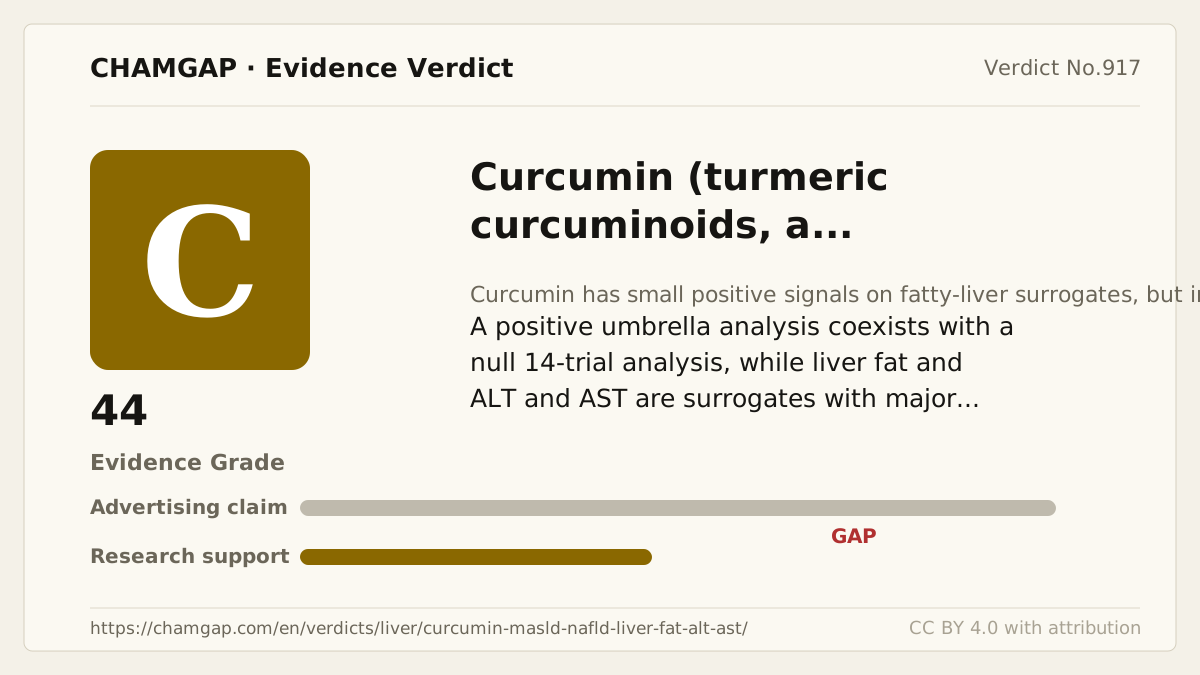
[Chamgap] Curcumin x liver fat and liver-enzyme improvement in MASLD or NAFLD — Evidence Grade C·44. 5 cited sources checked. Source: https://chamgap.com/en/verdicts/liver/curcumin-masld-nafld-liver-fat-alt-ast/ · CC BY 4.0CC BY 4.0 — free to use with attribution; do not distort grades, numbers, or verdict meaning.
What this document does and does not do
Chamgap is an information source. It reports what research has and has not confirmed; it does not tell readers what to take or buy. That decision belongs to readers and, when needed, medical or legal professionals. This verdict reflects literature available up to the search date and may change as new research appears. Nothing here is medical advice.