
Tart cherry concentrate,
does it really help with Reduction of uric acid and prevention of gout flares?
research showsEvidence for tart cherry in gout and urate is limited and conflicting, supporting C. A 28-day direct trial divided 50 people with gout among placebo and four dose groups and was null for serum-urate area under the curve, urinary urate excretion, and short-term flares, but it was not a large long-term prevention trial. In contrast, a 2026 meta-analysis of four randomized trials with 392 participants found a small, heterogeneous positive urate signal at SMD −0.22 in mixed populations. The direct null result conflicts with the positive surrogate signal, while evidence for flare prevention remains weak.
ads claimMarketing claims that anthocyanins 'control inflammation and flush uric acid,' prevent gout flares, or act as a natural urate-lowering medicine. Cyclooxygenase inhibition, antioxidant pathways, urate transporters, and docking analyses are mechanisms, not clinical achievement of urate targets or prevention of attacks in humans.
Useful facts when choosing a product
- Montmorency tart cherry juice, concentrate, powder, capsules, and jellies are distributed in Korea; one concentrate example directs users to dilute 30 mL per serving.
- The direct gout trial used Cherryvite concentrate at 7.5 to 30 mL twice daily. A marketed 30 mL daily serving is not the same as the trial maximum of 60 mL/day.
- Juices and concentrates contain sugars and calories, while powders and capsules differ in anthocyanin standardization and juice-equivalent amounts. Formulations cannot be assumed equivalent.
- Short-term tolerability is generally good, but gastrointestinal discomfort, cherry allergy, and sugar burden are possible. Tart cherry should not replace or prompt discontinuation of allopurinol, febuxostat, or other gout treatment.
Chamgap Semantic Classification Code
Candidate index · review held
UNK.tart-cherry-concentrate.UNK.uric-acid-and-prevention-of-gout-flares.prevent.placeboUnknown > Tart cherry concentrate > Unknown > uric acid and prevention of gout flares > Occurrence-prevention claim > Placebo
An automated migration candidate, not an issued permanent code; exact claim scope remains under review. This machine-generated migration candidate helps retrieval but is not a permanent assignment. The original verdict ID and URL remain authoritative.
What the research actually shows
The 2020 Stamp trial enrolled 50 people with gout and serum urate above 6 mg/dL; half used allopurinol and half used no urate-lowering therapy. Cherryvite concentrate at 7.5 to 30 mL twice daily for 28 days did not improve serum-urate area under the curve, urinary urate, anthocyanin change, or flare frequency (P=0.76). In the 2012 internet case-crossover study by Zhang and colleagues, cherry exposure over two days was associated with lower flare risk among 633 people, but exposure and outcomes were self-reported observational data. The 2026 meta-analysis by Zhang and colleagues found urate SMD −0.22 (95% CI −0.43 to −0.01) across four trials with 392 participants but concluded that quantity and consistency were limited. The 2023 open-label trial by Yang and colleagues used a tart-cherry citrate mixture together with febuxostat, so it was not a test of concentrate alone.
Why this is classified as C (43)
The direct gout trial was null for serum urate, urinary urate excretion, and short-term flares, but it divided 50 participants among five groups and lasted 28 days, falling short of large long-term null evidence. A meta-analysis of four randomized trials with 392 participants found a small, heterogeneous urate reduction at SMD −0.22 in mixed populations. This conflict between a direct null result and a positive surrogate signal supports C with 43 points.
Counterpoint. A very small urate reduction may occur in some mixed populations, but this does not establish replacement of standard urate-lowering treatment or long-term flare prevention. This verdict concerns a different gout axis from the sleep and exercise-recovery claim in item 97.
Rejudgment record. Reassessment (cross-check reflected) — Treated the null 28-day direct gout trial that divided 50 participants among placebo and four doses and the small heterogeneous positive urate signal from four randomized trials with 392 mixed-population participants as conflicting evidence
Sub-claim grades by effect
This ingredient is marketed for several effects. A single overall grade blends strong and weak claims together, so each effect is graded separately here. The overall grade reflects the strongest disconfirming or core claim.
| Effect (sub-claim) | Grade | Basis |
|---|---|---|
| Improvement of serum urate in people with gout | C | The null direct trial in 50 people conflicts with a small positive signal at SMD −0.22 in the mixed-population meta-analysis. |
| Prevention of gout flares | D | Flares were null in the direct 28-day trial, and an adequate long-term randomized prevention trial is absent. |
Cross-check — AI research and Codex final gate
Evidence Table
| Study | Design | Sample | Funding | Endpoint | Result | Weight |
|---|---|---|---|---|---|---|
| Stamp LK et al. 2020 | Randomized placebo- and dose-controlled trial | 50 | Health Research Council of New Zealand; product donated | Serum-urate area under the curve, urinary urate, and gout flares | At 7.5 to 30 mL twice daily for 28 days, there was no dose effect on serum urate, urate excretion, or short-term flares. | Key |
| Zhang Y et al. 2012 | Internet-based case-crossover observational study | 633 | Public funding from the U.S. National Institutes of Health | Recurrent gout attacks | Cherry intake over two days was associated with 35% lower flare risk, but exposure and outcomes were self-reported and nonrandomized. | Supportive |
| Zhang Z et al. 2026 | Meta-analysis of randomized trials | 392 | National Key Research and Development Program of China | Serum uric acid | A small reduction at SMD −0.22 was found in mixed populations, but heterogeneity was substantial and quantity and consistency were limited. | Supportive |
| Wang C et al. 2023 | Open-label randomized parallel-controlled trial | 282 | Chinese public research funding | Urine pH, urate, C-reactive protein, and flares | Among patients starting febuxostat, flares were fewer with the tart-cherry citrate mixture than with sodium bicarbonate, but the effect of pure tart cherry cannot be isolated. | Contextual |
Receipt — 4 References
All 4 cited sources were verified for existence at the original page (as of 2026-07-18).
Final verification and publication gate: Codex · Evidence date: 2026-07-18 · Corrections: none
Cite this verdict
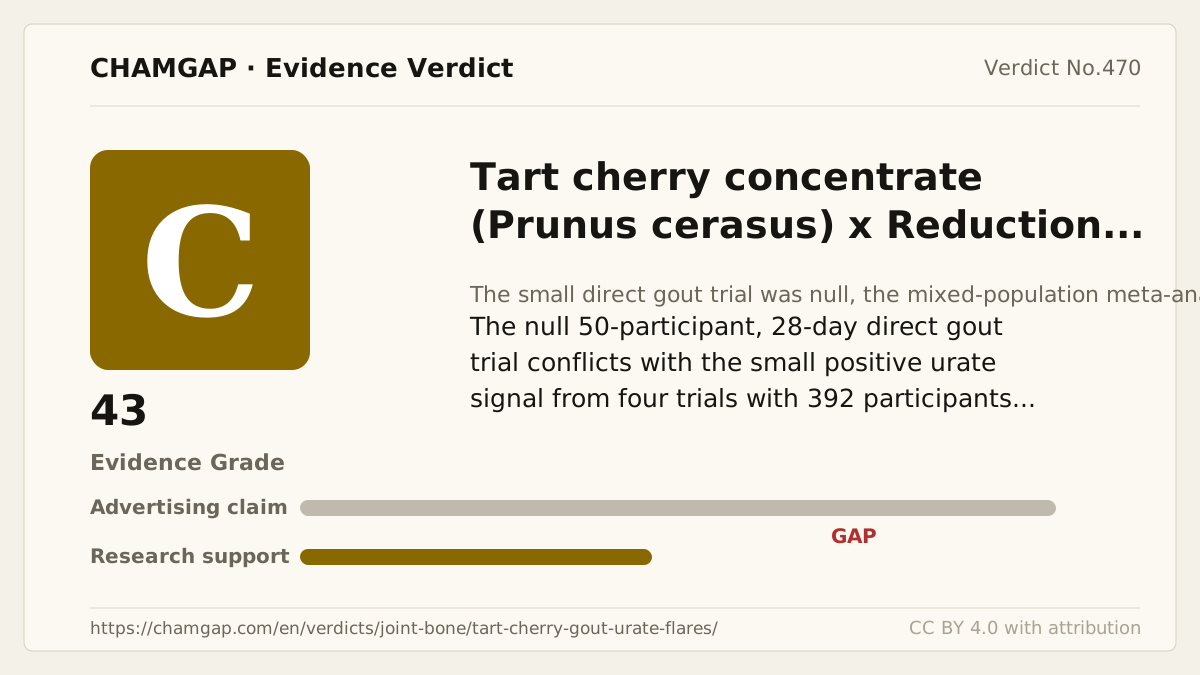
[Chamgap] Tart cherry concentrate x uric acid reduction and gout-flare prevention — Evidence Grade C·43. 4 cited sources checked. Source: https://chamgap.com/en/verdicts/joint-bone/tart-cherry-gout-urate-flares/ · CC BY 4.0CC BY 4.0 — free to use with attribution; do not distort grades, numbers, or verdict meaning.
What this document does and does not do
Chamgap is an information source. It reports what research has and has not confirmed; it does not tell readers what to take or buy. That decision belongs to readers and, when needed, medical or legal professionals. This verdict reflects literature available up to the search date and may change as new research appears. Nothing here is medical advice.