
Vitamin D, bone-health axis,
does it really help with Calcium absorption, prevention of osteomalacia, and reduction of fracture risk?
research showsCorrecting vitamin D deficiency to restore normal calcium-phosphate metabolism and bone mineralization and to prevent or treat osteomalacia is established. In contrast, adding vitamin D for unselected community-dwelling adults has not reduced fractures in large RCTs such as VITAL and D-Health.
ads claimEssential nutrient status or a bone-function label should not be converted into a claim that high-dose supplementation reduces fractures in every adult.
Useful facts when choosing a product
- Vitamin D is an essential nutrient widely used in standalone and combination products, not a single individually recognized proprietary ingredient.
- One microgram of vitamin D equals 40 IU.
- The 2,000 IU/day VITAL regimen and 60,000 IU/month D-Health regimen were research doses, not personal dose recommendations.
Chamgap Semantic Classification Code
Candidate index · review held
S.vitamin-d.UNK.calcium-absorption-prevention-of-osteomalacia-and-reduction-of-fracture-risk.prevent.placeboSupplements and nutraceuticals > Vitamin D > Unknown > Calcium absorption, prevention of osteomalacia, and reduction of fracture risk > Occurrence-prevention claim > Placebo
An automated migration candidate, not an issued permanent code; exact claim scope remains under review. This machine-generated migration candidate helps retrieval but is not a permanent assignment. The original verdict ID and URL remain authoritative.
What the research actually shows
Correction of deficiency for calcium-phosphate metabolism and prevention of osteomalacia is the established evidence axis. For fracture prevention in nondeficient or unselected adults, the large randomized VITAL trial of 25,871 participants, D-Health trial of 21,315 participants, and WHI trial of 36,282 participants found no significant benefit.
Why this is classified as B (70)
Deficiency correction, calcium-phosphate metabolism, and osteomalacia prevention are A, whereas fracture prevention in nondeficient adults is D after three null large RCTs. Because the headline includes both subclaims, an A would overstate the evidence; the overall rating is B with 70 points.
Counterpoint. Supplement need and dose vary with serum 25-hydroxyvitamin D, calcium intake, age, disease, and medications.
Rejudgment record. Reassessment (cross-check reflected) — Separated the grade-A deficiency-correction function from the grade-D fracture-prevention evidence in nondeficient adults and rated the combined headline B
Sub-claim grades by effect
This ingredient is marketed for several effects. A single overall grade blends strong and weak claims together, so each effect is graded separately here. The overall grade reflects the strongest disconfirming or core claim.
| Effect (sub-claim) | Grade | Basis |
|---|---|---|
| Deficiency correction, calcium/phosphate metabolism, and prevention of osteomalacia | A | Established in the clearly defined context of vitamin D deficiency |
| Fracture prevention in nondeficient adults | D | Null results in the large VITAL, D-Health, and WHI RCTs |
Cross-check — AI research and Codex final gate
Evidence Table
| Study | Design | Sample | Funding | Endpoint | Result | Weight |
|---|---|---|---|---|---|---|
| Gallagher et al. (2012), Journal of Clinical Endocrinology & Metabolism | Randomized dose-response placebo-controlled trial in postmenopausal women with low vitamin D, one year | 163 | Supported by the US National Institutes of Health | Serum 25-hydroxyvitamin D and calcium absorption | Serum levels rose with dose, while the calcium-absorption response was modest and nonlinear, underscoring the importance of deficiency status and context | Moderate |
| LeBoff et al. (2022), New England Journal of Medicine, VITAL | Large randomized double-blind placebo-controlled trial, median follow-up 5.3 years | 25,871 | Publicly funded, including the US National Institutes of Health | Total, nonvertebral, and hip fractures | At 2,000 IU/day, hazard ratios were 0.98 for total, 0.97 for nonvertebral, and 1.01 for hip fractures, with no significant reduction | High |
| Jackson et al. (2006), New England Journal of Medicine, WHI | Randomized double-blind placebo-controlled trial, mean follow-up of seven years | 36,282 | Supported by the US National Heart, Lung, and Blood Institute | Hip and total fractures | Calcium 1,000 mg/day plus vitamin D3 400 IU/day yielded a nonsignificant hip-fracture hazard ratio of 0.88 (95% CI 0.72 to 1.08) | High |
| Waterhouse et al. (2023), Lancet Diabetes & Endocrinology, D-Health | Population-based randomized double-blind placebo-controlled trial, up to five years | 20,326 | Publicly funded, including the Australian NHMRC | Total, nonvertebral, and hip fractures | At 60,000 IU/month, the total-fracture hazard ratio was 0.94 and not significant; hip fractures were not reduced | High |
Receipt — 5 References
All 5 cited sources were verified for existence at the original page (as of 2026-07-16).
Final verification and publication gate: Codex · Evidence date: 2026-07-16 · Corrections: none
Cite this verdict
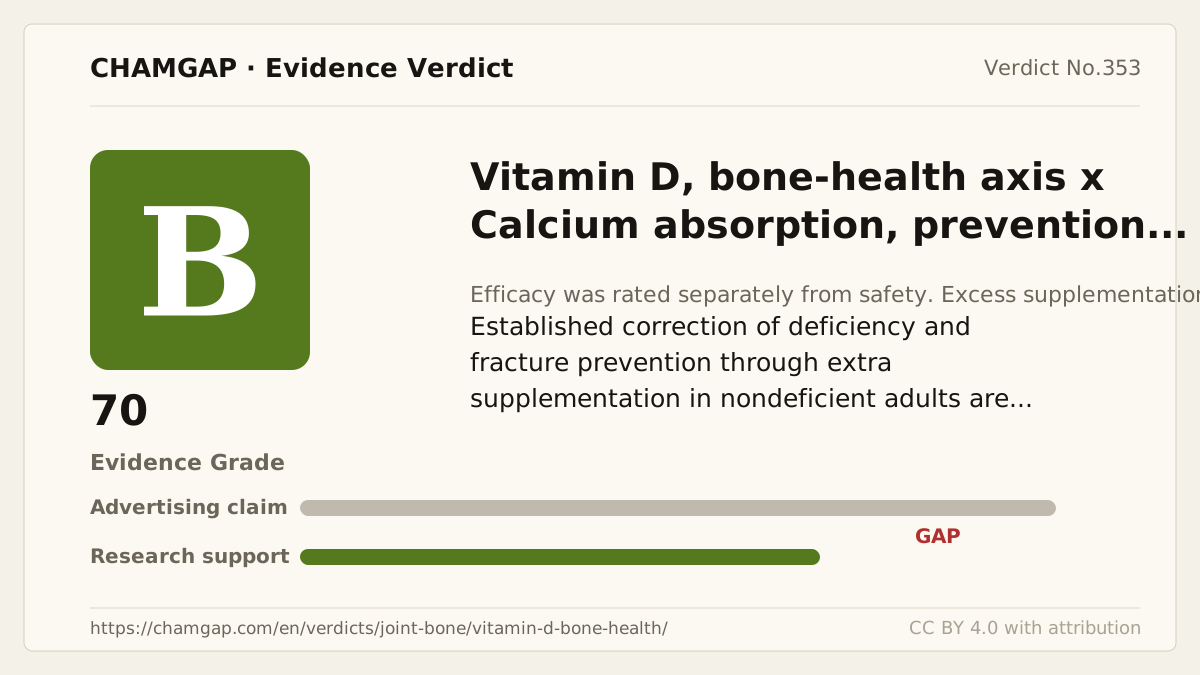
[Chamgap] Does vitamin D support calcium absorption and bone health and prevent fractures? — Evidence Grade B·70. 5 cited sources checked. Source: https://chamgap.com/en/verdicts/joint-bone/vitamin-d-bone-health/ · CC BY 4.0CC BY 4.0 — free to use with attribution; do not distort grades, numbers, or verdict meaning.
What this document does and does not do
Chamgap is an information source. It reports what research has and has not confirmed; it does not tell readers what to take or buy. That decision belongs to readers and, when needed, medical or legal professionals. This verdict reflects literature available up to the search date and may change as new research appears. Nothing here is medical advice.