
Oseltamivir,
does it really help with Shortening influenza symptoms leads to fewer hospitalizations and severe complications?
research showsOseltamivir is rated C for this composite claim because it shortens influenza symptoms by about one day but has not been shown to translate that improvement into fewer hospitalizations or severe complications. A clinical-study-report review found symptom alleviation 16.8 hours earlier in adults, and an individual-patient-data meta-analysis of manufacturer trials found a 25.2-hour difference. An independent meta-analysis of 15 randomized trials and 6,166 influenza-confirmed outpatients found no reduction in hospitalization, RR 0.79 (95% CI 0.48 to 1.29). Mortality and transmission reduction are also unknown because direct treatment-trial evidence is absent, while nausea, vomiting, and rare neuropsychiatric events are recorded separately under safety.
ads claimPromotion can connect recovering a day earlier with preventing hospitalization and severe complications. Randomized evidence fits modest symptom shortening, not a guarantee against severe disease, death, or transmission.
Useful facts when choosing a product
- Oseltamivir is a prescription neuraminidase-inhibiting antiviral for influenza; it is neither an antibiotic nor an immune supplement.
- A typical licensed adult treatment regimen is 75 mg twice daily for five days, with evidence fitting best when treatment starts within 48 hours of symptom onset. The individual prescription and renal dose adjustment take priority.
- Prophylaxis and treatment regimens differ, and oseltamivir does not replace influenza vaccination.
- Nausea, vomiting, and headache are common, and rare confusion or abnormal behavior should be monitored, especially in children and adolescents with influenza. These safety issues are separate from hospitalization-prevention efficacy.
Chamgap Semantic Classification Code
Candidate index · review held
M.oseltamivir.UNK.shortening-influenza-symptoms-leads-to-fewer-hospitalizations-and-severe-complications.reduce.UNKMedicinal interventions > Oseltamivir > Unknown > Shortening influenza symptoms leads to fewer hospitalizations and severe complications > Reduction claim > Unknown
An automated migration candidate, not an issued permanent code; exact claim scope remains under review. This machine-generated migration candidate helps retrieval but is not a permanent assignment. The original verdict ID and URL remain authoritative.
What the research actually shows
Jefferson 2014 analyzed 20 clinical study reports and found adult symptom alleviation 16.8 hours earlier, but no demonstrated reduction in hospitalization, verified pneumonia, serious complications, or transmission. Dobson 2015 analyzed individual data from nine Roche-sponsored adult trials with 4,328 participants; median symptom alleviation fell from 122.7 to 97.5 hours among influenza-confirmed patients, with some complication and admission signals. Hanula 2024 included large investigator-initiated trials and pooled 15 randomized trials with 6,166 participants, finding hospitalization RR 0.79 (95% CI 0.48 to 1.29) and risk difference -0.17%, neither significant.
Why this is classified as C (48)
Randomized evidence supports symptom shortening, but the effect is only about one day and an independent meta-analysis of 15 trials and 6,166 participants did not confirm fewer hospitalizations. Separating the positive symptom component from the unproven severe-outcome component gives C with 48 points.
Counterpoint. Early antiviral treatment may still be recommended for high-risk or severely ill patients on the basis of observational evidence and clinical judgment. That is not equivalent to definitive randomized proof of preventing admission or death in outpatients.
Rejudgment record. New verdict — Accepted randomized evidence for symptom shortening but applied the composite-claim and rule ① boundary because an independent meta-analysis of 15 trials did not confirm hospitalization reduction and a symptom endpoint cannot be extended to severe complications
Sub-claim grades by effect
This ingredient is marketed for several effects. A single overall grade blends strong and weak claims together, so each effect is graded separately here. The overall grade reflects the strongest disconfirming or core claim.
| Effect (sub-claim) | Grade | Basis |
|---|---|---|
| Shorter duration of influenza symptoms | C | Randomized-trial syntheses show a reduction of about 16.8 to 25.2 hours, but the effect is modest. |
| Reduced hospitalization and severe complications | ? | Fifteen trials with 6,166 participants did not confirm fewer hospitalizations, and severe events were sparse. |
| Reduced mortality and transmission | ? | Treatment trials provide no direct human evidence sufficient to judge mortality or transmission reduction. |
Cross-check — AI research and Codex final gate
Evidence Table
| Study | Design | Sample | Funding | Endpoint | Result | Weight |
|---|---|---|---|---|---|---|
| Hanula R et al. 2024 | Systematic review and meta-analysis of randomized trials | 15 randomized trials and 6,166 influenza-confirmed outpatients | Independent academic analysis including manufacturer and investigator-initiated trials | Hospitalization | RR was 0.79 (95% CI 0.48 to 1.29) with risk difference -0.17%, showing no significant reduction. | Key independent direct clinical endpoint |
| Jefferson T et al. 2014 | Systematic review of clinical study reports | Twenty placebo-controlled trials in the formal analysis | Public funding from the United Kingdom NIHR | Symptom alleviation, complications, hospitalization, transmission, and adverse events | Adult symptom alleviation was 16.8 hours earlier, but reductions in hospitalization, verified complications, and transmission were not established. | Key full-report synthesis |
| Dobson J et al. 2015 | Individual-patient-data meta-analysis of randomized trials | Nine trials and 4,328 adults | Foundation-supported analysis; all included trials were Roche-sponsored | Symptom alleviation, lower respiratory complications, hospitalization, and safety | Median symptom alleviation was 25.2 hours shorter in confirmed influenza, with an admission signal, but evidence was concentrated in manufacturer trials. | Positive symptom evidence with funding concentration |
Receipt — 4 References
All 4 cited sources were verified for existence at the original page (as of 2026-07-19).
Final verification and publication gate: Codex · Evidence date: 2026-07-19 · Corrections: none
Cite this verdict
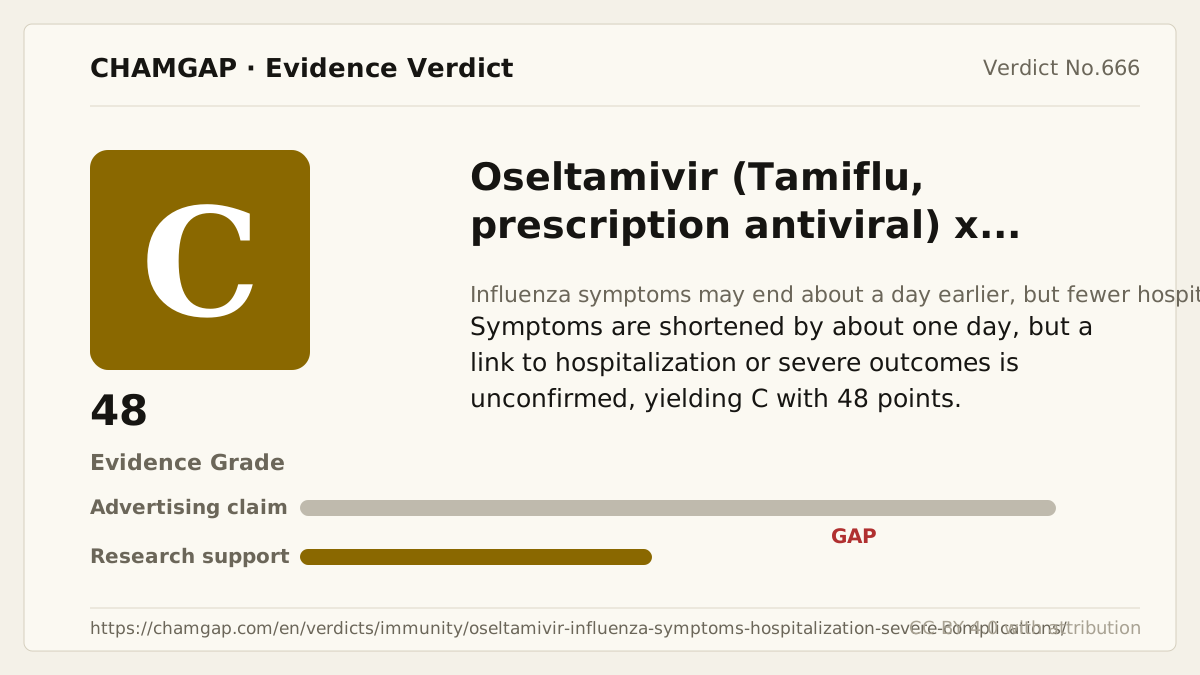
[Chamgap] Oseltamivir x shorter influenza symptoms and fewer hospitalizations or severe complications — Evidence Grade C·48. 4 cited sources checked. Source: https://chamgap.com/en/verdicts/immunity/oseltamivir-influenza-symptoms-hospitalization-severe-complications/ · CC BY 4.0CC BY 4.0 — free to use with attribution; do not distort grades, numbers, or verdict meaning.
What this document does and does not do
Chamgap is an information source. It reports what research has and has not confirmed; it does not tell readers what to take or buy. That decision belongs to readers and, when needed, medical or legal professionals. This verdict reflects literature available up to the search date and may change as new research appears. Nothing here is medical advice.