
Triphala,
does it really help with Improved bowel-movement frequency and completeness in chronic or functional constipation?
research showsTriphala is rated ? because no direct human efficacy literature establishes that Triphala alone improves bowel frequency and completeness in chronic or functional constipation. The frequently cited 34-person open-label study tested TLPL/AY/01/2008, which contained not only Triphala but also senna extract and psyllium, both established laxative components. A placebo-controlled study of Triphala alone examined gut microbiota in healthy people rather than complete spontaneous bowel movements in patients with constipation. Non-attributable combination evidence and the absence of a standalone constipation trial yield a null score.
ads claimMarketing converts improvement from a senna and psyllium combination and traditional bowel-cleansing concepts into a validated standalone treatment claim for Triphala. Antioxidant, oral-health, and microbiome studies belong to different evidence axes from evacuation completeness.
Useful facts when choosing a product
- Triphala generally combines the three fruits amla (Phyllanthus emblica), bibhitaki (Terminalia bellirica), and haritaki (Terminalia chebula).
- The Triphala evaluated here is distinct from senna, psyllium, and macrogol, and effects of constipation products containing those ingredients cannot be attributed to Triphala.
- Diarrhea, abdominal cramping, or bloating can occur, and products can differ in fruit ratios, extraction, and contaminant control.
- Blood in stool, weight loss, anemia, severe pain, or new persistent constipation calls for medical evaluation rather than supplement self-treatment.
Chamgap Semantic Classification Code
Candidate index · review held
F.triphala.food.bowel-movement-frequency-and-completeness-in-chronic-or-functional-constipation.improve.placeboFoods and beverages > Triphala > Food consumption > bowel-movement frequency and completeness in chronic or functional constipation > Improvement claim > Placebo
An automated migration candidate, not an issued permanent code; exact claim scope remains under review. This machine-generated migration candidate helps retrieval but is not a permanent assignment. The original verdict ID and URL remain authoritative.
What the research actually shows
Munshi et al. 2011 gave TLPL/AY/01/2008 to 34 people with functional constipation for 14 days and reported an increase in mean weekly bowel movements from 10.19 to 18.29 and improvement in incomplete evacuation. The formulation contained senna extract and psyllium husk together with Triphala and used an open uncontrolled design. Peterson et al. 2020 randomized 31 healthy participants to Triphala, manjistha, or placebo and analyzed gut microbiota; it was not a trial in constipation or evacuation completeness. Recent reviews cover diverse preclinical, oral-health, and metabolic research but do not supply a placebo-controlled standalone Triphala trial for chronic constipation.
Why this is classified as ?
The directly cited 34-person study was open and uncontrolled and tested a senna-psyllium-Triphala combination that prevents isolated attribution. The healthy-person microbiome trial did not measure constipation outcomes, and no standalone placebo-controlled chronic-constipation trial exists, yielding ? with a null score. Diarrhea, cramping, and product variability remain separate safety issues.
Counterpoint. Chronic constipation has ingredient-specific evidence for options such as psyllium and macrogol, while underlying cause and comorbidity determine when clinical evaluation is needed.
Rejudgment record. New verdict — Applied the no-standalone-human-efficacy criterion because the 34-person open trial tested a senna-psyllium-Triphala combination, the healthy-person microbiome trial did not assess constipation outcomes, and no placebo-controlled standalone Triphala trial for chronic constipation was identified
Sub-claim grades by effect
This ingredient is marketed for several effects. A single overall grade blends strong and weak claims together, so each effect is graded separately here. The overall grade reflects the strongest disconfirming or core claim.
| Effect (sub-claim) | Grade | Basis |
|---|---|---|
| Improved bowel frequency and completeness in chronic or functional constipation | ? | No placebo-controlled human efficacy trial of standalone Triphala was identified. |
| Attribution of senna and psyllium combination effects to Triphala alone | ? | The 34-person open trial used all three ingredients, preventing isolation of Triphala's effect. |
| Attribution of antioxidant or oral-health findings to constipation improvement | ? | Antioxidant, oral-health, and microbiome outcomes are not direct efficacy evidence for bowel frequency or completeness. |
Cross-check — AI research and Codex final gate
Evidence Table
| Study | Design | Sample | Funding | Endpoint | Result | Weight |
|---|---|---|---|---|---|---|
| Munshi R et al. 2011 | Open-label prospective single-arm exploratory trial | 34 patients with functional constipation; 31 completed | Evaluation of the proprietary Ayurvedic combination TLPL/AY/01/2008 | Weekly bowel movements, stool form, straining, and incomplete evacuation | Several outcomes improved after two weeks, but the product combined senna, psyllium, and Triphala and had no control group. | Combination evidence, not standalone human efficacy |
| Peterson CT et al. 2020 | Randomized double-blind placebo-controlled pilot trial | 31 healthy participants; nine Triphala completers | Academic pilot study | Four-week fecal microbiome composition by 16S rRNA profiling | This was a standalone human Triphala trial, but it assessed microbiota in healthy people rather than constipation frequency or completeness. | Different evidence axis, not human constipation efficacy |
| Tarasiuk A et al. 2018 review | Selective review of functional gastrointestinal literature | Synthesis of preclinical, constituent, and formulation literature | Not reported as an external product trial | Mechanisms, lower gastrointestinal symptoms, and need for future clinical research | It discussed potential but did not provide placebo-controlled efficacy evidence for standalone Triphala in chronic constipation. | Direct-evidence gap confirmation |
Receipt — 3 References
All 3 cited sources were verified for existence at the original page (as of 2026-07-19).
Final verification and publication gate: Codex · Evidence date: 2026-07-19 · Corrections: none
Cite this verdict
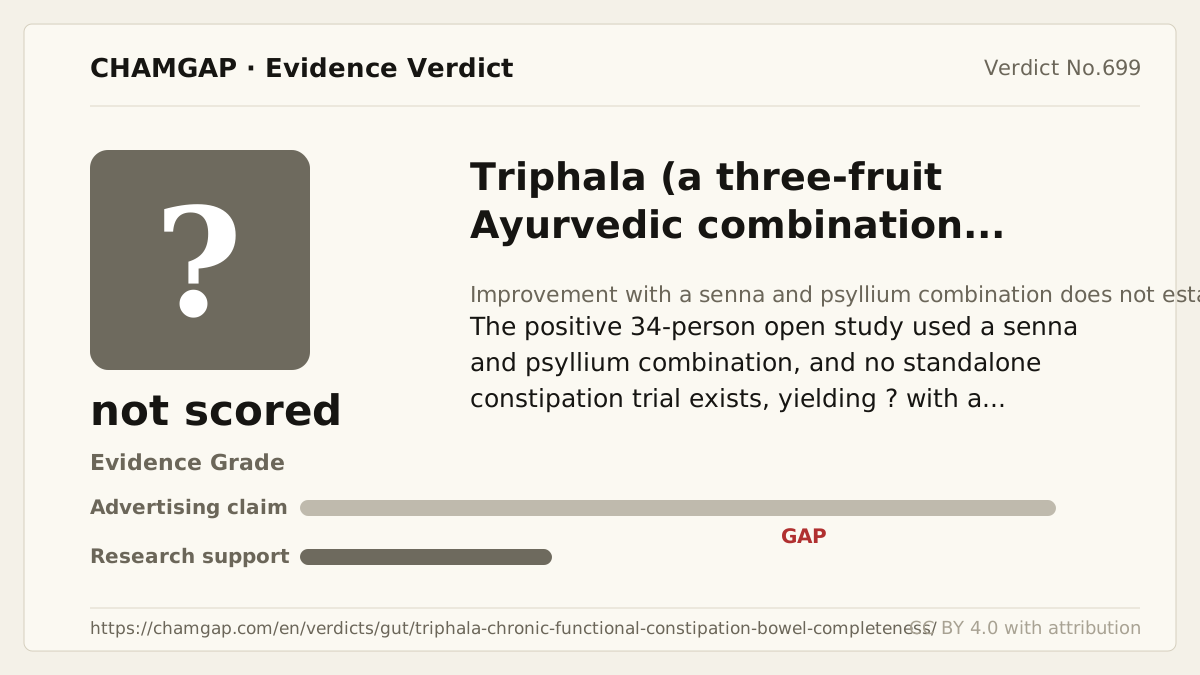
[Chamgap] Triphala x improved bowel frequency and completeness in chronic or functional constipation — Evidence Grade ?. 3 cited sources checked. Source: https://chamgap.com/en/verdicts/gut/triphala-chronic-functional-constipation-bowel-completeness/ · CC BY 4.0CC BY 4.0 — free to use with attribution; do not distort grades, numbers, or verdict meaning.
What this document does and does not do
Chamgap is an information source. It reports what research has and has not confirmed; it does not tell readers what to take or buy. That decision belongs to readers and, when needed, medical or legal professionals. This verdict reflects literature available up to the search date and may change as new research appears. Nothing here is medical advice.