
Simethicone,
does it really help with Reduced crying and symptoms caused by infantile colic?
research showsSimethicone is rated F because it does not reduce crying or symptoms of infantile colic beyond placebo. Two placebo-controlled crossover trials with 110 participants gave a response risk ratio of 0.95 (95% CI 0.73 to 1.23), while a separate 27-participant trial found no reduction in crying duration. The repeated direction is null, but all studies were small and at high risk of bias, so the refutation is less decisive than larger, stronger null evidence. Minimal intestinal absorption and generally favorable safety remain separate from efficacy, resulting in F with 15 points.
ads claimMarketing links the physical action of breaking up bubbles to treating the cause of colic and reducing crying. A plausible antifoaming mechanism does not establish clinical improvement in a multifactorial condition such as infantile colic.
Useful facts when choosing a product
- Simethicone is an antifoaming agent that lowers the surface tension of gas bubbles within the gastrointestinal tract and is minimally absorbed systemically.
- Concentrations and drop volumes vary among infant liquid products, so adult formulations or improvised dose conversions should not be used.
- It is generally well tolerated, but favorable safety and absent efficacy are separate findings. Persistent severe crying, fever, lethargy, poor feeding, bilious vomiting, blood in stool, or poor weight gain requires medical evaluation.
- Infantile colic commonly resolves within the first months of life, and caregiver support plus screening for warning signs is more important than repeatedly giving an ineffective medicine.
Chamgap Semantic Classification Code
Candidate index · review held
M.simethicone.UNK.crying-and-symptoms-caused-by-infantile-colic.reduce.placeboMedicinal interventions > Simethicone > Unknown > crying and symptoms caused by infantile colic > Reduction claim > Placebo
An automated migration candidate, not an issued permanent code; exact claim scope remains under review. This machine-generated migration candidate helps retrieval but is not a permanent assignment. The original verdict ID and URL remain authoritative.
What the research actually shows
The Metcalf trial randomized 83 infants aged two to eight weeks with colic in a double-blind crossover comparison of simethicone and placebo. Across 166 treatment periods lasting three to ten days, both treatments produced perceived improvement but did not differ. The 2016 Cochrane review assessed 18 studies with 1,014 infants across pain-relieving agents and found no placebo-controlled benefit for simethicone. A 2020 systematic review of reviews and guidelines also summarized simethicone evidence as null or unfavorable.
Why this is classified as F (15)
Two placebo-controlled crossover trials with 110 participants gave a response risk ratio of 0.95 (95% CI 0.73 to 1.23), and a separate 27-participant trial found no crying-duration benefit. The repeated null direction supports F, but small samples and high risk of bias limit the strength of refutation, giving 15 points. Minimal absorption and generally favorable safety do not raise an efficacy grade.
Counterpoint. Use for gas or bloating in other settings is not the same claim as reduced infantile-colic crying. This verdict is limited to crying and symptoms attributed to infantile colic.
Rejudgment record. New verdict — Applied F because two placebo-controlled crossover trials with 110 participants gave response RR 0.95 and a separate 27-participant trial found no crying-duration benefit, but limited the refutation strength to 15 points because all trials were small and at high risk of bias
Sub-claim grades by effect
This ingredient is marketed for several effects. A single overall grade blends strong and weak claims together, so each effect is graded separately here. The overall grade reflects the strongest disconfirming or core claim.
| Effect (sub-claim) | Grade | Basis |
|---|---|---|
| Reduced crying from infantile colic | F | A placebo-controlled crossover trial and repeated systematic reviews do not support efficacy. |
| Improved passage of gas or relief of general bloating | ? | Infantile-colic crying trials cannot determine efficacy for gas symptoms in other ages or conditions. |
| Minimal absorption implies efficacy for infantile colic | ? | Safety is a separate axis and is not an efficacy subclaim. |
Cross-check — AI research and Codex final gate
Evidence Table
| Study | Design | Sample | Funding | Endpoint | Result | Weight |
|---|---|---|---|---|---|---|
| Metcalf TJ et al. 1994 | Multicenter randomized double-blind placebo-controlled crossover trial | 83 infants aged two to eight weeks across 166 treatment periods | Inadequately reported | Parent-rated colic symptoms, response, and crying-related clinical assessment | Both treatments produced perceived improvement, but simethicone was no more effective than placebo. | Key direct null trial |
| Biagioli E et al. Cochrane review, 2016 | Systematic review of randomized and quasi-randomized trials | 18 pain-relief studies with 1,014 infants; four simethicone studies | Academic Cochrane review | Crying duration, colic improvement, and adverse events | Simethicone showed no benefit over placebo and evidence did not support its use. | Synthesis of repeated evidence |
| Ellwood J et al. 2020 | Systematic review of reviews and clinical guidelines | 32 included records, including simethicone studies and reviews | Public health-service and academic institutions | Crying, sleep, distress, and adverse events in infantile colic | Simethicone studies showed no benefit or an unfavorable direction and did not support use. | Later cross-check |
Receipt — 3 References
All 3 cited sources were verified for existence at the original page (as of 2026-07-19).
Final verification and publication gate: Codex · Evidence date: 2026-07-19 · Corrections: none
Cite this verdict
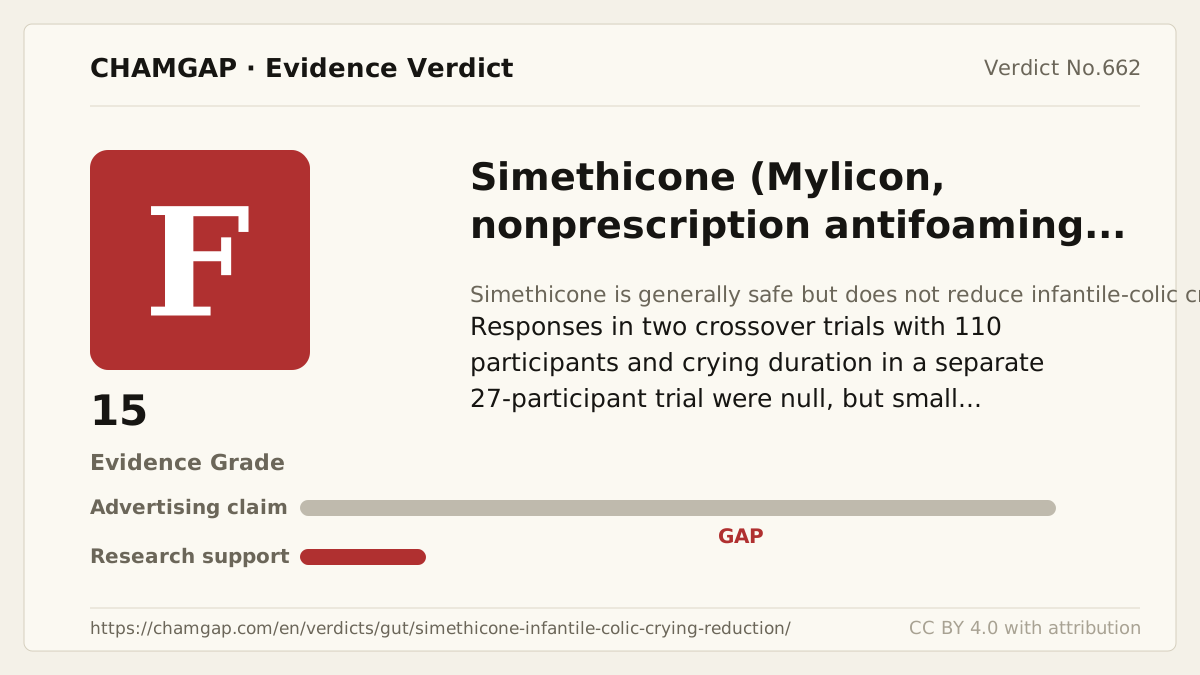
[Chamgap] Simethicone x reduced crying from infantile colic — Evidence Grade F·15. 3 cited sources checked. Source: https://chamgap.com/en/verdicts/gut/simethicone-infantile-colic-crying-reduction/ · CC BY 4.0CC BY 4.0 — free to use with attribution; do not distort grades, numbers, or verdict meaning.
What this document does and does not do
Chamgap is an information source. It reports what research has and has not confirmed; it does not tell readers what to take or buy. That decision belongs to readers and, when needed, medical or legal professionals. This verdict reflects literature available up to the search date and may change as new research appears. Nothing here is medical advice.