
Prucalopride,
does it really help with Normalization of spontaneous complete bowel movements in chronic idiopathic constipation inadequately responsive to laxatives?
research showsPrucalopride is rated B because it increases the proportion of patients with chronic idiopathic constipation inadequately responsive to laxatives who achieve at least three spontaneous complete bowel movements (SCBMs) per week. In an integrated analysis of six placebo-controlled trials with 2,484 patients, the 12-week response was 27.8% with prucalopride and 13.2% with placebo (OR 2.68, 95% CI 2.16 to 3.33). Diary-based SCBM is directly connected to patient symptoms. Most evidence lasts 12 weeks and about 72% did not meet the strict normalization threshold, so this is not a cure or universal normalization of motility.
ads claimMarketing may promise normalized motility, a constipation cure, or comfortable daily bowel movements for everyone. The evidence shows a higher probability that some patients meet a strict SCBM threshold over 12 weeks.
Useful facts when choosing a product
- Prucalopride is a selective 5-HT4 receptor agonist that stimulates propulsive gut motility through a mechanism different from polyethylene glycol, lactulose, or senna.
- It is a once-daily prescription treatment for adult chronic idiopathic constipation, with dose adjustment potentially needed for kidney function and age.
- Headache, nausea, abdominal pain, and diarrhea are common and often occur early in treatment, but persistent or severe symptoms require medical review.
- It should not be used when obstruction or perforation is suspected, and early response and the ongoing need for treatment should be reassessed.
Chamgap Semantic Classification Code
Candidate index · review held
M.prucalopride.UNK.normalization-of-spontaneous-complete-bowel-movements-in-chronic-idiopathic-constipation-inadequately-responsive-to-laxatives.assess.placeboMedicinal interventions > Prucalopride > Unknown > Normalization of spontaneous complete bowel movements in chronic idiopathic constipation inadequately responsive to laxatives > Association or change assessment > Placebo
An automated migration candidate, not an issued permanent code; exact claim scope remains under review. This machine-generated migration candidate helps retrieval but is not a permanent assignment. The original verdict ID and URL remain authoritative.
What the research actually shows
Camilleri 2016 integrated 2,484 participants from six similar phase 3 and 4 double-blind trials and reported a 12-week rate of at least three SCBMs per week of 27.8% versus 13.2%. A large Camilleri 2008 trial found rates of 30.9% with 2 mg and 12.0% with placebo. Trials included both sexes and multiple regions but largely arose from the sponsor's development program and focused on 12-week diaries rather than long-term clinical outcomes.
Why this is classified as B (66)
Across six trials, the direct symptom endpoint of at least three SCBMs per week was 27.8% versus 13.2%, OR 2.68 (95% CI 2.16 to 3.33), with consistent network-meta-analytic superiority. SCBM is a direct patient-experienced clinical endpoint, supporting B. Predominantly 12-week evidence, an absolute response near 28%, and the lack of evidence for cure or normalized motility lower the result to 66 points. Safety remains separate.
Counterpoint. Response should include complete evacuation and quality of life; nonresponse should prompt reassessment for secondary constipation, pelvic-floor dysfunction, or medication causes.
Rejudgment record. New verdict — Applied B because randomized trials and network meta-analysis consistently improved at least three SCBMs per week, a direct patient-experienced symptom endpoint, while deducting for 12-week core evidence, an absolute response near 28%, and the lack of proof for cure or normalized motility
Sub-claim grades by effect
This ingredient is marketed for several effects. A single overall grade blends strong and weak claims together, so each effect is graded separately here. The overall grade reflects the strongest disconfirming or core claim.
| Effect (sub-claim) | Grade | Basis |
|---|---|---|
| Increased spontaneous complete bowel movements in chronic constipation | B | A direct bowel endpoint was consistently positive across multiple trials. |
| Normalized motility or cured constipation | ? | Only a minority met the strict response threshold, and permanent normalization or cure was not tested. |
| Long-term normalization beyond 12 weeks | C | Extension data exist, but the core placebo-controlled evidence is concentrated at 12 weeks. |
Cross-check — AI research and Codex final gate
Evidence Table
| Study | Design | Sample | Funding | Endpoint | Result | Weight |
|---|---|---|---|---|---|---|
| Camilleri M et al. 2016 | Integrated analysis of six phase 3 and 4 randomized placebo-controlled trials | 2,484 efficacy and 2,552 safety participants | Shire development program; company employees coauthored | Mean of at least three SCBMs per week over 12 weeks | Response was 27.8% versus 13.2%, OR 2.68 (95% CI 2.16 to 3.33). | Key multi-trial synthesis of a direct endpoint |
| Camilleri M et al. 2008 | Multicenter randomized double-blind placebo-controlled trial | 620 patients with severe chronic constipation | Sponsored by Movetis | Mean of at least three SCBMs per week over 12 weeks | Rates were 30.9% with 2 mg, 28.4% with 4 mg, and 12.0% with placebo; both doses were significant. | Large direct randomized trial |
Receipt — 3 References
All 3 cited sources were verified for existence at the original page (as of 2026-07-19).
Final verification and publication gate: Codex · Evidence date: 2026-07-19 · Corrections: none
Cite this verdict
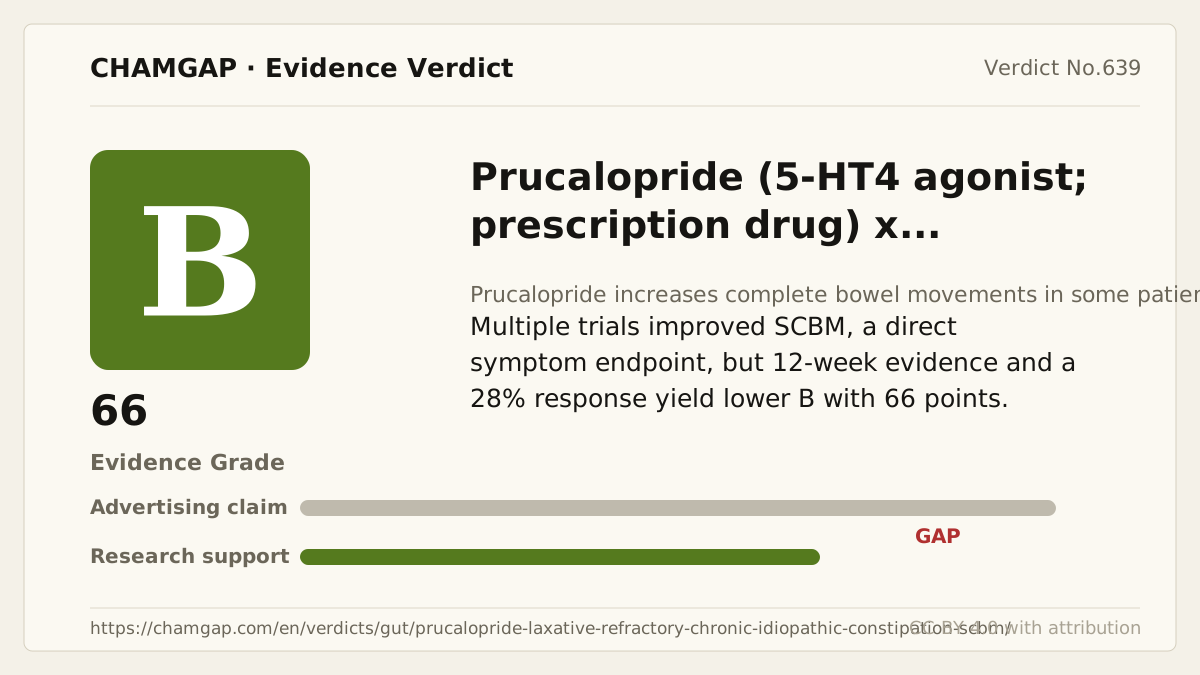
[Chamgap] Prucalopride x normalized spontaneous complete bowel movements in laxative-refractory chronic constipation — Evidence Grade B·66. 3 cited sources checked. Source: https://chamgap.com/en/verdicts/gut/prucalopride-laxative-refractory-chronic-idiopathic-constipation-scbm/ · CC BY 4.0CC BY 4.0 — free to use with attribution; do not distort grades, numbers, or verdict meaning.
What this document does and does not do
Chamgap is an information source. It reports what research has and has not confirmed; it does not tell readers what to take or buy. That decision belongs to readers and, when needed, medical or legal professionals. This verdict reflects literature available up to the search date and may change as new research appears. Nothing here is medical advice.