
Curcumin,
does it really help with Adjunctive induction and maintenance of remission in ulcerative colitis?
research showsIn mild-to-moderate ulcerative colitis, placebo-controlled RCTs and meta-analyses suggest that adding curcumin to standard 5-ASA therapy such as mesalamine or sulfasalazine may improve clinical or endoscopic induction and maintenance of remission. The total evidence base is small, however, and doses, oral versus enema delivery, bioavailability, and proprietary formulations vary, so the rating is B. The evidence does not establish monotherapy or efficacy in Crohn disease.
ads claimClaims may expand into 'turns off intestinal inflammation,' 'remission without medication,' or 'works for Crohn disease too.' Positive evidence mainly concerns adjunctive use with 5-ASA in mild-to-moderate UC, not replacement of standard medication.
Useful facts when choosing a product
- Curcumin supplements and foods are widely sold in South Korea, but they are not approved medicines for treating UC and cannot be assumed equivalent to study formulations.
- The maintenance RCT used 2 g/day for six months and an induction RCT used 3 g/day for four weeks; some trials used bioenhanced formulations or enemas.
- Equal label doses do not guarantee equal curcuminoid content, absorption enhancers, enteric delivery, or lot quality.
- Gastrointestinal discomfort may occur, and biliary disease, anticoagulant use, and the perioperative period warrant professional review. Safety is separate from the B rating.
Chamgap Semantic Classification Code
Candidate index · review held
S.curcumin.UNK.adjunctive-induction-and-maintenance-of-remission-in-ulcerative-colitis.maintain.MULTISupplements and nutraceuticals > Curcumin > Unknown > Adjunctive induction and maintenance of remission in ulcerative colitis > Maintenance claim > Multiple: primary unresolved
An automated migration candidate, not an issued permanent code; exact claim scope remains under review. This machine-generated migration candidate helps retrieval but is not a permanent assignment. The original verdict ID and URL remain authoritative.
What the research actually shows
The multicenter Hanai 2006 RCT kept 89 patients with quiescent UC on mesalamine or sulfasalazine and added curcumin 2 g/day or placebo for six months, reporting fewer relapses. The multicenter Lang 2015 RCT enrolled 50 patients with active mild-to-moderate UC despite optimized mesalamine; curcumin 3 g/day for four weeks produced clinical remission in 53.8% versus 0% and endoscopic remission in 38% versus 0%. The Zheng 2020 meta-analysis favored adjunctive curcumin for clinical and endoscopic remission, but included few heterogeneous trials. A 2022 update reported clinical-remission RR 2.10 while clinical improvement and endoscopic remission were not significant.
Why this is classified as B (62)
Human RCTs and meta-analyses repeatedly support adjunctive 5-ASA induction or maintenance of remission, justifying B. Small samples, wide confidence intervals, differences in dose, route, and bioavailability, and reliance on some proprietary formulations limit the score to 68.
Counterpoint. The signal is not zero, but its scope is mild-to-moderate UC with standard therapy. Severe UC, medication withdrawal, monotherapy, and Crohn disease require separate evidence.
Rejudgment record. New verdict — Repeatedly positive adjunctive 5-ASA remission RCTs and meta-analyses, limited by small samples and formulation heterogeneity
Sub-claim grades by effect
This ingredient is marketed for several effects. A single overall grade blends strong and weak claims together, so each effect is graded separately here. The overall grade reflects the strongest disconfirming or core claim.
| Effect (sub-claim) | Grade | Basis |
|---|---|---|
| Adjunctive induction and maintenance of remission with 5-ASA in mild-to-moderate UC | B | Small multicenter placebo-controlled RCTs and meta-analyses repeatedly show clinical and some endoscopic remission signals |
| Curcumin monotherapy or remission in Crohn disease | ? | The positive evidence primarily concerns adjunctive standard therapy in UC; direct human evidence sufficient to rate monotherapy or Crohn disease efficacy is absent |
Cross-check — AI research and Codex final gate
Evidence Table
| Study | Design | Sample | Funding | Endpoint | Result | Weight |
|---|---|---|---|---|---|---|
| Hanai H et al. 2006 | Multicenter randomized double-blind placebo-controlled trial | 89 | Academic multicenter study; product-related funding details unclear | Six-month relapse, clinical activity index, and endoscopic index | Adding 2 g/day to 5-ASA or sulfasalazine reduced six-month relapse and improved activity indices. | Key maintenance evidence |
| Lang A et al. 2015 | Multicenter randomized double-blind placebo-controlled trial | 50 | Sheba and Helmsley support; some author industry conflicts disclosed | Four-week clinical remission, response, and endoscopic remission | With mesalamine, 3 g/day produced clinical remission in 53.8% versus 0% and endoscopic remission in 38% versus 0%. | Key induction evidence |
| Zheng T et al. 2020 | Meta-analysis of randomized trials | Academic research | Clinical remission, endoscopic remission, and improvement | Adjunctive curcumin favored clinical remission with OR 5.18 and endoscopic remission with OR 5.69, but confidence intervals were wide. | Key synthesis |
Receipt — 4 References
All 4 cited sources were verified for existence at the original page (as of 2026-07-18).
Final verification and publication gate: Codex · Evidence date: 2026-07-18 · Corrections: none
Cite this verdict
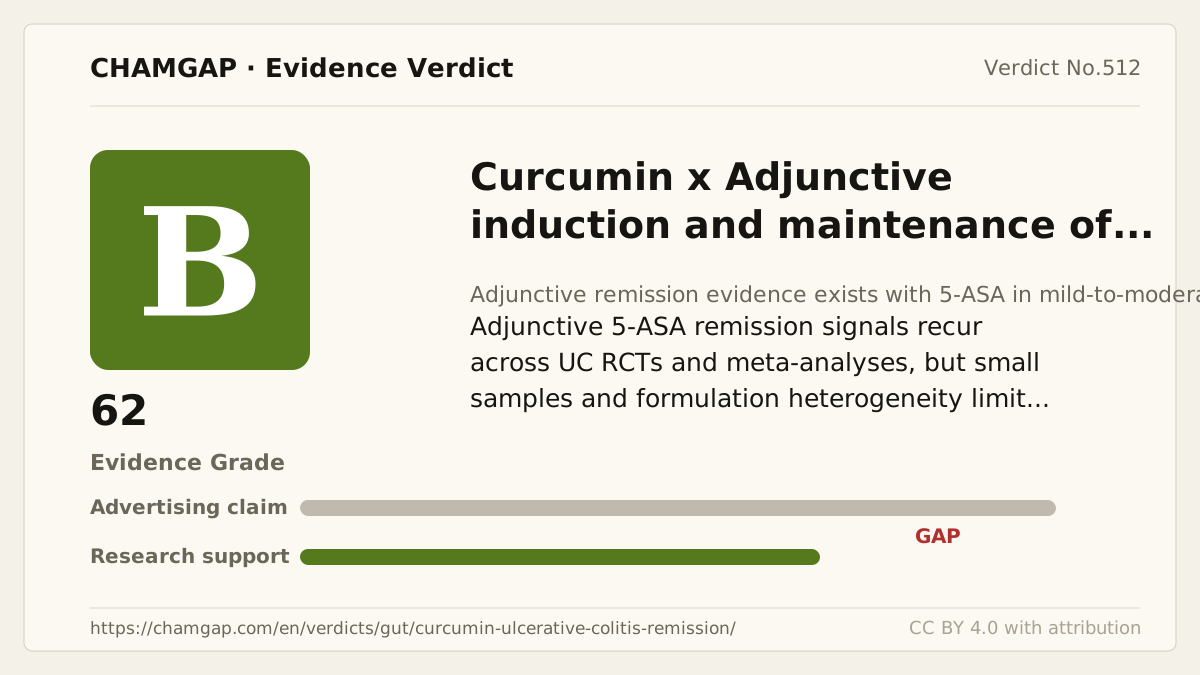
[Chamgap] Curcumin x adjunctive induction and maintenance of ulcerative-colitis remission — Evidence Grade B·62. 4 cited sources checked. Source: https://chamgap.com/en/verdicts/gut/curcumin-ulcerative-colitis-remission/ · CC BY 4.0CC BY 4.0 — free to use with attribution; do not distort grades, numbers, or verdict meaning.
What this document does and does not do
Chamgap is an information source. It reports what research has and has not confirmed; it does not tell readers what to take or buy. That decision belongs to readers and, when needed, medical or legal professionals. This verdict reflects literature available up to the search date and may change as new research appears. Nothing here is medical advice.