
Vibegron,
does it really help with Improved urinary frequency, urgency, and urgency urinary incontinence in overactive bladder?
research showsVibegron is rated B because it improves micturition frequency, urgency, and urgency urinary incontinence in overactive bladder. The international phase 3 EMPOWUR trial with 1,518 participants, a Japanese phase 3 trial, and a 210-participant Korean bridging randomized trial consistently favored vibegron on bladder-diary symptoms. In the Korean trial, the 12-week change in daily micturitions was -2.38 versus -1.21, and urgency and urgency urinary incontinence also declined significantly. The average incremental effect was modest, pivotal studies were company funded, and long-term placebo-controlled durability and cure remain limited, supporting B with 73 points.
ads claimPromotion can turn an average decline in daily micturitions into bladder normalization or a cure. The medicine treats symptoms, does not eliminate incontinence in every patient, and has not established disease-modifying benefit that persists after discontinuation.
Useful facts when choosing a product
- Vibegron is a prescription beta-3 adrenergic agonist acting on the bladder detrusor, and Beova is one of its brand names. Depending on country and product, 50-mg or 75-mg formulations are used, so the specific prescription and label govern dosing.
- Behavioral therapy, fluid and caffeine adjustment, and bladder training can be used alongside medication. Patients with voiding difficulty or high residual urine, especially those also taking an antimuscarinic, require monitoring for urinary retention.
- Headache, nasopharyngitis, urinary tract infection, and hypertension have been reported, although a dedicated ambulatory blood-pressure trial did not find a clinically meaningful mean increase. The prescriber should separately evaluate blood pressure and symptoms in patients with uncontrolled hypertension or cardiovascular disease.
- Overactive-bladder symptoms can overlap with urinary infection, polyuria, prostate disease, or neurological disease, so evaluation of the cause comes first. Differences in product dose and approved conditions should be checked separately from clinical-trial efficacy.
Chamgap Semantic Classification Code
Candidate index · review held
M.vibegron.UNK.urinary-frequency-urgency-and-urgency-urinary-incontinence-in-overactive-bladder.improve.MULTIMedicinal interventions > Vibegron > Unknown > urinary frequency, urgency, and urgency urinary incontinence in overactive bladder > Improvement claim > Multiple: primary unresolved
An automated migration candidate, not an issued permanent code; exact claim scope remains under review. This machine-generated migration candidate helps retrieval but is not a permanent assignment. The original verdict ID and URL remain authoritative.
What the research actually shows
EMPOWUR randomized 1,518 patients with overactive bladder to vibegron 75 mg, placebo, or tolterodine for 12 weeks, and vibegron improved the coprimary outcomes of daily micturitions and urgency urinary incontinence versus placebo. A Japanese phase 3 trial compared 50-mg and 100-mg vibegron with placebo and an active control and confirmed improvements in 12-week micturition frequency, urgency, and urgency urinary incontinence. A 20-center Korean bridging trial randomized 210 participants to 50 mg or placebo and found placebo-adjusted differences of -1.17 daily micturitions, -1.38 urgency episodes, and -0.62 urgency urinary incontinence episodes, while nocturia was not significantly different. A 52-week extension suggested persistence but primarily used tolterodine rather than placebo as the comparator.
Why this is classified as B (73)
EMPOWUR and Japanese and Korean randomized trials repeatedly improved the direct symptom outcomes of frequency, urgency, and urgency urinary incontinence. Placebo-adjusted mean differences were limited, all pivotal trials had industry support, and 52-week evidence mainly came from an active-controlled extension rather than a placebo comparison. Directness and replication support B, but independence, large effect, and long-term certainty required for A are absent, yielding 73 points.
Counterpoint. An additional reduction of around one episode per day can still matter to a patient with frequent disruptive symptoms. Inadequate response, retention, or blood-pressure concerns call for reassessment of the cause and alternative drug or nondrug treatment.
Rejudgment record. New verdict — Applied grade B because EMPOWUR and Japanese and Korean randomized trials replicated improvements in direct symptom outcomes of micturition frequency, urgency, and urgency urinary incontinence, while accounting for modest mean effect size, industry-funding concentration, and limited long-term placebo-controlled evidence
Sub-claim grades by effect
This ingredient is marketed for several effects. A single overall grade blends strong and weak claims together, so each effect is graded separately here. The overall grade reflects the strongest disconfirming or core claim.
| Effect (sub-claim) | Grade | Basis |
|---|---|---|
| Improved frequency, urgency, and urgency urinary incontinence in overactive bladder | B | Direct bladder-diary symptoms repeatedly improved in international, Japanese, and Korean randomized trials. |
| Normalization or cure of overactive bladder | ? | Trials showed average symptom reduction, not cure of the disease or normalization in every patient. |
| Long-term disease-modifying benefit that persists after discontinuation | ? | A 52-week treatment extension exists, but persistence after discontinuation has not been established. |
Cross-check — AI research and Codex final gate
Evidence Table
| Study | Design | Sample | Funding | Endpoint | Result | Weight |
|---|---|---|---|---|---|---|
| Staskin D et al. EMPOWUR. 2020 | International multicenter randomized double-blind placebo- and active-controlled phase 3 trial | 1,518 patients with overactive bladder | Urovant Sciences | Coprimary 12-week outcomes of daily micturitions and urgency urinary incontinence | Vibegron 75 mg significantly improved both coprimary outcomes and urgency versus placebo. | Pivotal large direct symptom evidence |
| Shin JH et al. Korean bridging trial. 2023 | Randomized double-blind placebo-controlled bridging trial at 20 Korean centers | 210 randomized and 197 included in the efficacy analysis | Jeil Pharmaceutical | Twelve-week bladder-diary micturitions, urgency, and urgency urinary incontinence | Placebo-adjusted differences were -1.17 daily micturitions, -1.38 urgency episodes, and -0.62 urgency urinary incontinence episodes; nocturia was not significant. | Direct Korean replication evidence |
| Yoshida M et al. Japanese phase 3 trial. 2018 | Randomized double-blind placebo- and active-controlled phase 3 trial | 1,232 Japanese patients with overactive bladder | Kyorin Pharmaceutical | Daily micturitions, urgency, and urgency urinary incontinence at 12 weeks | Vibegron 50 mg and 100 mg improved micturition frequency and key overactive-bladder symptoms versus placebo. | Large regional replication evidence |
Receipt — 3 References
All 3 cited sources were verified for existence at the original page (as of 2026-07-19).
Final verification and publication gate: Codex · Evidence date: 2026-07-19 · Corrections: none
Cite this verdict
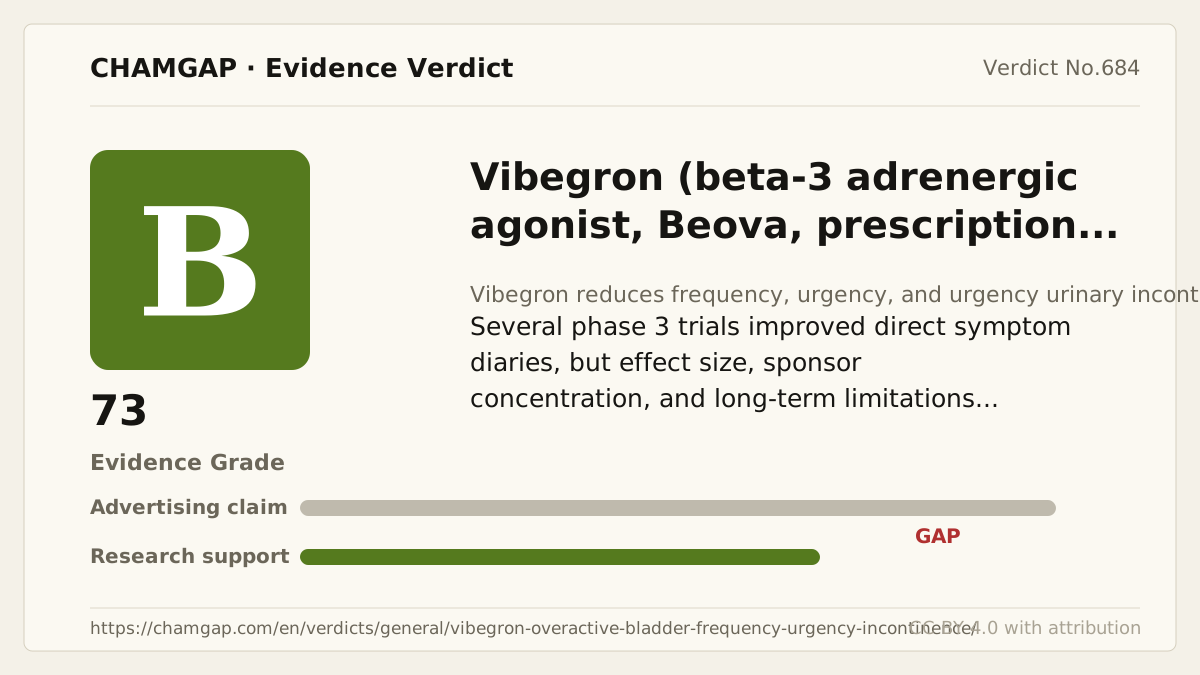
[Chamgap] Vibegron x improved frequency, urgency, and urgency urinary incontinence in overactive bladder — Evidence Grade B·73. 3 cited sources checked. Source: https://chamgap.com/en/verdicts/general/vibegron-overactive-bladder-frequency-urgency-incontinence/ · CC BY 4.0CC BY 4.0 — free to use with attribution; do not distort grades, numbers, or verdict meaning.
What this document does and does not do
Chamgap is an information source. It reports what research has and has not confirmed; it does not tell readers what to take or buy. That decision belongs to readers and, when needed, medical or legal professionals. This verdict reflects literature available up to the search date and may change as new research appears. Nothing here is medical advice.