
Varenicline,
does it really help with Increased long-term smoking cessation for at least six months when combined with behavioral support?
research showsVarenicline is rated A because repeated large randomized trials show higher abstinence for at least six months when used with behavioral support by adults willing to quit. The 2023 Cochrane review found RR 2.32 versus placebo or no medication (95% CI 2.15 to 2.51; 41 trials; 17,395 participants), with high-certainty evidence, and a 67-trial component network meta-analysis found OR 2.33. Biochemical verification was prioritized. The incremental medication effect is attributable, but I-squared of 60%, the behavioral-support context, and a substantial share of industry-funded trials make a top-end score excessive. The result remains A with 88 points.
ads claimMarketing can portray varenicline as a drug that automatically erases thoughts of smoking or the need for willpower. The randomized trials enrolled people willing to quit and included a target quit date, counseling or support, follow-up, and medication use. The drug reduces withdrawal and nicotine reward and raises the probability of success; it does not replace behavior and environment.
Useful facts when choosing a product
- Varenicline is a prescription partial agonist at the alpha4beta2 nicotinic acetylcholine receptor. It reduces withdrawal and the reward from smoking and is commonly started about one week before a target quit date with gradual titration.
- A standard course is often 12 weeks, and some people who quit may consider additional treatment according to relapse risk. Reduced kidney function can require dose adjustment, so the prescription should be followed.
- Success is influenced by motivation, a target date, counseling or behavioral support, medication adherence, and the smoking environment. Taking the tablets does not eliminate cravings or relapse in every person.
- Nausea is the most common adverse effect, and abnormal dreams and insomnia can occur. Although EAGLES did not find a significant increase in major neuropsychiatric events, psychiatric history, mood or behavior change, suicidal thoughts, seizures, and altered alcohol response still warrant clinical attention.
Chamgap Semantic Classification Code
Candidate index · review held
M.varenicline.UNK.long-term-smoking-cessation-for-at-least-when-combined-with-behavioral-support.increase.MULTIMedicinal interventions > Varenicline > Unknown > long-term smoking cessation for at least when combined with behavioral support > Increase claim > Multiple: primary unresolved
An automated migration candidate, not an issued permanent code; exact claim scope remains under review. This machine-generated migration candidate helps retrieval but is not a permanent assignment. The original verdict ID and URL remain authoritative.
What the research actually shows
The 2023 Cochrane review assessed 75 nicotine-receptor partial-agonist studies with 45,049 participants; the pivotal varenicline-versus-placebo analysis contained 41 trials and 17,395 participants. Estimated long-term abstinence was about 99 per 1,000 with placebo and 230 per 1,000 with varenicline. EAGLES stratified 8,144 participants by psychiatric history and followed 12 weeks of treatment with 12 weeks off treatment, confirming superior cessation efficacy without a significant attributable major neuropsychiatric signal. In a relapse-prevention Cochrane review, two extended-varenicline trials involving 1,297 assisted abstainers produced RR 1.23, but high heterogeneity limited certainty to moderate. Standard abstinence beyond six months is therefore A, while permanent maintenance after stopping and the optimal extension duration are more limited axes.
Why this is classified as A (88)
High-certainty Cochrane evidence from 41 trials and 17,395 participants gives RR 2.32 on direct abstinence at six months or longer, and a 67-trial network meta-analysis gives a consistent OR of 2.33. Biochemical verification and replication confirm A, while I-squared of 60%, behavioral-support conditions, and industry-funding concentration reduce the result to 88 points.
Counterpoint. If nausea or sleep effects undermine adherence, dose timing, dose adjustment, and alternative cessation treatment can be discussed. A lapse is not the end of treatment; a new quit attempt, counseling, nicotine replacement, or another strategy can be used.
Rejudgment record. New verdict — Applied the high-certainty Cochrane effect across 41 placebo-comparison trials and 17,395 participants plus large EAGLES replication on direct abstinence at six months or longer, while preserving attribution to a program that includes behavioral support and medication adherence
Sub-claim grades by effect
This ingredient is marketed for several effects. A single overall grade blends strong and weak claims together, so each effect is graded separately here. The overall grade reflects the strongest disconfirming or core claim.
| Effect (sub-claim) | Grade | Basis |
|---|---|---|
| Long-term smoking cessation for at least six months with behavioral support | A | A high-certainty direct abstinence endpoint is repeated across 41 placebo-comparison trials with 17,395 participants. |
| The same success rate guaranteed by medication without behavioral support or adherence | ? | Pivotal trials included support and medication use, and no human efficacy literature establishes this guarantee. |
| Relapse prevention with extended treatment after successful cessation | B | Two trials with 1,297 participants found RR 1.23 with moderate certainty, but heterogeneity was substantial. |
Cross-check — AI research and Codex final gate
Evidence Table
| Study | Design | Sample | Funding | Endpoint | Result | Weight |
|---|---|---|---|---|---|---|
| Livingstone-Banks J et al. Cochrane review, 2023 | Systematic review and meta-analysis of randomized trials | 75 studies and 45,049 participants overall; 41 varenicline-versus-placebo trials with 17,395 participants | Academic Cochrane Tobacco Addiction Group synthesis with author interests disclosed | Smoking abstinence at the longest follow-up of at least six months | The RR versus placebo or no medication was 2.32 (95% CI 2.15 to 2.51), with high certainty. | Pivotal independent replicated direct clinical endpoint |
| Anthenelli RM et al. EAGLES, 2016 | Multinational randomized double-blind triple-dummy placebo- and active-controlled trial | 8,144 smokers with or without psychiatric disorders | Pfizer and GlaxoSmithKline | Biochemically confirmed continuous abstinence and moderate-to-severe neuropsychiatric adverse events | Varenicline produced higher abstinence than placebo, patch, or bupropion without a significant attributable increase in major neuropsychiatric events. | Large efficacy replication and safety context |
| Livingstone-Banks J et al. relapse-prevention Cochrane review, 2019 | Systematic review of randomized relapse-prevention trials | 81 studies and 69,094 participants overall; two extended-varenicline trials with 1,297 participants | Academic Cochrane synthesis | Relapse prevention for at least six months among successful quitters | Extended varenicline gave RR 1.23 (95% CI 1.08 to 1.41), with moderate certainty limited by I-squared of 82%. | Scope limitation for maintenance and extended treatment |
Receipt — 4 References
All 4 cited sources were verified for existence at the original page (as of 2026-07-19).
Final verification and publication gate: Codex · Evidence date: 2026-07-19 · Corrections: none
Cite this verdict
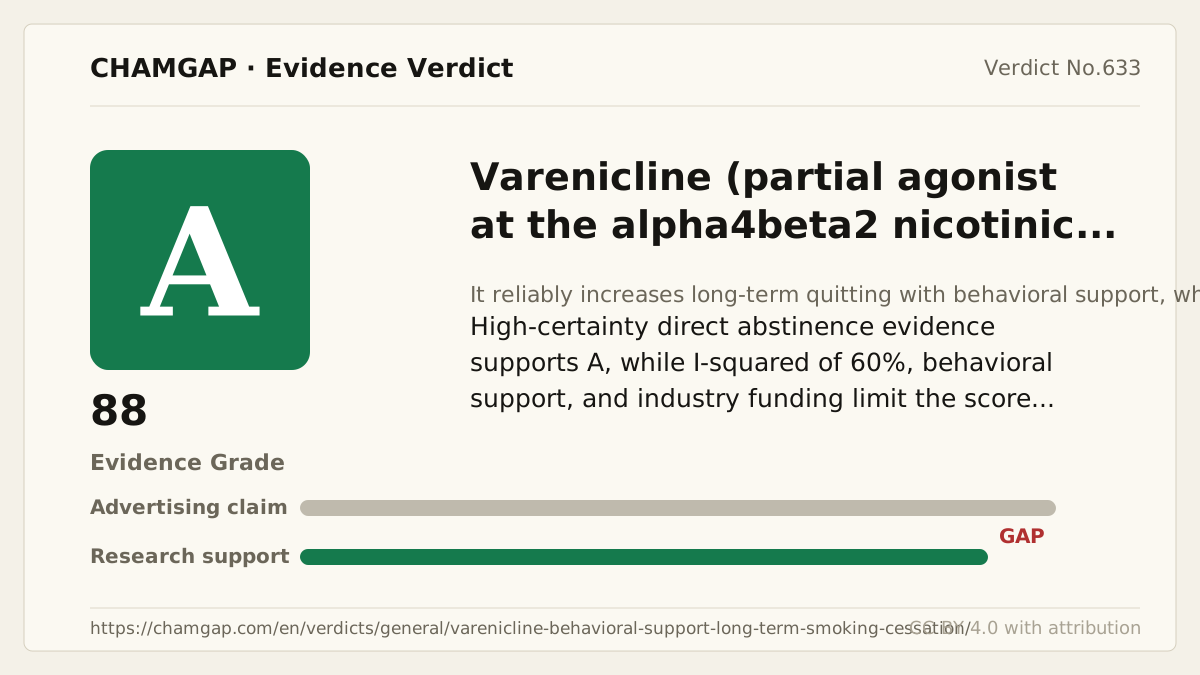
[Chamgap] Varenicline x smoking cessation for at least six months with behavioral support — Evidence Grade A·88. 4 cited sources checked. Source: https://chamgap.com/en/verdicts/general/varenicline-behavioral-support-long-term-smoking-cessation/ · CC BY 4.0CC BY 4.0 — free to use with attribution; do not distort grades, numbers, or verdict meaning.
What this document does and does not do
Chamgap is an information source. It reports what research has and has not confirmed; it does not tell readers what to take or buy. That decision belongs to readers and, when needed, medical or legal professionals. This verdict reflects literature available up to the search date and may change as new research appears. Nothing here is medical advice.