
Graviola,
does it really help with Cancer prevention, treatment, and adjunctive anticancer use?
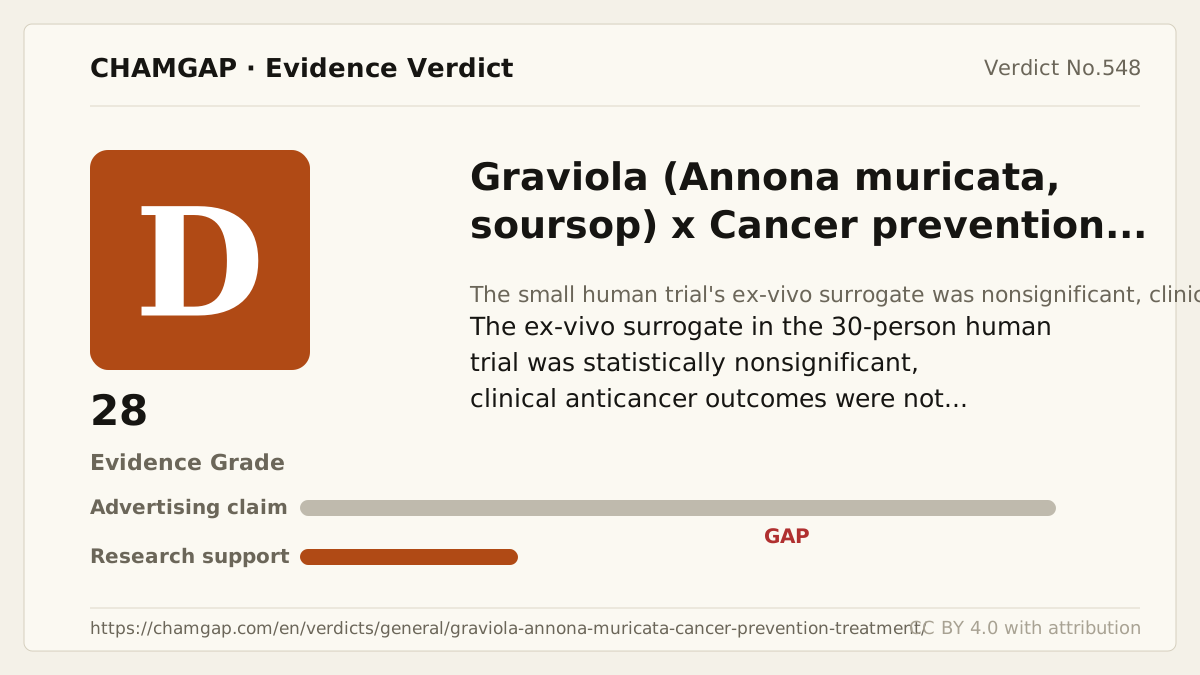
research showsA 30-person randomized trial after colorectal-cancer resection exists, with 28 completing, but it measured only ex-vivo cytotoxicity of patient serum against cultured cancer cells and was nonsignificant for both DLD-1 (p=0.08) and COLO-205 (p=0.47). It did not measure tumor response, recurrence, progression-free survival, or overall survival, and the remaining evidence is dominated by cell and animal studies, supporting grade D. Annonacin neurotoxicity and parkinsonism remain a separate safety concern.
ads claimMarketing translates cancer-cell death in culture, animal tumor inhibition, and acetogenin mechanisms into a natural agent that selectively kills cancer. In-vitro cytotoxicity establishes neither cancer prevention or treatment in humans nor safety for normal tissues.
Useful facts when choosing a product
- Soursop or graviola leaves are sold online in Korea as raw leaves, tea, or powder, but these products are not anticancer drugs.
- The only relevant patient trial used a specific ethanol-soluble leaf fraction at 300 mg/day for eight weeks, which is not interchangeable with leaf tea, fruit, seeds, or generic capsules.
- Acetogenin and annonacin content varies across leaves, pulp, seeds, and extraction methods, so commercial doses cannot be translated to the research product.
- Annonacin mitochondrial complex I neurotoxicity and an association with atypical parkinsonism are concerns. Replacing or combining cancer treatment without oncology review also risks delayed care and interactions.
Chamgap Semantic Classification Code
Candidate index · review held
UNK.graviola.UNK.cancer-prevention-treatment-and-adjunctive-anticancer-use.prevent.placeboUnknown > Graviola > Unknown > Cancer prevention, treatment, and adjunctive anticancer use > Occurrence-prevention claim > Placebo
An automated migration candidate, not an issued permanent code; exact claim scope remains under review. This machine-generated migration candidate helps retrieval but is not a permanent assignment. The original verdict ID and URL remain authoritative.
What the research actually shows
Indrawati 2017 randomized 30 outpatients after primary colorectal-tumor resection to leaf extract at 300 mg/day or maltose placebo, with 28 completing eight weeks. Ex-vivo cytotoxicity differences in patient serum against cultured colorectal cancer cells were nonsignificant for DLD-1 (p=0.08) and COLO-205 (p=0.47), while tumor size, recurrence, treatment response, progression-free survival, and overall survival were not assessed. Most evidence summarized in a 2022 review was cellular, animal, or mechanistic. Annonacin is a mitochondrial complex I-inhibiting neurotoxin, and observational research has linked Annonaceae consumption with atypical parkinsonism, so long-term high-dose use cannot be assumed safe.
Why this is classified as D (28)
A small human randomized trial exists, but its ex-vivo surrogate was nonsignificant and it did not measure target clinical anticancer outcomes. With no positive human efficacy signal and preclinical evidence predominating, grade D with 28 points applies; neurotoxicity is recorded separately as caution.
Counterpoint. The nonsignificant ex-vivo direction from one specific leaf extract can generate a hypothesis for later clinical trials. It does not justify cancer prevention, replacement treatment, or adjunctive-use claims.
Rejudgment record. Adjusted by final editorial verdict — A nonsignificant ex-vivo surrogate in a 30-person human trial, unmeasured clinical anticancer outcomes, and predominance of preclinical evidence
Sub-claim grades by effect
This ingredient is marketed for several effects. A single overall grade blends strong and weak claims together, so each effect is graded separately here. The overall grade reflects the strongest disconfirming or core claim.
| Effect (sub-claim) | Grade | Basis |
|---|---|---|
| Cancer prevention | D | No human graviola trial evaluating cancer incidence was identified. |
| Cancer treatment | D | No trial evaluated clinical anticancer outcomes such as tumor response, recurrence, progression-free survival, or overall survival; the only human RCT measured an ex-vivo surrogate that was nonsignificant. |
| Adjunctive use with anticancer therapy | D | No trial evaluated whether it improves standard-treatment response, toxicity, or survival; the only human RCT measured an ex-vivo surrogate that was nonsignificant. |
Cross-check — AI research and Codex final gate
Evidence Table
| Study | Design | Sample | Funding | Endpoint | Result | Weight |
|---|---|---|---|---|---|---|
| Indrawati L et al. 2017 | Randomized double-blind placebo-controlled pre-post trial | 8 | Indonesian academic research; no commercial funding reported | Cytotoxicity of patient serum against cultured colorectal cancer cells and nutritional status | Ex-vivo cytotoxicity after 300 mg/day leaf extract was directional only and statistically nonsignificant (DLD-1 p=0.08; COLO-205 p=0.47); tumor response, recurrence, and survival were not measured. | Not clinical efficacy |
| Ilango S et al. 2022 | Narrative comprehensive review | Indian public research grants | Graviola constituents, preclinical anticancer mechanisms, and clinical research status | Most anticancer evidence was preclinical, with a clinical-trial gap and need for further research. | Confirms literature gap | |
| Cleret de Langavant L et al. 2022 | Observational study in patients with parkinsonism | 180 | Academic and public research | Cumulative Annonaceae intake and disease severity or cognitive deficits | Fruit, juice, or herbal-tea intake was associated with more severe disease and cognitive deficits. | Safety |
Receipt — 4 References
All 4 cited sources were verified for existence at the original page (as of 2026-07-18).
Final verification and publication gate: Codex · Evidence date: 2026-07-18 · Corrections: none
Cite this verdict
[Chamgap] Graviola (soursop) x cancer prevention, treatment, and adjunctive anticancer use — Evidence Grade D·28. 4 cited sources checked. Source: https://chamgap.com/en/verdicts/general/graviola-annona-muricata-cancer-prevention-treatment/ · CC BY 4.0CC BY 4.0 — free to use with attribution; do not distort grades, numbers, or verdict meaning.
What this document does and does not do
Chamgap is an information source. It reports what research has and has not confirmed; it does not tell readers what to take or buy. That decision belongs to readers and, when needed, medical or legal professionals. This verdict reflects literature available up to the search date and may change as new research appears. Nothing here is medical advice.