
Betahistine,
does it really help with Reduced frequency of vertigo attacks in Ménière's disease?
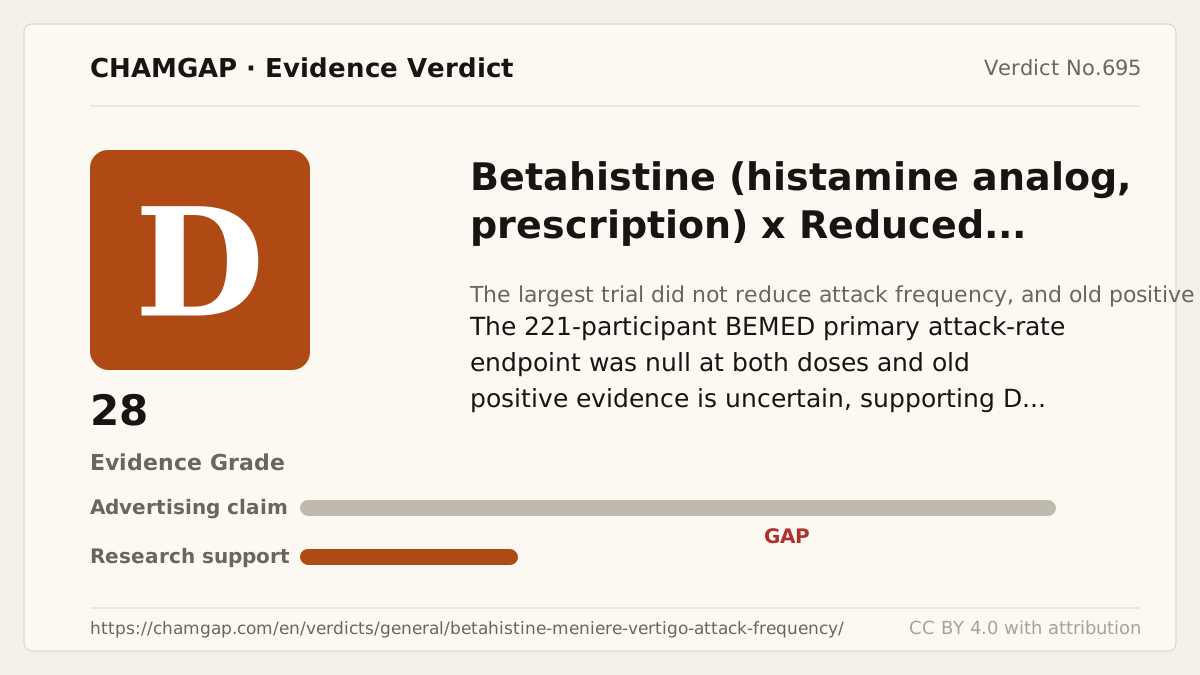
research showsBetahistine is rated D because it has not been shown to reduce the frequency of vertigo attacks in Ménière's disease. The largest long-term placebo-controlled trial, BEMED, followed 221 patients with definite disease for nine months, but attack-rate ratios versus placebo were 1.036 with low dose and 1.012 with high dose, showing no primary-endpoint difference. Older small crossover trials reported positive signals, but diagnostic, randomization, and reporting bias were substantial, and a 2023 Cochrane review rated the overall evidence low or very low certainty. A large direct null trial supports D with 28 points; the evidence does not constitute repeated high-quality refutation sufficient for F.
ads claimMarketing can present improved inner-ear blood flow or common prescribing practice as established attack prevention. Mechanism and authorization or custom do not substitute for a successful primary clinical endpoint, and the largest trial did not reduce attack frequency versus placebo.
Useful facts when choosing a product
- Betahistine is a histamine analog prescribed for Ménière-related vertigo in many countries, but authorized doses vary by country and product, so the specific label and prescription should be followed.
- The largest BEMED trial found no superiority over placebo for nine-month vertigo-attack rates with either the usual 48-mg daily dose or a high 144-mg daily dose.
- Nausea, dyspepsia, abdominal discomfort, and headache are generally mild, while a history of peptic ulcer and asthma warrants caution.
- Betahistine should be avoided in pheochromocytoma because of potential histamine-like effects, and unsupervised dose escalation may increase harm without evidence of added benefit.
Chamgap Semantic Classification Code
Candidate index · review held
M.betahistine.UNK.frequency-of-vertigo-attacks-in-menieres-disease.reduce.placeboMedicinal interventions > Betahistine > Unknown > frequency of vertigo attacks in Ménière's disease > Reduction claim > Placebo
An automated migration candidate, not an issued permanent code; exact claim scope remains under review. This machine-generated migration candidate helps retrieval but is not a permanent assignment. The original verdict ID and URL remain authoritative.
What the research actually shows
BEMED by Strupp and colleagues assigned 221 patients with definite Ménière's disease at 14 centers equally to placebo, betahistine 48 mg per day, or 144 mg per day. During nine months, the primary rate of vertigo attacks per 30 days was not lower than placebo: the rate ratio was 1.036 (95% CI 0.942 to 1.140) for low dose and 1.012 (0.919 to 1.114) for high dose. Attacks declined over time in every group, illustrating natural history and regression effects. Two small double-blind crossover studies by Oosterveld in 1976 reported some symptomatic improvement but had limited sample and method reporting. The 2023 Cochrane review by Webster and colleagues included 10 medicine trials with 848 participants and judged benefits and harms of betahistine very uncertain because of heterogeneity and bias.
Why this is classified as D (28)
The largest direct long-term randomized trial, BEMED with 221 participants, found no placebo advantage for the primary vertigo-attack-rate endpoint at either dose. Old small positive crossover trials have weak methods, and the 2023 Cochrane review judged the total evidence very uncertain. A large null trial conflicting with old weak positives supports D with 28 points; repeated independent large refutation or a clear recommendation against use sufficient for F is absent. Gastrointestinal adverse effects remain a separate safety issue.
Counterpoint. Improvement in an individual may reflect natural history, diet and lifestyle changes, concurrent treatment, or regression to the mean. Continued prescribing should be assessed with an attack diary and agreed goals and stopping rules with a clinician.
Rejudgment record. New verdict — Applied D under rule ② because the largest 221-participant BEMED randomized trial found no placebo advantage on the nine-month vertigo-attack-rate primary endpoint at either dose, while old small positive trials had weak methods
Sub-claim grades by effect
This ingredient is marketed for several effects. A single overall grade blends strong and weak claims together, so each effect is graded separately here. The overall grade reflects the strongest disconfirming or core claim.
| Effect (sub-claim) | Grade | Basis |
|---|---|---|
| Reduced frequency of vertigo attacks in Ménière's disease | D | The largest 221-participant long-term trial found a null direct attack-rate primary endpoint at both doses. |
| Positive symptomatic signal in old small trials | ? | Conflicting signals exist, but the human literature does not establish an independent efficacy claim by modern standards, so no definitive grade is assigned. |
| Reduced tinnitus and preservation of hearing | ? | These are outcomes separate from vertigo attacks, and no consistent human efficacy literature establishes the claim. |
Cross-check — AI research and Codex final gate
Evidence Table
| Study | Design | Sample | Funding | Endpoint | Result | Weight |
|---|---|---|---|---|---|---|
| Strupp M et al. 2016 BEMED | Multicenter randomized double-blind placebo-controlled long-term dose-finding trial | 221 patients with definite Ménière's disease at 14 centers | Public funding from the German Federal Ministry of Education and Research | Diary-recorded vertigo-attack rate per 30 days over nine months | Attack-rate ratios versus placebo were 1.036 for low dose and 1.012 for high dose, with no superiority at either dose. | Pivotal independent randomized trial with a null direct primary endpoint |
| Webster KE et al. 2023 Cochrane review | Systematic review of randomized trials of systemic medicines for Ménière's disease | 10 medicine trials with 848 participants | Public-interest support from the United Kingdom NIHR and Cochrane | Vertigo improvement and change, quality of life, hearing, tinnitus, and adverse effects | Benefits and harms of betahistine were judged very uncertain because of heterogeneity, bias, and imprecision. | Certainty assessment of the conflicting evidence base |
| Oosterveld WJ. 1976 | Two small double-blind placebo-controlled crossover trials | Two small trials; total sample inadequately reported in the abstract | Inadequately reported; Serc product-evaluation context | Clinical features and vertigo in Ménière's disease | Some positive symptomatic results were reported, but modern diagnostic, randomization, and reporting standards were not met. | Conflicting old positive evidence of low certainty |
Receipt — 3 References
All 3 cited sources were verified for existence at the original page (as of 2026-07-19).
Final verification and publication gate: Codex · Evidence date: 2026-07-19 · Corrections: none
Cite this verdict
[Chamgap] Betahistine x reduced frequency of vertigo attacks in Ménière's disease — Evidence Grade D·28. 3 cited sources checked. Source: https://chamgap.com/en/verdicts/general/betahistine-meniere-vertigo-attack-frequency/ · CC BY 4.0CC BY 4.0 — free to use with attribution; do not distort grades, numbers, or verdict meaning.
What this document does and does not do
Chamgap is an information source. It reports what research has and has not confirmed; it does not tell readers what to take or buy. That decision belongs to readers and, when needed, medical or legal professionals. This verdict reflects literature available up to the search date and may change as new research appears. Nothing here is medical advice.