
Rebamipide eye drops,
does it really help with Improvement of dry-eye symptoms and corneoconjunctival epithelial damage by promoting mucin secretion?
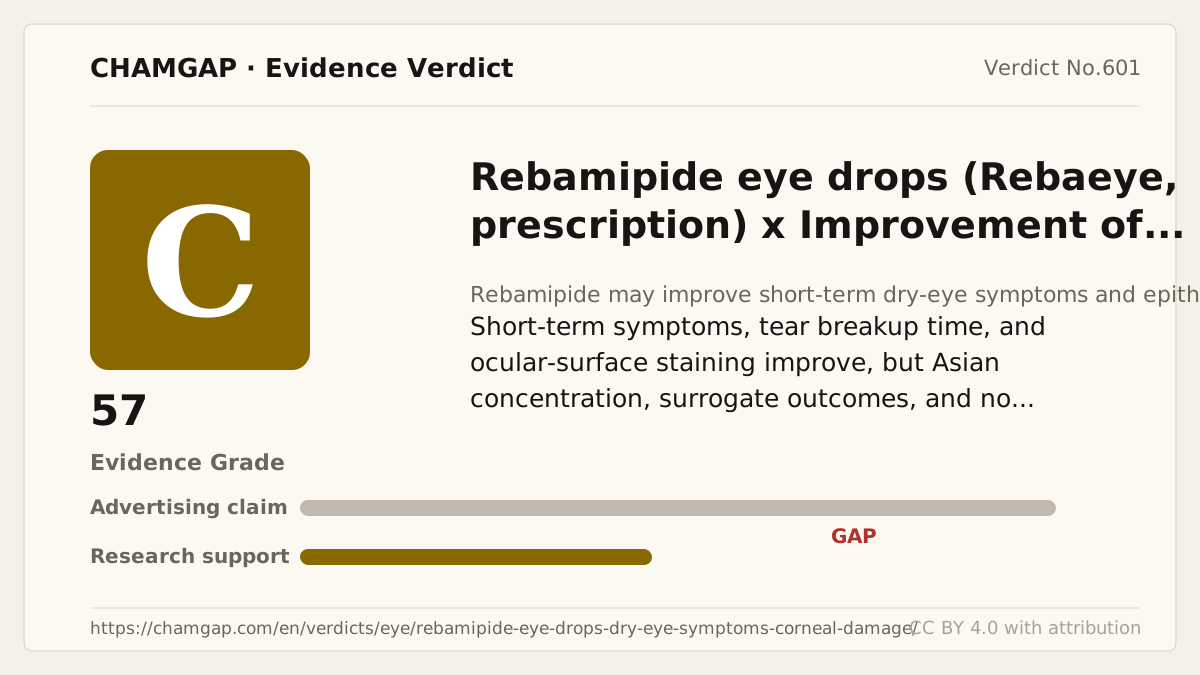
research showsRebamipide eye drops are rated C because randomized trials signal short-term improvement in dry-eye symptoms, tear breakup time, and ocular-surface staining. A 2025 meta-analysis of 12 randomized trials and 1,368 eyes favored rebamipide over artificial tears for tear breakup time and subjective symptoms, but studies were concentrated in Asia, were short, and measured symptoms, staining, and test values rather than clinical course. In a 12-week placebo-controlled trial, tear breakup time and corneal staining improved but symptom scores did not differ between groups. As with the grade-C precedents for diquafosol in verdict 591 and cyclosporine in verdict 592, rule ① caps short-term subjective and surrogate outcomes at C; long-term quality of life, vision preservation, and disease-course evidence is absent.
ads claimMarketing extends a mucin-secretion mechanism into claims of fundamental corneal restoration and durable resolution of dry eye. The demonstrated range is mainly several weeks of symptom, staining, and tear-film test changes, not preservation of long-term disease course or quality of life.
Useful facts when choosing a product
- Rebaeye is a Korean prescription 2% rebamipide eye drop used for corneoconjunctival epithelial damage in adults with dry eye. Dosing frequency and duration should follow the prescription and product label.
- Rebamipide was developed to promote mucin production and secretion from conjunctival goblet cells and the ocular surface. Confirmation of that mechanism is not equivalent to long-term improvement in vision or quality of life.
- Suspensions and clear solutions, preserved and preservative-free preparations, and multidose and single-use containers differ in formulation. Results from one formulation should not automatically be transferred to every rebamipide eye-drop product.
- A bitter taste, transient irritation, redness, or blurred vision can occur, and the container tip should not touch the eye or skin. Persistent pain, reduced vision, or a severe allergic reaction warrants medical evaluation.
Chamgap Semantic Classification Code
Candidate index · review held
M.rebamipide-eye-drops.ophthalmic.dry-eye-symptoms-and-corneoconjunctival-epithelial-damage-by-promoting-mucin-secretion.improve.MULTIMedicinal interventions > Rebamipide eye drops > Ophthalmic > dry-eye symptoms and corneoconjunctival epithelial damage by promoting mucin secretion > Improvement claim > Multiple: primary unresolved
An automated migration candidate, not an issued permanent code; exact claim scope remains under review. This machine-generated migration candidate helps retrieval but is not a permanent assignment. The original verdict ID and URL remain authoritative.
What the research actually shows
Kinoshita 2012 randomized 308 patients under double masking and reported that four weeks of 1% and 2% rebamipide improved corneal fluorescein staining and most ocular symptoms versus placebo; Otsuka funded the trial and employees were coauthors. Kinoshita 2013 randomized 188 patients against sodium hyaluronate and found superiority for conjunctival staining and selected symptoms, while Schirmer testing and tear breakup time were comparable. Eom 2023 randomized 220 patients for 12 weeks and found better tear breakup time and a small corneal-staining difference, but no significant between-group symptom-score difference. Chiu 2025 synthesized 12 trials and 1,368 eyes and favored rebamipide for tear breakup time and subjective symptoms, but no long-term vision, quality-of-life, or progression outcome was assessed.
Why this is classified as C (57)
The short-term improvements in symptoms, tear breakup time, and staining from randomized trials and meta-analysis are accepted. The evidence is nevertheless concentrated in Asia, lasts weeks to 12 weeks, relies on symptoms and ocular-surface surrogates, includes a newer placebo trial with a null OSDI comparison, and lacks long-term quality-of-life, vision, or disease-course outcomes. Rule ① and the diquafosol and cyclosporine precedents give C with 57 points. Local irritation and formulation differences remain separate safety issues.
Counterpoint. When artificial tears are insufficient for dry eye with epithelial damage, an ophthalmologist can prescribe rebamipide and assess short-term response. Persistent symptoms call for evaluation of meibomian-gland dysfunction, Sjogren disease, medicines, contact lenses, and environmental causes.
Rejudgment record. New verdict — Accepted short-term improvements in symptoms, tear breakup time, and ocular-surface staining from a 12-trial meta-analysis and placebo- and active-controlled trials, but applied rule ① and verdicts 591 and 592 because of Asian concentration, short follow-up, a null OSDI comparison in a newer placebo trial, and absent long-term quality-of-life, vision, and disease-course outcomes
Sub-claim grades by effect
This ingredient is marketed for several effects. A single overall grade blends strong and weak claims together, so each effect is graded separately here. The overall grade reflects the strongest disconfirming or core claim.
| Effect (sub-claim) | Grade | Basis |
|---|---|---|
| Improvement of dry-eye symptoms and corneoconjunctival epithelial-damage surrogates | C | Short-term trials and meta-analysis are positive, but one OSDI comparison was null and regional, duration, and surrogate limitations remain. |
| Long-term improvement in quality of life, vision preservation, or disease course | ? | No reliable long-term human efficacy literature directly assessing these outcomes was found. |
Cross-check — AI research and Codex final gate
Evidence Table
| Study | Design | Sample | Funding | Endpoint | Result | Weight |
|---|---|---|---|---|---|---|
| Chiu CW et al. 2025 | Systematic review and meta-analysis of randomized trials | 12 randomized trials and 1,368 eyes | Detailed funding was not stated in the PubMed abstract | Tear breakup time, Schirmer testing, corneal staining, dry-eye symptoms, and adverse events | Rebamipide favored tear breakup time with SMD 1.42 and symptoms with SMD -1.61 versus artificial tears, but trials were heterogeneous and centered on short-term surrogates. | Key synthesis with surrogate-outcome limitations |
| Kinoshita S et al. 2012 | Multicenter randomized double-masked placebo-controlled phase 2 trial | 308 patients with dry eye treated for four weeks | Funded by Otsuka Pharmaceutical with company employees as coauthors | Corneal and conjunctival staining, tear breakup time, Schirmer testing, and five ocular symptoms | The 1% and 2% groups improved corneal staining and most symptoms versus placebo, but treatment lasted four weeks. | Direct positive placebo-controlled evidence with industry sponsorship |
| Eom Y et al. 2023 | Multicenter randomized placebo-controlled trial | 220 patients with dry eye treated for 12 weeks | Research funding from Samil Pharmaceutical | Tear breakup time, corneoconjunctival staining, Schirmer testing, and OSDI | Tear breakup time and corneal staining in the 2% group improved versus placebo, but symptom scores did not significantly differ between groups at any visit. | Positive surrogate outcomes with a null subjective endpoint |
Receipt — 4 References
All 4 cited sources were verified for existence at the original page (as of 2026-07-19).
Final verification and publication gate: Codex · Evidence date: 2026-07-19 · Corrections: none
Cite this verdict
[Chamgap] Rebamipide eye drops x improvement of dry-eye symptoms and corneoconjunctival epithelial damage — Evidence Grade C·57. 4 cited sources checked. Source: https://chamgap.com/en/verdicts/eye/rebamipide-eye-drops-dry-eye-symptoms-corneal-damage/ · CC BY 4.0CC BY 4.0 — free to use with attribution; do not distort grades, numbers, or verdict meaning.
What this document does and does not do
Chamgap is an information source. It reports what research has and has not confirmed; it does not tell readers what to take or buy. That decision belongs to readers and, when needed, medical or legal professionals. This verdict reflects literature available up to the search date and may change as new research appears. Nothing here is medical advice.