
Pirenoxine eye drops,
does it really help with Slowing progression of early senile cataract?
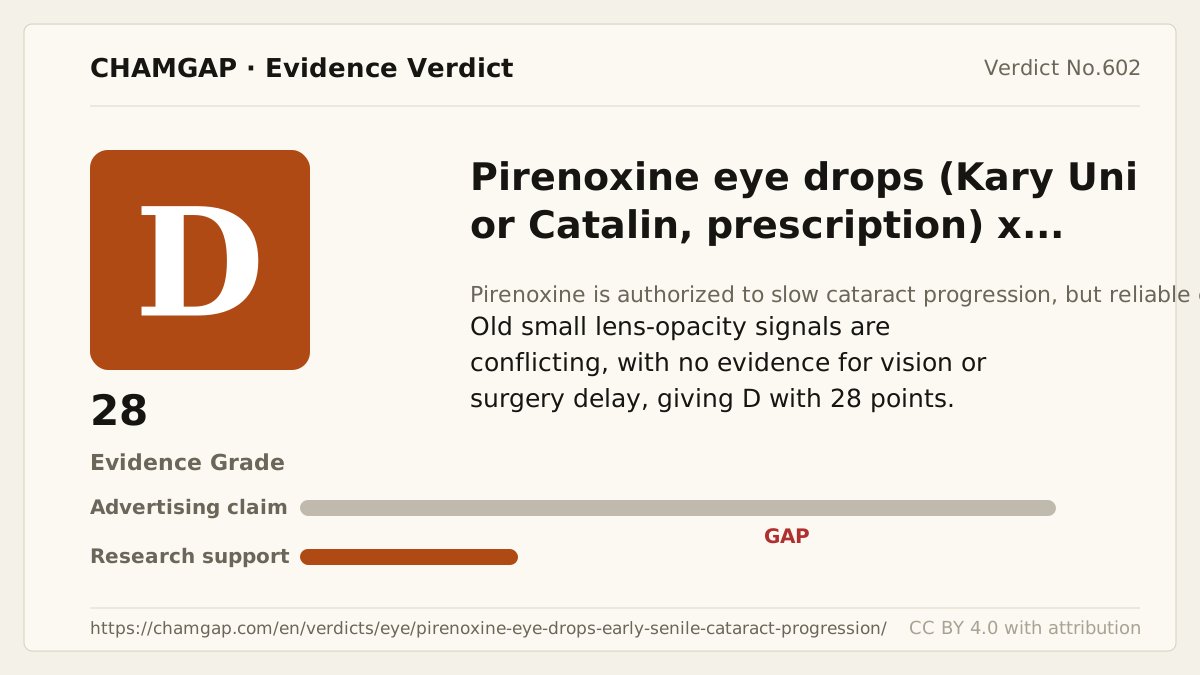
research showsPirenoxine eye drops are rated D despite authorization for slowing early senile cataract because reliable clinical evidence is inadequate. A 72-patient 24-month controlled trial and small comparative studies reported lens-opacity signals, but they are old and incompletely reported, while a 1983 clinical trial across cataract types found no effect. A 2022 review concluded that efficacy remains controversial after six decades and that most evidence comes from in vitro and animal models. No reliable human trial directly demonstrating preserved vision or delayed cataract surgery was found, and regulatory authorization is not an efficacy grade.
ads claimMarketing presents antioxidant or quinone-competition mechanisms and authorization language as proof that the drops reliably delay cataract and avoid surgery. The data concern small lens-opacity changes and do not establish vision or surgical timing.
Useful facts when choosing a product
- Kary Uni and Catalin are prescription pirenoxine eye drops used for slowing early senile cataract progression. The authorized wording does not guarantee an effect size or delayed surgery.
- Pirenoxine is hypothesized to interfere with quinone and metal-ion processes involved in lens-protein opacity. A durable clinical effect in the human lens has not been established.
- Formulations and preparation instructions differ, including products that must be shaken or reconstituted. The relevant label and prescription instructions should be followed.
- Transient irritation, redness, itching, or allergic blepharitis can occur. Worsening vision should prompt ophthalmic assessment for surgery and other eye disease rather than indefinite reliance on drops.
Chamgap Semantic Classification Code
Candidate index · review held
M.pirenoxine-eye-drops.ophthalmic.slowing-progression-of-early-senile-cataract.assess.placeboMedicinal interventions > Pirenoxine eye drops > Ophthalmic > Slowing progression of early senile cataract > Association or change assessment > Placebo
An automated migration candidate, not an issued permanent code; exact claim scope remains under review. This machine-generated migration candidate helps retrieval but is not a permanent assignment. The original verdict ID and URL remain authoritative.
What the research actually shows
Kociecki 2004 compared 35 pirenoxine-treated and 37 placebo-treated patients with early cortical cataract and measured EAS-1000 lens opacity for 24 months, reporting less progression especially in those aged 59 years or younger. Polunin 2010 reported early Pentacam optical-density differences in selected lens layers, but the PubMed abstract does not provide adequate sample-size, randomization, or masking detail. Angra 1983 is cited by later reviews as failing to confirm efficacy in a clinical evaluation that included mixed opacity patterns. Upaphong 2022 found that most positive evidence was in vitro or animal research and that human efficacy remains controversial.
Why this is classified as D (28)
Positive lens-opacity signals from old small human controlled studies are acknowledged, but findings conflict and no modern large independent randomized trial exists. Reliable evidence directly assessing vision, function, or delayed cataract surgery was not found. Separating regulatory status from efficacy gives D with 28 points. Verdict 551 concerns N-acetylcarnosine and cataract reversal, a different ingredient and claim axis.
Counterpoint. A person prescribed pirenoxine for early cataract can discuss the uncertainty with an ophthalmologist rather than stopping on their own and can monitor vision and opacity over time. Surgery is the established restorative treatment when cataract impairs daily function.
Rejudgment record. New verdict — Accepted a positive 72-patient 24-month lens-opacity controlled study and small comparative signals, but applied old small incompletely reported and conflicting evidence, no large independent randomized trial, no direct vision or cataract-surgery-delay endpoint, and separation of regulatory authorization from efficacy
Sub-claim grades by effect
This ingredient is marketed for several effects. A single overall grade blends strong and weak claims together, so each effect is graded separately here. The overall grade reflects the strongest disconfirming or core claim.
| Effect (sub-claim) | Grade | Basis |
|---|---|---|
| Slowing progression of early senile cataract | D | Old small lens-opacity signals conflict, and no modern large independent randomized trial exists. |
| Preservation of vision and delay of cataract surgery | ? | No reliable human efficacy literature directly demonstrating these clinical outcomes was found. |
Cross-check — AI research and Codex final gate
Evidence Table
| Study | Design | Sample | Funding | Endpoint | Result | Weight |
|---|---|---|---|---|---|---|
| Kociecki J et al. 2004 | Placebo-controlled clinical trial | 72 patients with early cortical cataract; 35 pirenoxine and 37 placebo | Inadequately reported | EAS-1000 lens opacity and 24-month progression | Less opacity progression was reported especially at age 59 years or younger, but the study was small and did not assess clinical vision or surgery outcomes. | Old small positive surrogate evidence |
| Polunin GS et al. 2010 | Comparative study in early senile cataract | Sample size not stated in the PubMed abstract | Inadequately reported | Pentacam optical density by lens layer | Optical density was lower in selected cortical layers early in treatment, while other lens layers were unchanged. | Incompletely reported surrogate signal |
| Upaphong P et al. 2022 | Narrative review of mechanistic, preclinical, and clinical literature | Six decades of literature with few clinical trials | Academic grant support with no conflict declared | Lens-opacity mechanisms and human clinical efficacy | Most positive data came from in vitro and animal models, while human clinical efficacy was conflicting and controversial. | Evidence-map and clinical-gap assessment |
Receipt — 4 References
All 4 cited sources were verified for existence at the original page (as of 2026-07-19).
Final verification and publication gate: Codex · Evidence date: 2026-07-19 · Corrections: none
Cite this verdict
[Chamgap] Pirenoxine eye drops x slowing progression of early senile cataract — Evidence Grade D·28. 4 cited sources checked. Source: https://chamgap.com/en/verdicts/eye/pirenoxine-eye-drops-early-senile-cataract-progression/ · CC BY 4.0CC BY 4.0 — free to use with attribution; do not distort grades, numbers, or verdict meaning.
What this document does and does not do
Chamgap is an information source. It reports what research has and has not confirmed; it does not tell readers what to take or buy. That decision belongs to readers and, when needed, medical or legal professionals. This verdict reflects literature available up to the search date and may change as new research appears. Nothing here is medical advice.