
N-acetylcarnosine eye drops,
does it really help with Reversal or slowed progression of age-related cataract and restoration of vision?
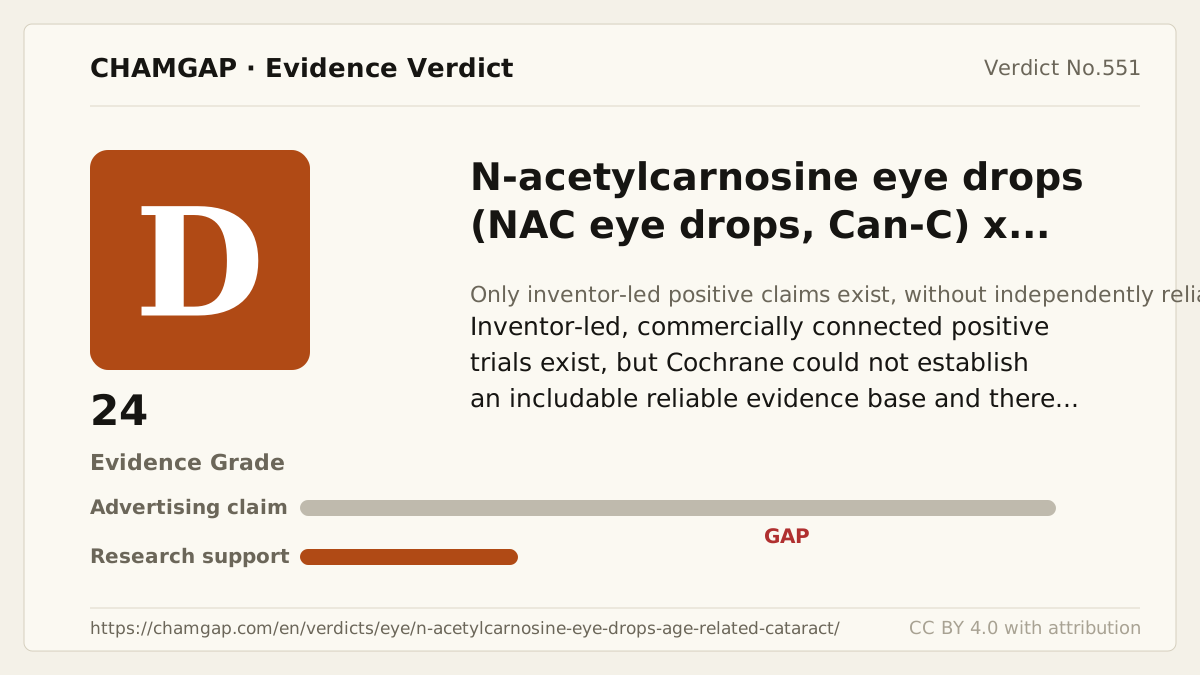
research showsHuman cataract papers on NAC eye drops do exist, but positive evidence is concentrated in small studies by inventor Mark Babizhayev and researchers affiliated with his commercial organization. A 2017 Cochrane review could not obtain enough information to judge the design and conduct of two candidate studies involving 114 people, included neither, and concluded that there was no convincing evidence of cataract reversal or prevention of progression. With no independent replication and no human trial that passed this reliability assessment, the evidence is effectively D.
ads claimMarketing expands inventor-led findings into claims such as dissolving cataracts without surgery, restoring lens clarity, and preventive daily use. It generally omits that Cochrane had no includable study and that independent replication is absent.
Useful facts when choosing a product
- Can-C is sold online internationally, including in packages of two 5-mL bottles containing 1% NAC, and is mainly visible to Korean consumers through direct-import channels; no Korean-approved NAC eye drop for cataract treatment was identified.
- The Babizhayev study used 1% NAC, one or two drops in each eye twice daily. Seller directions may recommend more frequent use and are not necessarily the research regimen.
- In 2023, the FDA stated that Can-C and related NAC eye products had no approved applications and that cataract treatment or prevention was outside the ophthalmic-demulcent monograph.
- Sterility, preservatives, and container contamination are critical for eye drops. Pain, discharge, redness, or sudden vision change requires discontinuation and medical evaluation; surgery remains the standard treatment for functionally significant cataract.
Chamgap Semantic Classification Code
Candidate index · review held
UNK.n-acetylcarnosine-eye-drops.ophthalmic.reversal-or-slowed-progression-of-age-related-cataract-and-restoration-of-vision.assess.placeboUnknown > N-acetylcarnosine eye drops > Ophthalmic > Reversal or slowed progression of age-related cataract and restoration of vision > Association or change assessment > Placebo
An automated migration candidate, not an issued permanent code; exact claim scope remains under review. This machine-generated migration candidate helps retrieval but is not a permanent assignment. The original verdict ID and URL remain authoritative.
What the research actually shows
Babizhayev and colleagues studied 49 people and 76 eyes with age-related cataract, administering 1% NAC twice daily and observing six-month and, for some participants, 24-month outcomes; they claimed improvements in visual acuity, glare, and lens opacity. The authors were affiliated with the commercial NAC developer, and later positive work came from the same inventor group. The Cochrane review by Dubois and Bastawrous searched databases, trial registries, and conference abstracts through June 2016 and found two candidate studies from Russia and the United States involving 114 people, but it obtained too little information from the authors to judge their design and conduct reliably and included no study. In 2023, the FDA stated that Can-C and other NAC eye drops had no approved applications and that cataract treatment or prevention was not permitted under the ophthalmic-demulcent monograph. Regulatory status is a separate product fact, not the basis of the efficacy grade.
Why this is classified as D (24)
Positive human papers make ? inappropriate, but all are concentrated in an inventor-commercial network and Cochrane could not obtain enough information to classify any candidate trial reliably. Starting from the C ceiling under rule ②-b, absent independent replication and unverified core trial methods support an effective D with 24 points. Unapproved status and eye-drop safety are recorded separately from efficacy.
Counterpoint. The antioxidant mechanism and inventor-reported positive signals remain hypotheses for an independent trial. They do not currently justify delaying surgery or expecting restored vision.
Rejudgment record. New verdict — Inventor-led commercial positive studies exist, but Cochrane could not verify design and conduct well enough to include a study and there is no independent replication, so rule ②-b and absent independent evidence were applied
Sub-claim grades by effect
This ingredient is marketed for several effects. A single overall grade blends strong and weak claims together, so each effect is graded separately here. The overall grade reflects the strongest disconfirming or core claim.
| Effect (sub-claim) | Grade | Basis |
|---|---|---|
| Slowing or prevention of age-related cataract progression | D | There is no independent replication beyond inventor-led work, and Cochrane had no trial it could include as reliable evidence. |
| Reversal of established age-related cataract | D | Claims of improved lens opacity are confined to an inventor-commercial network and did not pass reliability assessment. |
| Restoration of vision reduced by cataract | D | Positive visual-acuity signals were reported but lack independent verification and cannot support substitution for surgery. |
Cross-check — AI research and Codex final gate
Evidence Table
| Study | Design | Sample | Funding | Endpoint | Result | Weight |
|---|---|---|---|---|---|---|
| Babizhayev MA et al. 2002 | Inventor-led clinical trial reported as randomized and placebo-controlled | 49 participants and 76 cataract-affected eyes; six months, with some followed for 24 months | Authors affiliated with Innovative Vision Products; high commercial-interest concern | Best-corrected visual acuity, glare sensitivity, and lens opacity | Reported improvements with 1% NAC, but no independent replication exists and Cochrane could not classify the design and conduct reliably. | Positive but very low reliability |
| Dubois VDJ-P and Bastawrous A. 2017 Cochrane review | Cochrane systematic review | Two candidate studies with 114 participants; zero included studies | Cochrane Eyes and Vision; independent of commercial NAC manufacturers | Cataract reversal, prevention of progression, vision, and quality of life | Could not obtain essential design information, left both studies awaiting classification, and concluded that no convincing efficacy evidence existed. | Key reliability assessment |
| FDA warning letter to DR Vitamins, LLC. 2023 | Regulatory product and labeling review | Not applicable | United States Food and Drug Administration | Approval status, cataract treatment labeling, and existence of adequate trials | Stated that Can-C had no approved application, cataract use was outside the ophthalmic OTC monograph, and the agency was unaware of adequate well-controlled supporting trials. | Product status and supporting context |
Receipt — 3 References
All 3 cited sources were verified for existence at the original page (as of 2026-07-18).
Final verification and publication gate: Codex · Evidence date: 2026-07-18 · Corrections: none
Cite this verdict
[Chamgap] N-acetylcarnosine eye drops x reversal or slowed progression of age-related cataract and restoration of vision — Evidence Grade D·24. 3 cited sources checked. Source: https://chamgap.com/en/verdicts/eye/n-acetylcarnosine-eye-drops-age-related-cataract/ · CC BY 4.0CC BY 4.0 — free to use with attribution; do not distort grades, numbers, or verdict meaning.
What this document does and does not do
Chamgap is an information source. It reports what research has and has not confirmed; it does not tell readers what to take or buy. That decision belongs to readers and, when needed, medical or legal professionals. This verdict reflects literature available up to the search date and may change as new research appears. Nothing here is medical advice.