
Cyclosporine ophthalmic emulsion,
does it really help with Improved tear production and symptoms in inflammatory dry eye?
research showsCyclosporine ophthalmic emulsion is rated C because signs and tear-production signals in selected inflammatory dry eye are offset by inconsistent outcomes and low certainty. The latest Cochrane review included 30 trials and 4,009 participants, but symptoms, staining, Schirmer testing, and tear-film breakup time did not align. Six-month symptom benefit for the 0.05% formulation depended essentially on one trial, and about half of the included studies were pharmaceutical-company funded. Onset is slow and instillation burning is common.
ads claimMarketing can simplify the statement that your eyes make more of their own tears into a certain and rapid solution for every type of dry eye. The indication fits inflammation-associated tear suppression more closely, benefit may take months, and nonresponse is common.
Useful facts when choosing a product
- Restasis is a prescription 0.05% cyclosporine ophthalmic emulsion used when reduced tear production is associated with ocular inflammation. Diagnosis and dosing should follow the prescriber.
- Unlike an immediately lubricating artificial tear, benefit can develop slowly. Trials and prescribing information primarily assessed meaningful tear-production differences after three to six months.
- The most common adverse reaction is instillation burning, reported in about 17% of clinical-trial participants. Redness, stinging, pain, discharge, foreign-body sensation, and transient blurring can also occur.
- Suspected active ocular infection or worsening pain or vision requires clinical review. Instructions for spacing other drops and handling contact lenses should follow the label and clinician guidance.
Chamgap Semantic Classification Code
Candidate index · review held
M.cyclosporine-ophthalmic-emulsion.ophthalmic.tear-production-and-symptoms-in-inflammatory-dry-eye.improve.UNKMedicinal interventions > Cyclosporine ophthalmic emulsion > Ophthalmic > tear production and symptoms in inflammatory dry eye > Improvement claim > Unknown
An automated migration candidate, not an issued permanent code; exact claim scope remains under review. This machine-generated migration candidate helps retrieval but is not a permanent assignment. The original verdict ID and URL remain authoritative.
What the research actually shows
The two multicenter phase 3 studies reported by Sall and colleagues in 2000 randomized 877 patients with moderate to severe dry eye to 0.05% or 0.1% cyclosporine or vehicle for six months. The 0.05% formulation improved corneal staining, Schirmer testing, and some subjective measures, but not every sign and symptom aligned. FDA prescribing information reports that approximately 15% versus 5% achieved a Schirmer increase of at least 10 mm at six months among patients presumed to have inflammation-suppressed tear production. The 2026 Cochrane update reviewed 30 trials involving 4,009 participants over six weeks to twelve months and found possible improvement in selected symptoms and signs alongside inconsistency, high heterogeneity, and low certainty. Twelve included trials were manufacturer funded, which was reflected in calibration.
Why this is classified as C (52)
Despite 30 trials and 4,009 participants, symptoms, staining, Schirmer testing, and tear-film breakup time were inconsistent and most outcomes had low certainty. Six-month symptom evidence for the 0.05% formulation depended essentially on one trial, and about half of the studies were industry funded. Evidence limited to symptoms and test measures supports C with 52 points. Burning and delayed onset are separate use and safety cautions.
Counterpoint. Patients with documented inflammation and reduced tear production who remain symptomatic despite artificial tears may be reasonable candidates. Other mechanisms, including meibomian-gland dysfunction or neuropathic ocular pain, may require additional diagnosis and combined treatment.
Rejudgment record. Reassessment (cross-check reflected) — Applied C because 30 trials and 4,009 participants still produced inconsistent symptom, staining, Schirmer, and tear-film results with mostly low certainty, six-month symptom benefit for 0.05% depended essentially on one trial, and about half of studies were industry funded
Sub-claim grades by effect
This ingredient is marketed for several effects. A single overall grade blends strong and weak claims together, so each effect is graded separately here. The overall grade reflects the strongest disconfirming or core claim.
| Effect (sub-claim) | Grade | Basis |
|---|---|---|
| Improvement in inflammatory dry-eye signs and tear production | C | Cochrane found inconsistent outcomes, low certainty, and industry sponsorship. |
| Generalization to all dry eye and symptom improvement | ? | Symptoms and signs diverge, onset is slow, and evidence applies to selected groups. |
Cross-check — AI research and Codex final gate
Evidence Table
| Study | Design | Sample | Funding | Endpoint | Result | Weight |
|---|---|---|---|---|---|---|
| Sall K et al. 2000 | Two multicenter randomized double-masked vehicle-controlled phase 3 trials | 877 patients with moderate to severe dry eye | Allergan development program | Six-month corneal and conjunctival staining, Schirmer testing, tear-film measures, OSDI, and individual symptoms | The 0.05% group improved corneal staining, Schirmer testing, and some symptoms versus vehicle, but not all signs and symptoms aligned. | Key large development trials |
| Priyadarshini SR et al. 2026 Cochrane update | Systematic review of randomized trials | 30 randomized trials and 4,009 participants | Cochrane review supported by the United States NIH and NEI; 12 included trials were manufacturer funded | Symptoms, corneal staining, tear production and stability, discontinuation, and adverse events | Some benefit was possible, but symptom and tear outcomes were inconsistent and highly heterogeneous, producing low overall certainty. | Key independent synthesis |
| FDA Restasis prescribing information | Regulatory summary of clinical-trial data | Six-month registration-trial population | Manufacturer submission reviewed by the FDA | Schirmer increase of at least 10 mm and adverse reactions | A marked tear-production response occurred in about 15% versus 5%, and instillation burning occurred in about 17%. | Effect-size and safety context |
Receipt — 4 References
All 4 cited sources were verified for existence at the original page (as of 2026-07-19).
Final verification and publication gate: Codex · Evidence date: 2026-07-19 · Corrections: none
Cite this verdict
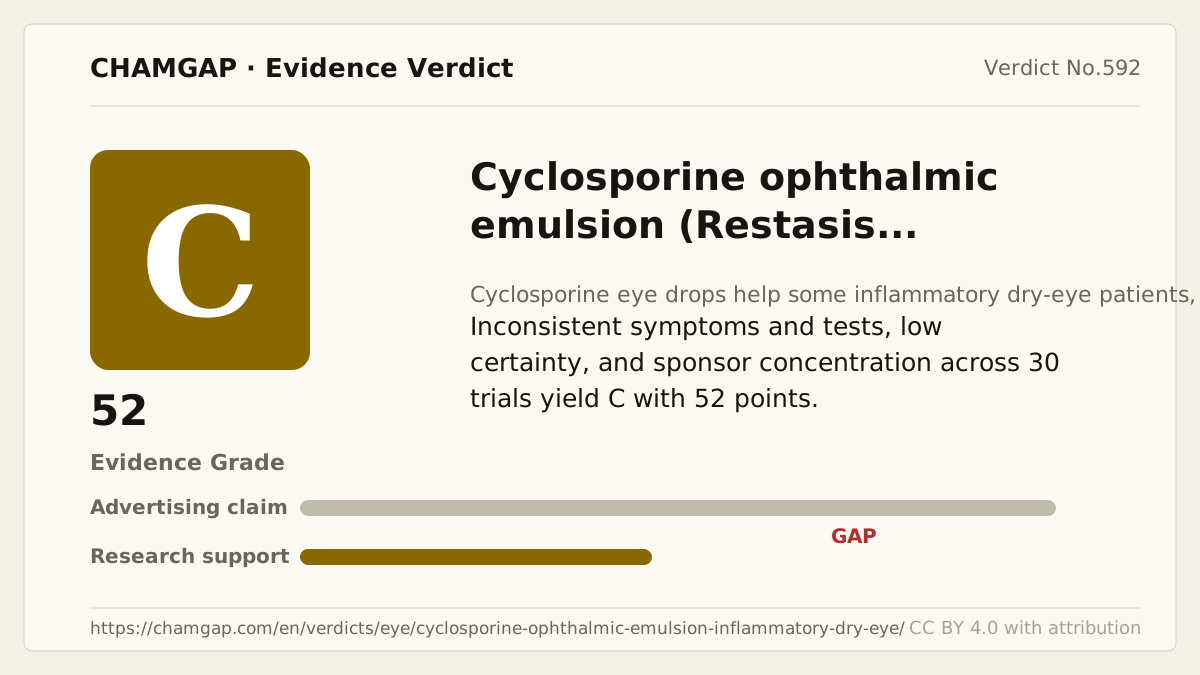
[Chamgap] Cyclosporine ophthalmic emulsion x inflammatory dry-eye improvement — Evidence Grade C·52. 4 cited sources checked. Source: https://chamgap.com/en/verdicts/eye/cyclosporine-ophthalmic-emulsion-inflammatory-dry-eye/ · CC BY 4.0CC BY 4.0 — free to use with attribution; do not distort grades, numbers, or verdict meaning.
What this document does and does not do
Chamgap is an information source. It reports what research has and has not confirmed; it does not tell readers what to take or buy. That decision belongs to readers and, when needed, medical or legal professionals. This verdict reflects literature available up to the search date and may change as new research appears. Nothing here is medical advice.