
Blackcurrant anthocyanins,
does it really help with VDT-related eye fatigue and dark adaptation?
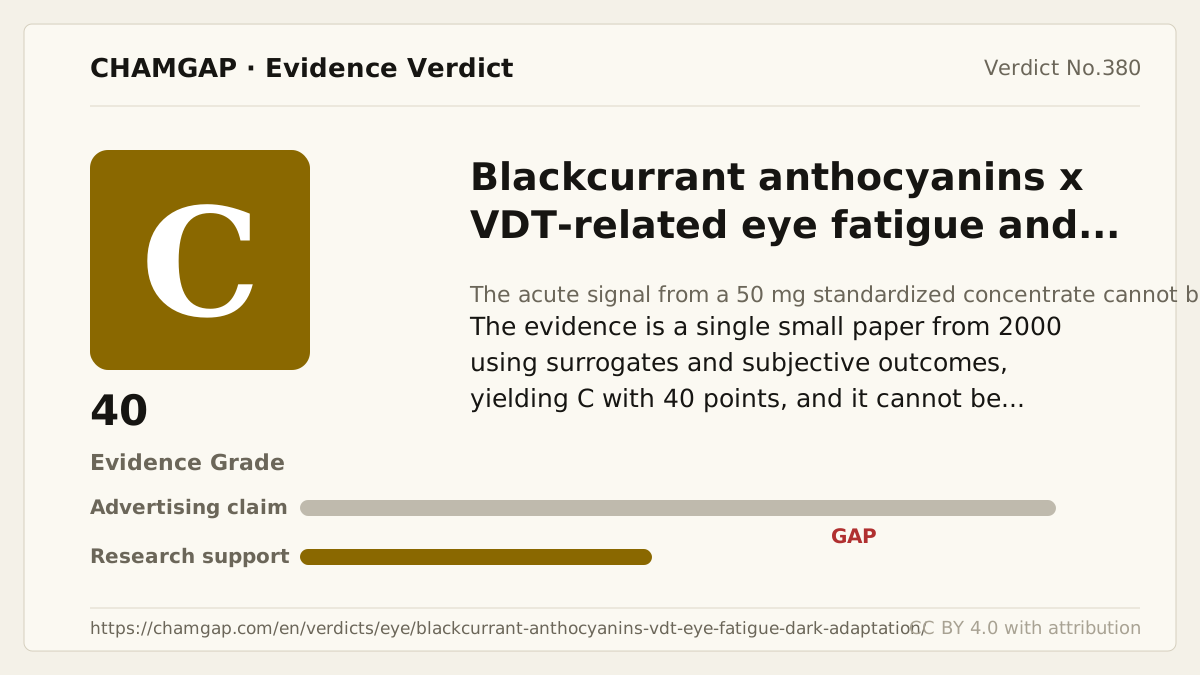
research showsThis claim receives C because a small double-blind crossover trial of standardized blackcurrant anthocyanoside concentrate found signals for the dark-adaptation threshold and selected subjective eye-fatigue symptoms after a 50 mg dose. Dark adaptation involved only 12 participants and the VDT refraction and symptom study 21; the between-condition refraction result was borderline null at p=0.064. Independent replication and clinical vision outcomes are absent.
ads claimClaims expand to 'better night vision,' 'screen protection,' and 'focus recovery,' while whole blackcurrant powder is treated as equivalent to standardized anthocyanin concentrate. Trials of other berries or antioxidant combinations are also cited as if they were blackcurrant evidence.
Useful facts when choosing a product
- Blackcurrant powders, juices, concentrates, and anthocyanin-labeled capsules are sold in Korea.
- The direct eye study used single doses of 12.5-50 mg anthocyanosides, with the main signal at 50 mg.
- Whole-fruit powder weight is not the same as anthocyanin content, so milligram labels cannot be compared directly.
- No major short-term safety signal emerged, but long-term ocular efficacy and safety data for concentrated extracts are limited.
Chamgap Semantic Classification Code
Candidate index · review held
UNK.blackcurrant-anthocyanins.UNK.vdt-related-eye-fatigue-and-dark-adaptation.assess.placeboUnknown > Blackcurrant anthocyanins > Unknown > VDT-related eye fatigue and dark adaptation > Association or change assessment > Placebo
An automated migration candidate, not an issued permanent code; exact claim scope remains under review. This machine-generated migration candidate helps retrieval but is not a permanent assignment. The original verdict ID and URL remain authoritative.
What the research actually shows
The 2000 Nakaishi crossover study compared 12.5, 20, and 50 mg in a 12-person dark-adaptation experiment and reported a pre-to-post threshold change at 50 mg. In a 21-person VDT experiment, the between-condition refraction result was p=0.064, while selected eye and lower-back questionnaire symptoms improved. Many later eye-fatigue trials tested bilberry, maqui berry, or combinations containing lutein and astaxanthin; they were not pooled as standalone blackcurrant evidence.
Why this is classified as C (40)
The direct standalone study is recognized, but it is one paper from 2000 with only 12 participants for dark adaptation and 21 for VDT outcomes, borderline-null refraction at p=0.064, subjective eye-fatigue findings, and no independent replication, yielding C with 40 points.
Counterpoint. The acute dark-adaptation signal merits exploration, but a large independent trial is needed for sustained VDT symptoms and clinically meaningful visual function.
Rejudgment record. Reassessment (cross-check reflected) — Recognized the standalone human trial but applied a C ceiling for tiny samples, surrogate and subjective outcomes, p=0.064 refraction, and absent independent replication
Sub-claim grades by effect
This ingredient is marketed for several effects. A single overall grade blends strong and weak claims together, so each effect is graded separately here. The overall grade reflects the strongest disconfirming or core claim.
| Effect (sub-claim) | Grade | Basis |
|---|---|---|
| Improved dark-adaptation threshold | C | A 50 mg signal in a 12-person single-dose experiment |
| VDT-related eye fatigue and refractive change | C | Selected subjective symptoms improved in 21 people, while refraction was p=0.064 |
Cross-check — AI research and Codex final gate
Evidence Table
| Study | Design | Sample | Funding | Endpoint | Result | Weight |
|---|---|---|---|---|---|---|
| Nakaishi et al. (2000), dark adaptation | Double-blind placebo-controlled crossover dose study | 12 | Ingredient research linked to Meiji Seika | Dark-adaptation threshold | Lower pre-to-post threshold at 50 mg; tiny sample | Key |
| Nakaishi et al. (2000), VDT task | Double-blind placebo-controlled crossover trial | 21 | Ingredient research linked to Meiji Seika | Post-VDT refraction and eye-fatigue questionnaire | Refraction p=0.064; selected subjective symptoms improved | Key |
Receipt — 1 References
All 1 cited sources were verified for existence at the original page (as of 2026-07-16).
Final verification and publication gate: Codex · Evidence date: 2026-07-16 · Corrections: none
Cite this verdict
[Chamgap] Blackcurrant anthocyanins x VDT-related eye fatigue and dark adaptation — Evidence Grade C·40. 1 cited sources checked. Source: https://chamgap.com/en/verdicts/eye/blackcurrant-anthocyanins-vdt-eye-fatigue-dark-adaptation/ · CC BY 4.0CC BY 4.0 — free to use with attribution; do not distort grades, numbers, or verdict meaning.
What this document does and does not do
Chamgap is an information source. It reports what research has and has not confirmed; it does not tell readers what to take or buy. That decision belongs to readers and, when needed, medical or legal professionals. This verdict reflects literature available up to the search date and may change as new research appears. Nothing here is medical advice.