
Venovenous ECMO,
does it really help with Reduction of 60-day mortality in very severe acute respiratory distress syndrome?
research showsThe grade is D. In EOLIA's prespecified intention-to-treat primary analysis, 60-day mortality was 44 of 124 (35%) with early ECMO and 57 of 125 (46%) with conventional ventilation, RR 0.76 (95% CI 0.55 to 1.04), P=0.09. Rescue crossover occurred in 35 of 125 control patients (28%), plausibly diluting separation, but crossover-adjusted analyses no longer preserve the original randomized comparison without assumptions.
ads claimECMO immediately changes oxygenation, but that physiological effect is not the same as a successful randomized mortality endpoint. Advertising should not present 35% versus 46% as definitive survival proof while omitting rescue crossover and specialized-center effects.
Useful facts when choosing a product
- VV-ECMO returns extracorporeally oxygenated and decarboxylated venous blood to the venous circulation, enabling lung-protective ventilation.
- Thirty-five of 125 control patients (28%) crossed to rescue ECMO under prespecified criteria.
- Bleeding leading to transfusion occurred in 46% versus 28%, severe thrombocytopenia in 27% versus 16%, and ischemic stroke in 0% versus 5%.
Chamgap Semantic Classification Code
Candidate index · review held
UNK.early-venovenous-extracorporeal-membrane-oxygenation.intravenous.mortality-in-very-severe-acute-respiratory-distress-syndrome.reduce.UNKUnknown > Early venovenous extracorporeal membrane oxygenation > Intravenous > mortality in very severe acute respiratory distress syndrome > Reduction claim > Unknown
An automated migration candidate, not an issued permanent code; exact claim scope remains under review. This machine-generated migration candidate helps retrieval but is not a permanent assignment. The original verdict ID and URL remain authoritative.
What the research actually shows
Eligibility required no more than seven days of intubation and, despite optimized care, PaO2/FiO2 below 50 for more than three hours, below 80 for more than six hours, or pH below 7.25 with PaCO2 at least 60 mm Hg for more than six hours. The trial stopped for futility under prespecified rules at the fourth interim analysis, after 249 participants had been analyzed and before reaching the target of 331. An individual-patient meta-analysis of CESAR and EOLIA found 90-day mortality of 77/214 (36%) versus 103/215 (48%), RR 0.75 (95% CI 0.60 to 0.94), but CESAR tested referral to an ECMO center and a six-month outcome, and the pooled estimate contains EOLIA itself. It is not an independent competing result on the exact same question.
Why this is classified as D (34)
The prespecified primary mortality analysis of a publicly funded randomized trial was null and imprecise enough to retain substantial benefit. Crossover adjustment and a meta-analysis provide context but do not create independent replication of the exact randomized question. Stopping for futility after 249 participants, before the target of 331, adds one avoidable limitation, giving D with 34 points.
Counterpoint. D does not mean rescue ECMO has no role. The trial explicitly allowed protocol-defined rescue ECMO; this verdict asks whether routine early initiation significantly reduced 60-day mortality.
Rejudgment record. Cross-check applied — Verification of EOLIA's 60-day primary analysis, 28% crossover, nonrandomized nature of adjustment, harms, and comparability with the CESAR-containing meta-analysis
| Endpoint | H | Hard endpoint - actual events such as death |
| Replication | R1 | Single confirmatory trial |
| Independence | I2 | Decisive evidence is publicly or non-profit funded |
| Effect size | E0 | Null |
| Precision | C0 | The confidence interval leaves room for benefit |
Stored derived and displayed grades match; this is not a current recalculation or validity check (D).
Sub-claim grades by effect
This ingredient is marketed for several effects. A single overall grade blends strong and weak claims together, so each effect is graded separately here. The overall grade reflects the strongest disconfirming or core claim.
| Effect (sub-claim) | Grade | Basis |
|---|---|---|
| Lower 60-day mortality with early VV-ECMO | D | The prespecified intention-to-treat primary analysis had P=0.09 and included no effect. |
| No value from protocol-defined rescue ECMO | ? | EOLIA allowed rescue therapy and was not designed to test this separate claim. |
| No increase in transfusion-requiring bleeding | F | Bleeding requiring transfusion was significantly more frequent, 46% versus 28%. |
Cross-check — AI research and Codex final gate
Evidence Table
| Study | Design | Sample | Funding | Endpoint | Result | Weight |
|---|---|---|---|---|---|---|
| Combes A et al. 2018 EOLIA | International multicenter randomized open-label trial | 249 randomized, 124 versus 125 | French Ministry of Health, public research programs, and nonprofit support | Primary all-cause mortality at 60 days | 44/124 (35%) versus 57/125 (46%), RR 0.76 (95% CI 0.55 to 1.04), P=0.09; control crossover 35/125 (28%) | Decisive primary intention-to-treat analysis |
| Munshi L et al. 2020 individual-patient meta-analysis | Individual-patient pooling of the CESAR and EOLIA randomized trials | 429 participants | Canadian public and academic support | Ninety-day mortality | 77/214 (36%) versus 103/215 (48%), RR 0.75 (95% CI 0.60 to 0.94), I-squared 0% | Supportive evidence using a different strategy and pooled unit |
Receipt — 2 References
All 2 cited sources were verified for existence at the original page (as of 2026-08-07).
Final verification and publication gate: Codex · Evidence date: 2026-08-07 · Corrections: none
Cite this verdict
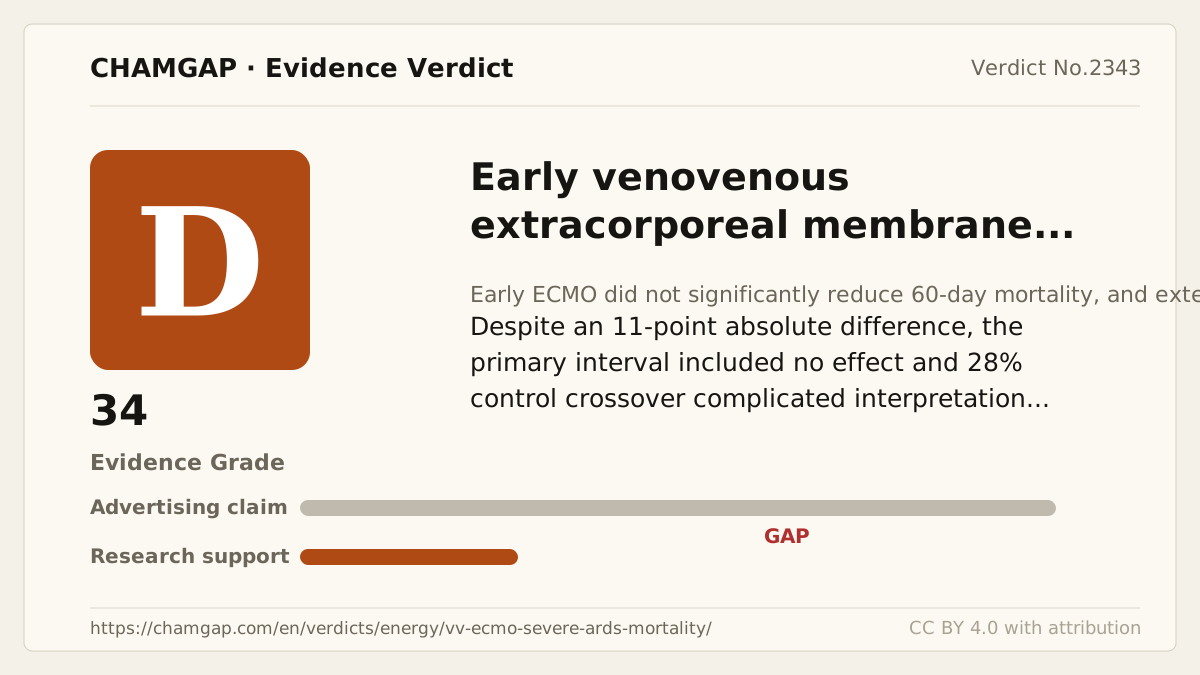
[Chamgap] Venovenous ECMO x mortality in very severe ARDS — Evidence Grade D·34. 2 cited sources checked. Source: https://chamgap.com/en/verdicts/energy/vv-ecmo-severe-ards-mortality/ · CC BY 4.0CC BY 4.0 — free to use with attribution; do not distort grades, numbers, or verdict meaning.
What this document does and does not do
Chamgap is an information source. It reports what research has and has not confirmed; it does not tell readers what to take or buy. That decision belongs to readers and, when needed, medical or legal professionals. This verdict reflects literature available up to the search date and may change as new research appears. Nothing here is medical advice.