
Theobromine,
does it really help with Gentler and longer-lasting alertness and energy than caffeine?
research showsThe standalone claim of gentler, longer-lasting alertness and energy from theobromine is rated F because direct human trials repeatedly failed to support it. In a 24-person double-blind crossover trial, none of 100, 200, or 400 mg consistently improved mood or vigilance over two hours, while 100 mg caffeine reduced lethargy and fatigue and increased vigor. In an 80-person placebo-controlled crossover trial, 250 mg had limited subjective effects, 500 and 1,000 mg produced negative mood and increased heart rate, and cognition did not improve. A potentially longer plasma half-life is pharmacokinetics, not clinical evidence of sustained alertness.
ads claimMarketing turns cocoa's comforting image and a long half-life into jitter-free gentle energy and focus lasting longer than caffeine. Direct trials did not confirm standalone alertness or vigilance benefits.
Useful facts when choosing a product
- Theobromine is a methylxanthine naturally present in cocoa and is also a human metabolite of caffeine. Its concentration in chocolate and cocoa varies widely with raw material and processing.
- Its human plasma half-life is often reported at about seven to twelve hours. A long half-life does not automatically mean sustained alerting efficacy.
- Purified theobromine supplements and cocoa foods differ in caffeine, flavanols, sugar, and calories. Their effects are not interchangeable.
- High doses can cause nausea, headache, sweating, tremor, palpitations, and increased heart rate. Dogs metabolize theobromine slowly and must never be given cocoa or chocolate products.
Chamgap Semantic Classification Code
Candidate index · review held
UNK.theobromine.UNK.gentler-and-longer-lasting-alertness-and-energy-than-caffeine.assess.placeboUnknown > Theobromine > Unknown > Gentler and longer-lasting alertness and energy than caffeine > Association or change assessment > Placebo
An automated migration candidate, not an issued permanent code; exact claim scope remains under review. This machine-generated migration candidate helps retrieval but is not a permanent assignment. The original verdict ID and URL remain authoritative.
What the research actually shows
Judelson 2013 used a six-condition double-blind crossover in 24 healthy men to compare 100, 200, and 400 mg theobromine, placebo, and 100 mg caffeine. Theobromine had no consistent effect on standardized mood measures or a two-hour visual-vigilance task, while caffeine reduced fatigue and increased vigor. Baggott 2013 randomized 80 healthy adults under double masking to placebo, caffeine 200 mg, and theobromine 250, 500, and 1,000 mg. Lower-dose subjective effects were limited, higher doses produced negative mood and increased heart rate, the highest dose impaired an attention-alerting index, and memory and digit-span performance did not improve.
Why this is classified as F (8)
A direct double-blind trial of 100 to 400 mg found no mood or vigilance effect, and a broader 250-to-1,000-mg trial found no caffeine-like alertness while higher doses caused negative mood and increased heart rate. These repeated direct failures of the gentle sustained energy claim give F with 8 points. Caffeine in verdict 119 and EnXtra in verdict 562 are different ingredients, and their evidence was not transferred.
Counterpoint. Enjoying cocoa as food is separate from dosing theobromine as a stimulant. For persistent low energy or alertness, sleep deprivation, anemia, thyroid disease, depression, medicines, and caffeine use deserve assessment.
Rejudgment record. New verdict — Applied direct repeated refutation from a 24-person double-blind crossover in which 100, 200, and 400 mg all failed on mood and vigilance despite a successful caffeine positive control, plus an 80-person placebo-controlled crossover showing limited low-dose subjective effects and negative mood and increased heart rate at high doses
Sub-claim grades by effect
This ingredient is marketed for several effects. A single overall grade blends strong and weak claims together, so each effect is graded separately here. The overall grade reflects the strongest disconfirming or core claim.
| Effect (sub-claim) | Grade | Basis |
|---|---|---|
| Improved alertness and energy | F | Two double-blind trials failed to reproduce standalone mood, vigilance, or cognitive benefit. |
| Longer-lasting alertness than caffeine | F | Despite a long half-life, sustained vigilance benefit was null in direct testing while the caffeine positive control increased vigor. |
Cross-check — AI research and Codex final gate
Evidence Table
| Study | Design | Sample | Funding | Endpoint | Result | Weight |
|---|---|---|---|---|---|---|
| Judelson DA et al. 2013 | Randomized double-blind six-condition crossover trial | 24 healthy men | Not reported in the abstract | Standardized mood scales and a two-hour visual-vigilance task | None of 100, 200, or 400 mg consistently affected mood or vigilance, while 100 mg caffeine reduced fatigue and increased vigor. | Key direct refutation with a validated positive control |
| Baggott MJ et al. 2013 | Randomized double-blind placebo- and caffeine-controlled crossover trial | 80 healthy participants | Supported by Unilever R&D with additional U.S. NIH support | Subjective drug effects, mood, cognition, and cardiovascular measures | The 250-mg dose had limited subjective effects; 500 and 1,000 mg produced negative mood and increased heart rate, without cognitive improvement. | Independent replication across a broad dose range |
Receipt — 3 References
All 3 cited sources were verified for existence at the original page (as of 2026-07-19).
Final verification and publication gate: Codex · Evidence date: 2026-07-19 · Corrections: none
Cite this verdict
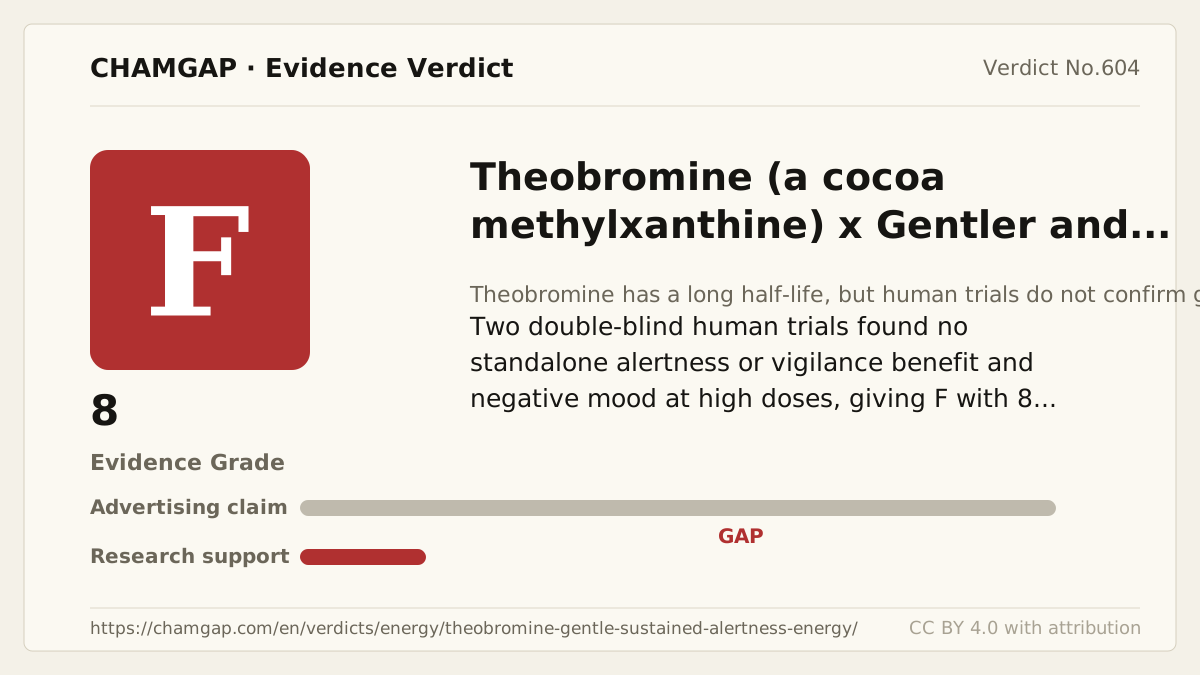
[Chamgap] Theobromine x gentler and longer-lasting alertness and energy than caffeine — Evidence Grade F·8. 3 cited sources checked. Source: https://chamgap.com/en/verdicts/energy/theobromine-gentle-sustained-alertness-energy/ · CC BY 4.0CC BY 4.0 — free to use with attribution; do not distort grades, numbers, or verdict meaning.
What this document does and does not do
Chamgap is an information source. It reports what research has and has not confirmed; it does not tell readers what to take or buy. That decision belongs to readers and, when needed, medical or legal professionals. This verdict reflects literature available up to the search date and may change as new research appears. Nothing here is medical advice.