
American ginseng,
does it really help with Improvement of cancer-related fatigue in patients and survivors?
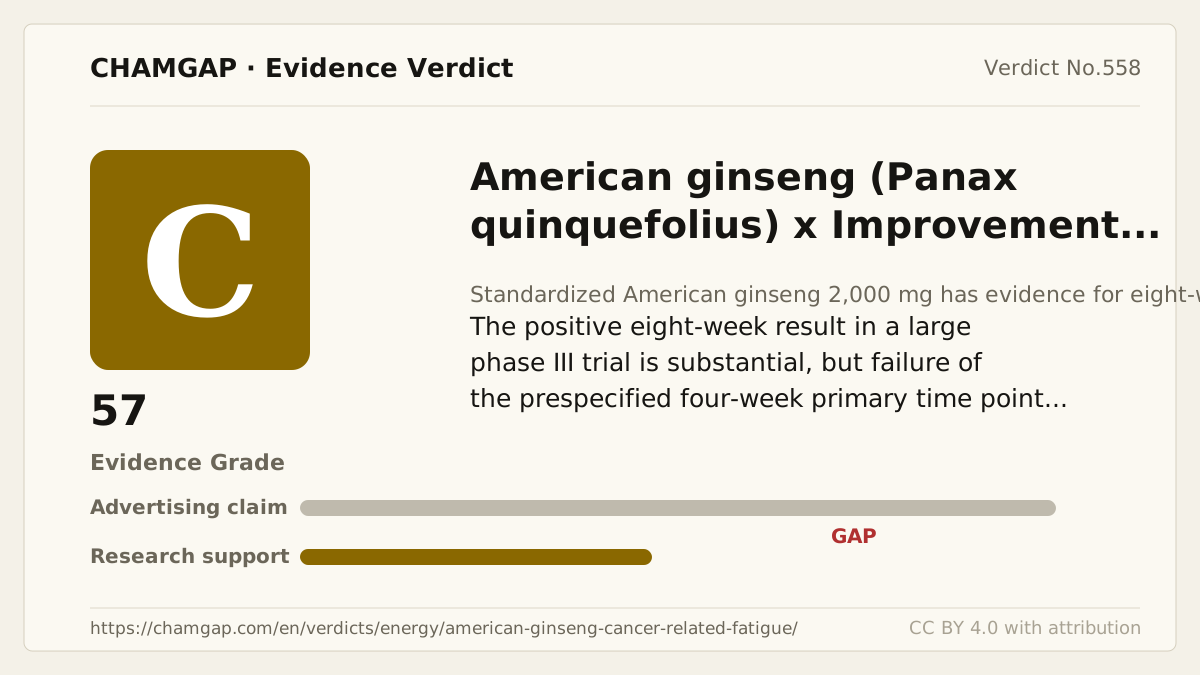
research showsAmerican ginseng 2,000 mg/day is rated C for cancer-related fatigue. In the 364-person N07C2 phase III trial across 40 institutions, the prespecified primary four-week time point failed, 14.4 versus 8.2 with p=0.07, while only the eight-week result was positive, 20.0 versus 10.3 with p=0.003. The later positive signal is substantial, but the preceding N03CA dose-finding study came from the same NCCTG research program and is not an independent replication, while a separate 32-person trial in head-and-neck cancer survivors was null at 1,000 mg/day. Failure of the primary time point, reliance on a specific 2,000 mg material, and lack of independent confirmation limit the grade to high C.
ads claimAdvertisements can extend 'energy for patients with cancer' or 'recovery from treatment fatigue' to general vitality and exercise energy. The direct evidence concerns an eight-week patient-reported fatigue scale in selected patients and survivors; it is not evidence for anticancer treatment, recurrence prevention, or energy in healthy adults.
Useful facts when choosing a product
- In Korea, raw roots and capsules are marketed as hwagisam, Western ginseng, or American ginseng, but this species is different from red ginseng, Panax ginseng.
- The pivotal product was dried Panax quinquefolius root powder at 2,000 mg/day standardized to 3% ginsenosides.
- Low-dose blends and extracts may differ in species, plant part, ginsenoside profile, and dose and are not equivalent to the trial product.
- Patients with cancer should review possible reduction of warfarin effect and interactions with glucose-lowering or anticancer treatment with their clinical team. The pivotal trial excluded warfarin and antidiabetic-drug users.
Chamgap Semantic Classification Code
Candidate index · review held
UNK.american-ginseng.UNK.cancer-related-fatigue-and-survivors.improve.placeboUnknown > American ginseng > Unknown > cancer-related fatigue and survivors > Improvement claim > Placebo
An automated migration candidate, not an issued permanent code; exact claim scope remains under review. This machine-generated migration candidate helps retrieval but is not a permanent assignment. The original verdict ID and URL remain authoritative.
What the research actually shows
The Barton 2013 N07C2 trial assigned 364 fatigued patients or survivors within two years of cancer diagnosis at 40 institutions to American ginseng 2,000 mg/day or placebo for eight weeks. The four-week change in the general Multidimensional Fatigue Symptom Inventory–Short Form subscale was 14.4 versus 8.2 with P=.07; at eight weeks it was 20.0 versus 10.3 with P=.003. Toxicity did not notably differ, and the trial received National Cancer Institute-related public grants and Breast Cancer Research Foundation support. The preceding N03CA dose-finding trial suggested activity at 1,000 to 2,000 mg/day, whereas the Guglielmo 2020 trial of 32 head-and-neck cancer survivors was null at 1,000 mg/day.
Why this is classified as C (57)
The publicly funded phase III trial of 364 participants across 40 institutions provides a strong signal for patient-reported fatigue improvement at eight weeks. However, the prespecified four-week primary time point failed with p=0.07, N03CA belongs to the same NCCTG research program, and a separate 1,000 mg trial was null. Restriction to a 2,000 mg material standardized to 3% ginsenosides and lack of independent confirmation result in high C with 57 points.
Counterpoint. This verdict applies only to cancer-related fatigue and does not transfer to energy in healthy adults, low-dose blends, red ginseng, or eleuthero.
Rejudgment record. Reassessment (cross-check reflected) — Accepted the positive eight-week result in the N07C2 multicenter phase III trial as a substantial later signal, while accounting for failure of the prespecified four-week primary time point, nonindependence of N03CA within the same NCCTG research program, the null separate 1,000 mg trial, restriction to a specific 2,000 mg material, and lack of independent confirmation
Sub-claim grades by effect
This ingredient is marketed for several effects. A single overall grade blends strong and weak claims together, so each effect is graded separately here. The overall grade reflects the strongest disconfirming or core claim.
| Effect (sub-claim) | Grade | Basis |
|---|---|---|
| Improvement of cancer-related fatigue in patients and survivors | C | The large randomized trial was positive at eight weeks, but the prespecified four-week primary time point failed, independent replication is lacking, and the result is limited to a specific 2,000 mg material. |
| Vitality and energy in healthy adults | ? | This is a different verdict axis requiring separate direct human efficacy evidence. |
Cross-check — AI research and Codex final gate
Evidence Table
| Study | Design | Sample | Funding | Endpoint | Result | Weight |
|---|---|---|---|---|---|---|
| Barton DL et al. 2013 N07C2 | Phase III multicenter double-blind randomized placebo-controlled trial | 364 participants across 40 institutions | United States public research grants and the Breast Cancer Research Foundation | General fatigue subscale of the Multidimensional Fatigue Symptom Inventory–Short Form at the primary four-week time point and at eight weeks | At four weeks the change was 14.4 versus 8.2 with P=.07, while at eight weeks the American-ginseng group improved significantly more, 20.0 versus 10.3 with P=.003. | Key |
| Barton DL et al. 2010 N03CA | Double-blind randomized placebo-controlled dose-finding trial | 290 patients with cancer-related fatigue enrolled, with smaller analyzable samples over time | United States public research network | Brief Fatigue Inventory, the SF-36 vitality subscale, and perceived benefit | Fatigue and vitality signals were larger at 1,000 to 2,000 mg/day than at 750 mg/day, supporting dose selection for phase III. | Supportive |
| Guglielmo M et al. 2020 | Phase II double-blind randomized placebo-controlled trial | 32 survivors after treatment for head and neck cancer | Unknown | Eight-week Brief Fatigue Inventory | American ginseng 1,000 mg/day did not improve fatigue versus placebo. | Limiting |
Receipt — 3 References
All 3 cited sources were verified for existence at the original page (as of 2026-07-18).
Final verification and publication gate: Codex · Evidence date: 2026-07-18 · Corrections: none
Cite this verdict
[Chamgap] American ginseng (Panax quinquefolius) x cancer-related fatigue — Evidence Grade C·57. 3 cited sources checked. Source: https://chamgap.com/en/verdicts/energy/american-ginseng-cancer-related-fatigue/ · CC BY 4.0CC BY 4.0 — free to use with attribution; do not distort grades, numbers, or verdict meaning.
What this document does and does not do
Chamgap is an information source. It reports what research has and has not confirmed; it does not tell readers what to take or buy. That decision belongs to readers and, when needed, medical or legal professionals. This verdict reflects literature available up to the search date and may change as new research appears. Nothing here is medical advice.