
Pulmonary rehabilitation,
does it really help with Improvement of dyspnea and health-related quality of life in stable COPD?
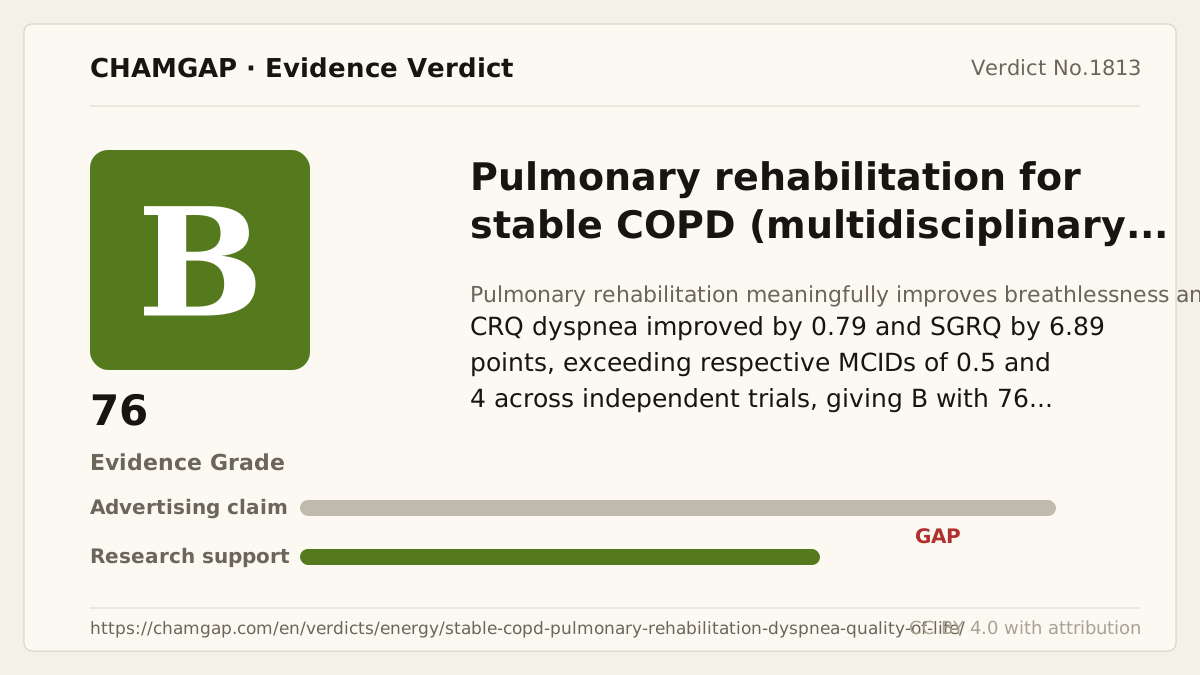
research showsPulmonary rehabilitation for stable COPD is rated B for dyspnea and quality of life. In a Cochrane review of 65 trials and 3,822 participants, CRQ dyspnea improved by a mean 0.79 points per item (95% CI 0.56 to 1.03; 19 trials, 1,283 participants), exceeding the approximately 0.5-point-per-item CRQ MCID. SGRQ total score improved by 6.89 points (95% CI 4.52 to 9.26; 19 trials, 1,146 participants), exceeding the four-point threshold established by Jones. Griffiths analyzed all 200 randomized participants by intention to treat and found improved health status and fewer hospital days. Dyspnea and quality of life are treatment targets, not surrogates.
ads claimMarketing may present pulmonary rehabilitation as a single treatment that replaces oxygen or medication and restores the lung. Evidence supports meaningful relief of breathlessness and daily-life burden in stable patients participating in a structured program, not regeneration of lung tissue.
Useful facts when choosing a product
- CRQ dyspnea and SGRQ are patient-reported treatment targets, endpoint P, rather than laboratory surrogates. The cited MCIDs are approximately 0.5 CRQ point per item and 4 SGRQ points.
- verdict 1562, which is B with 73 points, addresses readmission prevention after hospitalization for an acute exacerbation. This verdict concerns stable disease and symptom or quality-of-life outcomes.
- verdict 1303, which is B with 78 points, concerns survival with long-term home oxygen in severe resting hypoxemia, while verdict 1195, which is B with 75 points, concerns exacerbation prevention with azithromycin.
Chamgap Semantic Classification Code
Candidate index · review held
X.pulmonary-rehabilitation.behavioral.dyspnea-and-health-related-quality-of-life-in-stable-copd.improve.usual-careBehaviors, exposures and policies > Pulmonary rehabilitation > Behavioral delivery > dyspnea and health-related quality of life in stable COPD > Improvement claim > Usual care
An automated migration candidate, not an issued permanent code; exact claim scope remains under review. This machine-generated migration candidate helps retrieval but is not a permanent assignment. The original verdict ID and URL remain authoritative.
What the research actually shows
Griffiths and colleagues randomized 200 people with disabling chronic lung disease, mostly COPD, to six-week multidisciplinary outpatient rehabilitation, 99, or usual medical management, 101, and analyzed all 200 by intention to treat. Hospital days were 10.4 versus 21.0, P=0.022, while walking and disease-specific health status also improved. McCarthy's Cochrane review synthesized 65 trials and 3,822 participants, finding a CRQ dyspnea mean difference of 0.79 per item and SGRQ total mean difference of -6.89. The CRQ MCID is approximately 0.5 point per item, not 0.5 for the total score, from Jaeschke's patient-anchored work; the SGRQ threshold is four points from Jones.
Why this is classified as B (72)
P, R2, I2, and E+ are present, with pooled effects exceeding sourced MCIDs. The B1 ceiling for unmasked patient-reported outcomes in rehabilitation gives B with 72 points.
Counterpoint. Maintaining benefit requires continued exercise and disease management, and persistence after program completion varies.
Rejudgment record. Cross-check applied — Independent stable-COPD trials exceeded sourced CRQ and SGRQ MCIDs on patient-reported treatment targets, with unmasked reporting recorded as B1
| Endpoint | P | Symptom or function itself is the target - including patient reports and performance tests |
| Replication | R2 | Independently replicated across trials |
| Independence | I2 | Decisive evidence is publicly or non-profit funded |
| Effect size | E+ | Meets the clinically important threshold |
Stored derived and displayed grades match; this is not a current recalculation or validity check (B).
Sub-claim grades by effect
This ingredient is marketed for several effects. A single overall grade blends strong and weak claims together, so each effect is graded separately here. The overall grade reflects the strongest disconfirming or core claim.
| Effect (sub-claim) | Grade | Basis |
|---|---|---|
| Improvement in CRQ dyspnea | B | MD 0.79 exceeded the sourced 0.5-point MCID. |
| Improvement in SGRQ health-related quality of life | B | MD -6.89 exceeded Jones's four-point MCID. |
| Improvement in daily function after exercise and education | B | Multiple trials were positive for walking ability and patient-reported function. |
Cross-check — AI research and Codex final gate
Evidence Table
| Study | Design | Sample | Funding | Endpoint | Result | Weight |
|---|---|---|---|---|---|---|
| Griffiths TL et al. 2000 | Randomized usual-care-controlled intention-to-treat trial | 200 randomized (99/101); actual intention-to-treat analysis 200 | Non-United States governmental and academic research support | One-year health-care use, walking ability, and general and disease-specific health status | Hospital days were 10.4 versus 21.0, P=0.022, with improved health status; the main analysis was positive, while admissions involved 40 versus 41 patients. | Representative long-term pragmatic randomized trial |
| McCarthy B et al. 2015 Cochrane | Systematic review and meta-analysis of randomized trials | 65 trials and 3,822 participants; CRQ 19 trials and 1,283, SGRQ 19 trials and 1,146 | Academic Cochrane Airways Group support; not manufacturer-led | CRQ dyspnea and SGRQ total score | CRQ MD 0.79 (0.56 to 1.03) and SGRQ MD -6.89 (-9.26 to -4.52), both exceeding MCIDs. | Decisive multiple-trial synthesis |
Receipt — 4 References
All 4 cited sources were verified for existence at the original page (as of 2026-07-24).
Final verification and publication gate: Codex · Evidence date: 2026-07-24 · Corrections: none
Cite this verdict
[Chamgap] Pulmonary rehabilitation x improved dyspnea and quality of life in stable COPD — Evidence Grade B·72. 4 cited sources checked. Source: https://chamgap.com/en/verdicts/energy/stable-copd-pulmonary-rehabilitation-dyspnea-quality-of-life/ · CC BY 4.0CC BY 4.0 — free to use with attribution; do not distort grades, numbers, or verdict meaning.
What this document does and does not do
Chamgap is an information source. It reports what research has and has not confirmed; it does not tell readers what to take or buy. That decision belongs to readers and, when needed, medical or legal professionals. This verdict reflects literature available up to the search date and may change as new research appears. Nothing here is medical advice.