
Pyridostigmine bromide,
does it really help with Symptomatic relief of fluctuating muscle weakness and fatigability in myasthenia gravis?
research showsPyridostigmine is international first-line symptomatic therapy for myasthenia gravis, and newly identified direct Class I randomized evidence supports B. A 2026 double-blind placebo-controlled crossover trial at Leiden University Medical Center enrolled 19 participants who were acetylcholine-receptor-antibody positive and already using pyridostigmine. Pyridostigmine improved the Myasthenia Gravis Impairment Index by 5.3 points versus placebo, and Myasthenia Gravis Activities of Daily Living, Quantitative Myasthenia Gravis, and revised 15-item Myasthenia Gravis Quality of Life outcomes all favored treatment. This fills the direct-trial gap present in the 2014 Cochrane review and aligns with international first-line symptomatic use. The five-day crossover periods, sample of 19, and restriction to acetylcholine-receptor-antibody-positive current users preclude extension to muscle-specific kinase myasthenia or treatment-naive patients, yielding a low B with 62 points. Cholinergic gastrointestinal symptoms, cramps, bradycardia, increased secretions, and cholinergic crisis remain separate safety concerns.
ads claimCalling it a myasthenia treatment can turn rapid symptomatic relief into a claim of treating autoimmunity or preventing disease progression. Its role is to improve neuromuscular transmission for a limited period after dosing, not to replace immunotherapy, thymectomy, or crisis management.
Useful facts when choosing a product
- Pyridostigmine bromide is a prescription medicine whose dose and interval are adjusted by clinicians to myasthenia symptoms; immediate-release and extended-release formulations have different release characteristics and should not be interchanged without direction.
- Its duration is limited, so individualized timing may account for daily fluctuation, meals, swallowing difficulty, and planned activity; patients should not increase the prescribed dose on their own.
- Abdominal cramps, diarrhea, nausea, salivation, sweating, and muscle cramps are common cholinergic adverse effects, while overdose can worsen weakness through cholinergic crisis and cause bradycardia or increased bronchial secretions.
- Breathing difficulty, dysphagia, or rapidly worsening generalized weakness requires urgent evaluation to distinguish myasthenic crisis from medication excess rather than repeated self-dosing.
Chamgap Semantic Classification Code
Candidate index · review held
M.pyridostigmine-bromide.UNK.symptomatic-relief-of-fluctuating-muscle-weakness-and-fatigability-in-myasthenia-gravis.relieve.MULTIMedicinal interventions > Pyridostigmine bromide > Unknown > Symptomatic relief of fluctuating muscle weakness and fatigability in myasthenia gravis > Symptom-relief claim > Multiple: primary unresolved
An automated migration candidate, not an issued permanent code; exact claim scope remains under review. This machine-generated migration candidate helps retrieval but is not a permanent assignment. The original verdict ID and URL remain authoritative.
What the research actually shows
The Cochrane review by Mehndiratta and colleagues searched randomized and quasi-randomized evidence through 2014 but found no large cholinesterase-inhibitor trial in generalized myasthenia gravis. The 2016 international guidance by Sanders and colleagues used a RAND/UCLA modified-Delphi process and recommended pyridostigmine in initial treatment for most patients. Remijn-Nelissen and colleagues then conducted a 2026 single-center double-blind placebo-controlled crossover trial at Leiden University Medical Center in 19 acetylcholine-receptor-antibody-positive participants on stable standard care who were already using pyridostigmine, with two five-day treatment periods. Compared with placebo, pyridostigmine improved the Myasthenia Gravis Impairment Index by 5.3 points, Quantitative Myasthenia Gravis by 1.4 points, Myasthenia Gravis Activities of Daily Living by 1.2 points, and revised 15-item Myasthenia Gravis Quality of Life by 2.0 points; the study was classified as Class I evidence. It confirms short-term direct symptom benefit but does not establish sustained immunologic disease control, altered natural history, or efficacy in muscle-specific kinase myasthenia or treatment-naive patients.
Why this is classified as B (62)
International first-line symptomatic guidance now aligns with a 2026 Class I placebo-controlled crossover trial showing improvement in the Myasthenia Gravis Impairment Index, activities of daily living, quantitative severity, and quality of life, supporting B. The sample of 19, five-day periods, and restriction to acetylcholine-receptor-antibody-positive current users prevent extension to muscle-specific kinase myasthenia and treatment-naive patients, yielding a low B with 62 points. Cholinergic adverse effects and crisis are separate safety issues.
Counterpoint. Appropriately timed dosing can quickly assist daily function, but failure to meet goals calls for specialist discussion of immunotherapy and other disease-controlling strategies. Patients with MuSK-antibody myasthenia may respond less well and experience adverse effects at conventional doses.
Rejudgment record. Cross-check incorporated — Raised the grade to B because international first-line symptomatic guidance now aligns with a 2026 Class I double-blind placebo-controlled crossover trial in 19 acetylcholine-receptor-antibody-positive current users showing a 5.3-point improvement in the Myasthenia Gravis Impairment Index and favorable activities-of-daily-living, quantitative-severity, and quality-of-life outcomes; retained a low B for the five-day small-sample design and lack of extension to muscle-specific kinase myasthenia or treatment-naive patients
Sub-claim grades by effect
This ingredient is marketed for several effects. A single overall grade blends strong and weak claims together, so each effect is graded separately here. The overall grade reflects the strongest disconfirming or core claim.
| Effect (sub-claim) | Grade | Basis |
|---|---|---|
| Temporary relief of fluctuating muscle weakness | B | A Class I crossover trial improved the Myasthenia Gravis Impairment Index by 5.3 points versus placebo, but its 19 acetylcholine-receptor-antibody-positive current users do not support extension to muscle-specific kinase myasthenia or treatment-naive patients. |
| Symptomatic relief of activity-related fatigability | B | Activities of daily living and Quantitative Myasthenia Gravis also favored treatment, but five-day crossover periods and restriction to acetylcholine-receptor-antibody-positive current users leave muscle-specific kinase myasthenia and treatment-naive patients unestablished. |
| Short-term functional improvement in ocular, bulbar, and generalized symptoms | B | Class I evidence supports short-term function and quality of life in current users with ocular or generalized acetylcholine-receptor-antibody-positive disease, but it does not extend to muscle-specific kinase myasthenia or treatment-naive patients and does not establish immunologic disease control. |
Cross-check — AI research and Codex final gate
Evidence Table
| Study | Design | Sample | Funding | Endpoint | Result | Weight |
|---|---|---|---|---|---|---|
| Mehndiratta MM et al. 2014 Cochrane review | Systematic review of randomized and quasi-randomized trials | Zero large trials in generalized myasthenia gravis; one abstract-only ten-participant crossover trial of intranasal neostigmine | Academic Cochrane Neuromuscular Group review | Improvement in myasthenic symptoms within 1 to 14 days and thereafter | No large pyridostigmine randomized trial existed, and the only small neostigmine trial was inconclusive. | Key evidence for the modern direct-trial gap |
| Sanders DB et al. 2016 international consensus | International RAND/UCLA modified-Delphi expert-consensus guidance | Panel of 15 international myasthenia gravis experts | Convened by the Myasthenia Gravis Foundation of America, which paid the article-processing charge | Management recommendations covering symptomatic and immunosuppressive treatment | Consensus recommended pyridostigmine as part of initial treatment for most patients, with dose adjusted to symptoms. | Support for clinical-standard status and direct symptomatic role |
| Remijn-Nelissen L et al. 2026 | Randomized double-blind placebo-controlled crossover trial at Leiden University Medical Center; two five-day periods with a two-day washout | 19 acetylcholine-receptor-antibody-positive participants on stable standard care who were current pyridostigmine users | Funding not stated in the PubMed abstract; single-center study at Leiden University Medical Center | Primary Myasthenia Gravis Impairment Index; secondary activities of daily living, Quantitative Myasthenia Gravis, and revised 15-item quality of life | Pyridostigmine improved the Myasthenia Gravis Impairment Index by 5.3 points versus placebo and favored activities of daily living by 1.2 points, Quantitative Myasthenia Gravis by 1.4 points, and revised 15-item quality of life by 2.0 points; the study provided Class I evidence. | New Class I randomized evidence confirming direct symptom benefit |
Receipt — 3 References
All 3 cited sources were verified for existence at the original page (as of 2026-07-21).
Final verification and publication gate: Codex · Evidence date: 2026-07-21 · Corrections: none
Cite this verdict
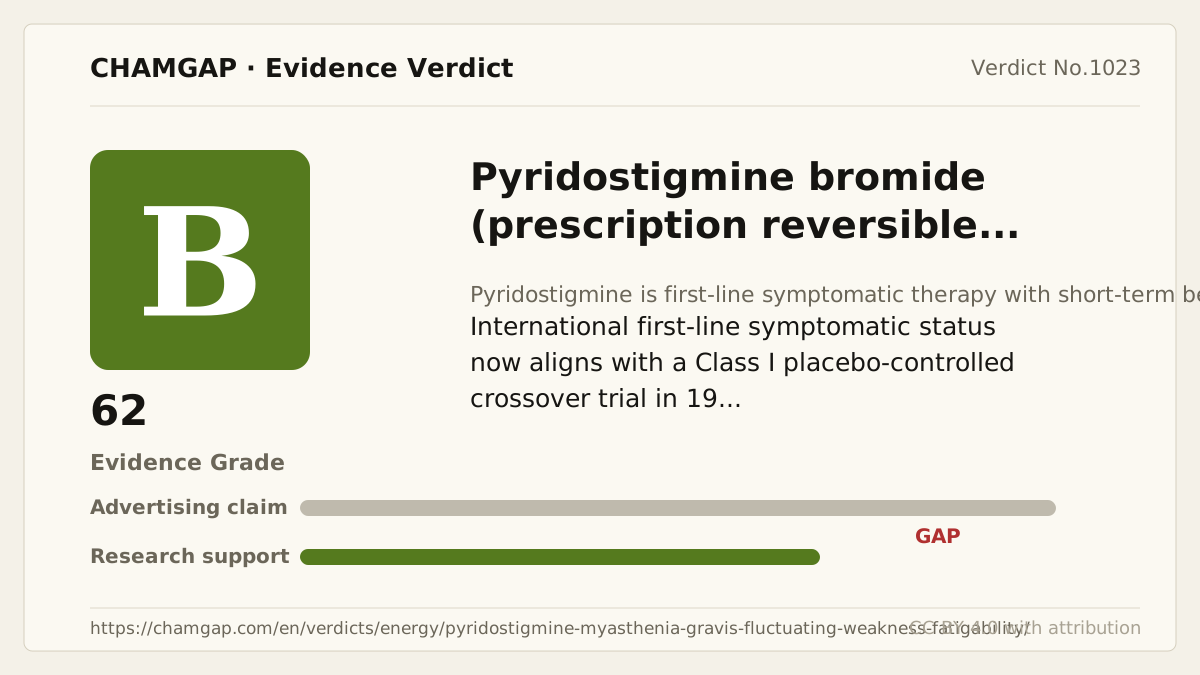
[Chamgap] Pyridostigmine bromide x relief of fluctuating weakness and fatigability in myasthenia gravis — Evidence Grade B·62. 3 cited sources checked. Source: https://chamgap.com/en/verdicts/energy/pyridostigmine-myasthenia-gravis-fluctuating-weakness-fatigability/ · CC BY 4.0CC BY 4.0 — free to use with attribution; do not distort grades, numbers, or verdict meaning.
What this document does and does not do
Chamgap is an information source. It reports what research has and has not confirmed; it does not tell readers what to take or buy. That decision belongs to readers and, when needed, medical or legal professionals. This verdict reflects literature available up to the search date and may change as new research appears. Nothing here is medical advice.