
Post-exacerbation pulmonary rehabilitation,
does it really help with Prevention of readmission after hospitalization for a COPD exacerbation?
research showsPulmonary rehabilitation after hospitalization for a COPD exacerbation is rated B because the readmission evidence has moderate GRADE certainty. In the 2016 Cochrane review, the readmission odds ratio across 8 studies and 810 participants was 0.44 (95% CI 0.21 to 0.91); certainty was moderate in the presence of substantial heterogeneity, I²=77%. Quality of life and exercise capacity improved with high-certainty evidence, but mortality had an OR of 0.68 (95% CI 0.28 to 1.67) with low certainty and was not established.
ads claimPromotional material can present pulmonary rehabilitation as if it were a breathing device or home positive-pressure ventilation. This verdict concerns a recovery program combining exercise training, breathing strategies, education, and self-management, not acute noninvasive ventilation or long-term home NIV.
Useful facts when choosing a product
- Post-exacerbation pulmonary rehabilitation is a multicomponent program combining aerobic and resistance exercise, breathing training, symptom management, education, and self-management support.
- Follow-up in the Cochrane readmission studies ranged from 3 to 18 months, and session number, supervision, setting, and educational intensity varied.
- Exercise dose is adjusted to oxygen saturation, dyspnea, fall risk, cardiovascular comorbidity, and recovery from the recent exacerbation.
- Dyspnea and fatigue may occur during exercise; falls and serious events are uncommon, but unstable symptoms require clinical assessment and appropriate supervision.
Chamgap Semantic Classification Code
Candidate index · review held
X.post-exacerbation-pulmonary-rehabilitation.behavioral.readmission-after-hospitalization-for-a-copd-exacerbation.prevent.UNKBehaviors, exposures and policies > Post-exacerbation pulmonary rehabilitation > Behavioral delivery > readmission after hospitalization for a COPD exacerbation > Occurrence-prevention claim > Unknown
An automated migration candidate, not an issued permanent code; exact claim scope remains under review. This machine-generated migration candidate helps retrieval but is not a permanent assignment. The original verdict ID and URL remain authoritative.
What the research actually shows
The 2016 Puhan Cochrane review included 20 studies of pulmonary rehabilitation after COPD exacerbations. Readmission across 8 studies and 810 participants had an OR of 0.44 (95% CI 0.21 to 0.91), I²=77%, with moderate certainty. Mortality across 6 studies and 670 participants had an OR of 0.68 (95% CI 0.28 to 1.67), I²=59%, with low certainty. Across eight studies, the SGRQ total score improved by a mean 7.80 points (95% CI 3.47 to 12.12 better), exceeding its four-point minimal important difference, and six-minute walk distance improved by 62 m (95% CI 38 to 86); these functional outcomes had high certainty. The updated analysis supporting the 2023 ATS guideline also rated posthospital readmission as a critical outcome with moderate certainty.
Why this is classified as B (73)
Readmission after COPD exacerbation had an OR of 0.44 (95% CI 0.21 to 0.91) across 8 studies and 810 participants, but heterogeneity of I²=77% limited GRADE certainty to moderate, giving B with 73 points.
Counterpoint. High-certainty gains in quality of life and exercise capacity cannot be converted into a mortality claim; mortality evidence was low certainty.
Rejudgment record. New verdict — The claimed endpoint of readmission after a COPD exacerbation has moderate GRADE certainty with substantial heterogeneity in programs and results, so the moderate-certainty ceiling gives grade B
Sub-claim grades by effect
This ingredient is marketed for several effects. A single overall grade blends strong and weak claims together, so each effect is graded separately here. The overall grade reflects the strongest disconfirming or core claim.
| Effect (sub-claim) | Grade | Basis |
|---|---|---|
| Prevention of readmission after a COPD exacerbation | B | Across 8 studies and 810 participants, OR was 0.44 (95% CI 0.21 to 0.91), I²=77%, with moderate GRADE certainty. |
| Improved quality of life and exercise capacity | B | SGRQ improved by 7.80 points and six-minute walk distance by 62 m with high certainty and clinically important magnitudes, but these functional and patient-reported outcomes do not replace the readmission hard endpoint. |
| Reduced mortality | C | Across 6 studies and 670 participants, OR was 0.68 (95% CI 0.28 to 1.67), I²=59%, with low certainty, so a reduction was not established. |
Cross-check — AI research and Codex final gate
Evidence Table
| Study | Design | Sample | Funding | Endpoint | Result | Weight |
|---|---|---|---|---|---|---|
| Puhan MA et al. 2016 | Cochrane systematic review and meta-analysis of randomized trials | 20 studies; 8 studies and 810 participants for readmission; 6 studies and 670 participants for mortality | Academic Cochrane review; funding varied across individual trials | Hospital readmission, mortality, quality of life, and exercise capacity | Readmission OR was 0.44 (95% CI 0.21 to 0.91), I²=77%, moderate certainty; mortality OR was 0.68 (0.28 to 1.67), low certainty; SGRQ and six-minute walk distance improved with high certainty. | Key endpoint-specific GRADE evidence |
| Rochester CL et al. 2023 ATS guideline | GRADE-based clinical practice guideline with updated systematic review | 17 randomized trials and 1,724 participants for pulmonary rehabilitation after exacerbation hospitalization; 12 trials for readmission | American Thoracic Society | Readmission-centered healthcare utilization, exercise capacity, quality of life, dyspnea, mortality, and adverse events | Readmission odds were about 52% lower on average, and certainty for the critical endpoint was moderate. | Updated guideline cross-check |
Receipt — 2 References
All 2 cited sources were verified for existence at the original page (as of 2026-07-23).
Final verification and publication gate: Codex · Evidence date: 2026-07-23 · Corrections: none
Cite this verdict
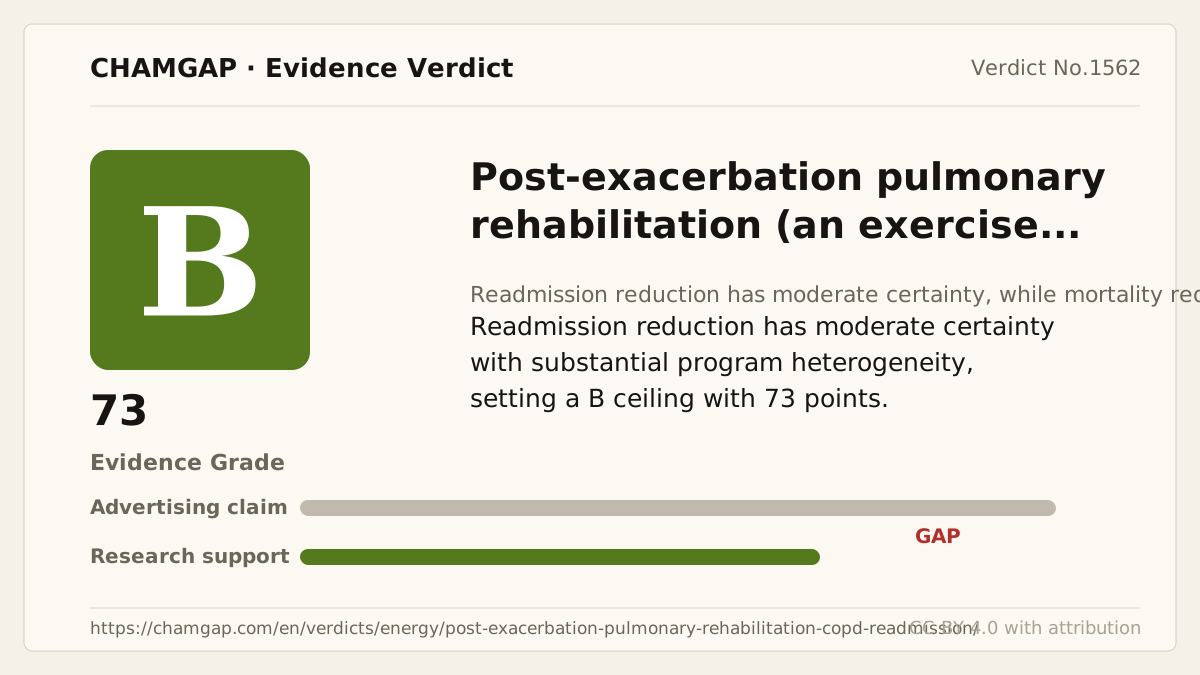
[Chamgap] Post-exacerbation pulmonary rehabilitation x prevention of readmission after COPD hospitalization — Evidence Grade B·73. 2 cited sources checked. Source: https://chamgap.com/en/verdicts/energy/post-exacerbation-pulmonary-rehabilitation-copd-readmission/ · CC BY 4.0CC BY 4.0 — free to use with attribution; do not distort grades, numbers, or verdict meaning.
What this document does and does not do
Chamgap is an information source. It reports what research has and has not confirmed; it does not tell readers what to take or buy. That decision belongs to readers and, when needed, medical or legal professionals. This verdict reflects literature available up to the search date and may change as new research appears. Nothing here is medical advice.