
Portable canned oxygen,
does it really help with Faster fatigue recovery and improved subsequent exercise performance during or after exercise at sea level?
research showsThe claim is graded D because canned oxygen has not improved fatigue recovery or subsequent performance in normoxic sea-level exercise. A blinded placebo-controlled study of 20 healthy adults found no benefit for performance, recovery, or cognition, and a crossover study of 13 athletes found no benefit for heart-rate or ventilation recovery, perceived exertion, or subsequent exercise. The samples were small, but results were consistently null and no large confirmatory trial exists.
ads claimMarketing treats a high oxygen concentration as proof of faster muscle recovery and better next-bout performance. In normally saturated people, a brief inhalation has not been shown to remove the limiting factor in tissue oxygen delivery.
Useful facts when choosing a product
- Canned oxygen provides a limited amount of concentrated oxygen for brief inhalation and is not medical oxygen-treatment equipment.
- A label such as 95% describes can contents, not the dose reaching the alveoli after mixing with room air or a proven clinical effect.
- Normoxic sea-level studies have not shown better heart-rate or ventilation recovery, perceived fatigue, or subsequent performance.
- Oxygen accelerates combustion, so cans must be kept away from flames, smoking, and heat. Breathlessness or suspected hypoxemia should not be self-treated while delaying medical care.
Chamgap Semantic Classification Code
Candidate index · review held
UNK.portable-canned-oxygen.inhaled.faster-fatigue-recovery-and-improved-subsequent-exercise-performance-during-or-after-exercise-at-sea-level.improve.placeboUnknown > Portable canned oxygen > Inhaled > Faster fatigue recovery and improved subsequent exercise performance during or after exercise at sea level > Improvement claim > Placebo
An automated migration candidate, not an issued permanent code; exact claim scope remains under review. This machine-generated migration candidate helps retrieval but is not a permanent assignment. The original verdict ID and URL remain authoritative.
What the research actually shows
Etheredge and colleagues used a blinded placebo-controlled design in 20 healthy adults and found no benefit for exhaustive exercise, respiratory recovery, or recovery cognition. Robbins and colleagues crossed 13 male athletes through air, 100% oxygen, and oxygen followed by air during recovery, finding no difference in heart-rate or ventilation recovery, perceived exertion, or subsequent exhaustive performance. The studies are small but directionally consistent, and no large confirmatory randomized trial was found.
Why this is classified as D (27)
Two controlled normoxic studies found no recovery or subsequent-performance benefit, with small samples and no confirmatory trial, yielding D with 27 points.
Counterpoint. Evidence from altitude or diagnosed hypoxemia cannot be extrapolated to consumer canned oxygen at sea level.
Rejudgment record. New verdict — Applied rules ② and ③ because blinded and crossover controlled studies in healthy normoxic adults consistently found no benefit for recovery, perceived fatigue, or subsequent performance, while samples were small and no large confirmatory trial exists
Sub-claim grades by effect
This ingredient is marketed for several effects. A single overall grade blends strong and weak claims together, so each effect is graded separately here. The overall grade reflects the strongest disconfirming or core claim.
| Effect (sub-claim) | Grade | Basis |
|---|---|---|
| Faster fatigue recovery after sea-level exercise | D | No benefit was found for heart-rate, ventilation, or subjective recovery measures. |
| Improved subsequent exercise performance | D | Subsequent time to exhaustion did not improve in the crossover trial. |
| Improved exercise capacity under normoxia at sea level | D | Small controlled studies are null and no large confirmatory trial exists. |
Cross-check — AI research and Codex final gate
Evidence Table
| Study | Design | Sample | Funding | Endpoint | Result | Weight |
|---|---|---|---|---|---|---|
| Etheredge C et al. 2014 | Blinded placebo-controlled experiment | 20 healthy college-aged adults | Inadequately reported | Exhaustive performance, respiratory recovery, and cognition | The personal oxygen supplement did not improve performance, recovery, or cognition. | Direct null trial |
| Robbins MK et al. 1992 | Random-order crossover trial | 13 male athletes | United States NIH support | Heart-rate and ventilation recovery, Borg rating, and subsequent exhaustive exercise | One hundred percent oxygen did not improve recovery measures or subsequent performance. | Direct null trial |
Receipt — 2 References
All 2 cited sources were verified for existence at the original page (as of 2026-07-23).
Final verification and publication gate: Codex · Evidence date: 2026-07-23 · Corrections: none
Cite this verdict
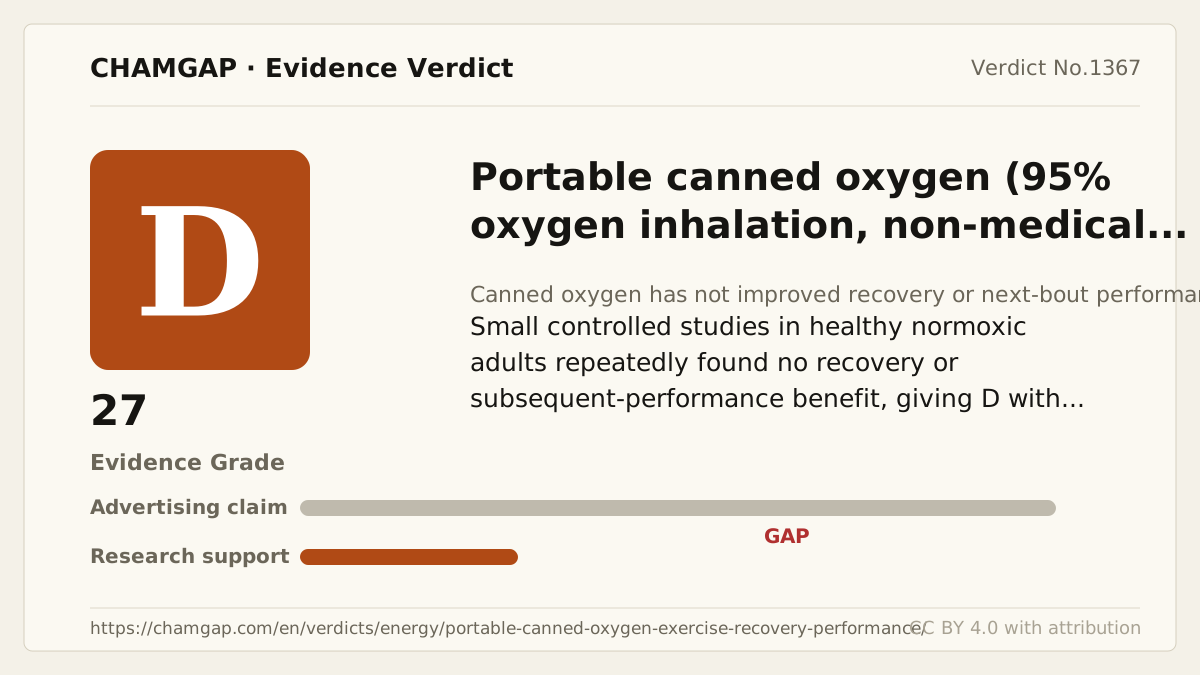
[Chamgap] Portable canned oxygen x exercise recovery and subsequent performance at sea level — Evidence Grade D·27. 2 cited sources checked. Source: https://chamgap.com/en/verdicts/energy/portable-canned-oxygen-exercise-recovery-performance/ · CC BY 4.0CC BY 4.0 — free to use with attribution; do not distort grades, numbers, or verdict meaning.
What this document does and does not do
Chamgap is an information source. It reports what research has and has not confirmed; it does not tell readers what to take or buy. That decision belongs to readers and, when needed, medical or legal professionals. This verdict reflects literature available up to the search date and may change as new research appears. Nothing here is medical advice.