
Pitolisant,
does it really help with Reduced excessive daytime sleepiness and cataplexy in narcolepsy?
research showsPitolisant is rated B because placebo-controlled randomized trials show reductions in excessive daytime sleepiness and cataplexy in narcolepsy. HARMONY I found a significant improvement over placebo on the Epworth Sleepiness Scale, and HARMONY-CTP found roughly half the weekly cataplexy rate seen with placebo. These are patient-experienced clinical symptoms, but the trials lasted only seven to eight weeks, had relatively modest samples, and involved substantial developer participation, so the evidence does not reach A. Headache, insomnia, nausea, and potential QT prolongation are separate safety issues.
ads claimMarketing may portray the drug as simultaneously solving daytime sleepiness and cataplexy or fully restoring normal alertness. The evidence supports average symptom reductions with a prescription treatment, and individual response and residual sleepiness can remain.
Useful facts when choosing a product
- Pitolisant is a prescription antagonist and inverse agonist at central histamine H3 receptors that increases histaminergic wake-promoting signaling.
- It is generally taken once in the morning and titrated according to clinical response and tolerability. The approved label and individual prescription determine the exact dose.
- Its benefit is symptomatic reduction of excessive daytime sleepiness and cataplexy; it does not cure narcolepsy or replace sleep hygiene and management of coexisting sleep disorders.
- Headache, insomnia, and nausea are common, and QT prolongation can occur. A history of QT prolongation, arrhythmia risk, hepatic or renal impairment, and concomitant QT-prolonging medicines require prescriber review.
Chamgap Semantic Classification Code
Candidate index · review held
M.pitolisant.UNK.excessive-daytime-sleepiness-and-cataplexy-in-narcolepsy.reduce.MULTIMedicinal interventions > Pitolisant > Unknown > excessive daytime sleepiness and cataplexy in narcolepsy > Reduction claim > Multiple: primary unresolved
An automated migration candidate, not an issued permanent code; exact claim scope remains under review. This machine-generated migration candidate helps retrieval but is not a permanent assignment. The original verdict ID and URL remain authoritative.
What the research actually shows
Dauvilliers and colleagues' HARMONY I trial randomized 95 adults with narcolepsy to pitolisant, modafinil, or placebo in an eight-week double-blind study. Pitolisant improved the Epworth Sleepiness Scale more than placebo but did not establish noninferiority to modafinil. Szakacs and colleagues' HARMONY-CTP trial randomized 105 patients with frequent cataplexy for seven weeks and found an approximately 49% lower weekly cataplexy rate with pitolisant than placebo. The 2021 AASM guideline used a systematic review and GRADE process to strongly recommend pitolisant for adults with narcolepsy. It controls symptoms but does not remove the cause or cure narcolepsy.
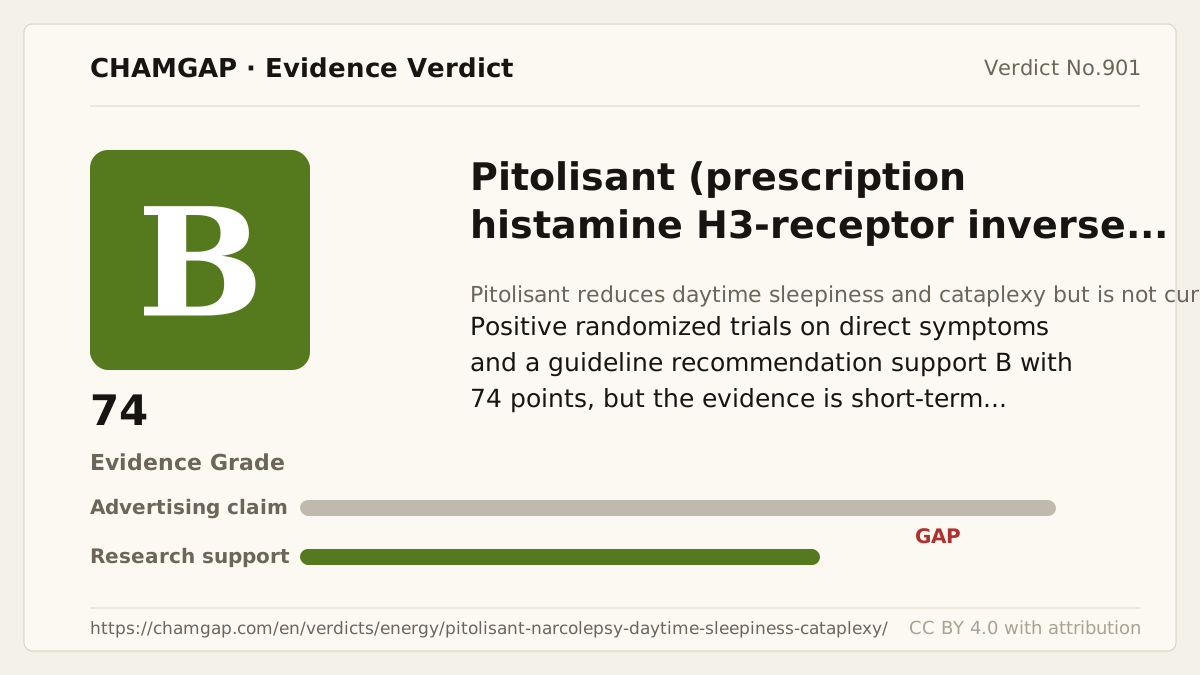
Why this is classified as B (74)
Placebo-controlled trials are positive for the direct symptoms of excessive daytime sleepiness and cataplexy, and the AASM recommends treatment. The pivotal trials nevertheless lasted seven to eight weeks, enrolled 95 and 105 participants, and had substantial developer involvement, falling short of large independent long-term evidence for A. Alignment with the existing narcolepsy solriamfetol verdict gives B with 74 points; QT prolongation remains a separate safety issue.
Counterpoint. If sleepiness or cataplexy remains inadequately controlled, sleep duration, obstructive sleep apnea, sedating co-medications, and other narcolepsy treatments should be reassessed. Driving fitness depends on demonstrated alertness and clinical judgment, not merely on taking the medicine.
Rejudgment record. New verdict — Accepted positive placebo-controlled HARMONY trials on the direct symptoms of excessive daytime sleepiness and cataplexy plus the AASM recommendation, while assigning B for short duration, modest sample sizes, and developer-centered evidence
Sub-claim grades by effect
This ingredient is marketed for several effects. A single overall grade blends strong and weak claims together, so each effect is graded separately here. The overall grade reflects the strongest disconfirming or core claim.
| Effect (sub-claim) | Grade | Basis |
|---|---|---|
| Reduction of excessive daytime sleepiness in narcolepsy | B | Epworth scores and objective wakefulness testing improved, but this does not imply complete normalization or a cure. |
| Reduction of cataplexy frequency in narcolepsy | B | The direct symptom endpoint in HARMONY-CTP was positive, but the trial lasted only seven weeks. |
| Improved objective maintenance of wakefulness in narcolepsy | B | Objective testing supports the symptom findings, while long-term functional outcome data remain limited. |
Cross-check — AI research and Codex final gate
Evidence Table
| Study | Design | Sample | Funding | Endpoint | Result | Weight |
|---|---|---|---|---|---|---|
| Dauvilliers Y et al. HARMONY I. 2013 | Multicenter randomized double-blind placebo- and active-controlled trial | 95 adults with narcolepsy | Supported by Bioprojet with developer authorship | Eight-week change in Epworth Sleepiness Scale score | Pitolisant improved the Epworth score significantly more than placebo but did not establish noninferiority to modafinil. | Core direct evidence for daytime sleepiness |
| Szakacs Z et al. HARMONY-CTP. 2017 | Multicenter randomized double-blind placebo-controlled trial | 105 patients with narcolepsy and cataplexy | Supported by Bioprojet with developer authorship | Weekly cataplexy rate during the seven-week stable-dose period | The weekly cataplexy rate ratio for pitolisant versus placebo was a significant 0.51. | Core direct evidence for cataplexy |
| Maski K et al. AASM guideline. 2021 | Systematic review and GRADE-based clinical practice guideline | Treatment literature across central disorders of hypersomnolence | American Academy of Sleep Medicine | Sleepiness, cataplexy, disease severity, quality of life, and benefit-harm balance | Issued a strong recommendation for pitolisant in adults with narcolepsy. | Independent guideline synthesis |
Receipt — 3 References
All 3 cited sources were verified for existence at the original page (as of 2026-07-20).
Final verification and publication gate: Codex · Evidence date: 2026-07-20 · Corrections: none
Cite this verdict
[Chamgap] Pitolisant x reduced excessive daytime sleepiness and cataplexy in narcolepsy — Evidence Grade B·74. 3 cited sources checked. Source: https://chamgap.com/en/verdicts/energy/pitolisant-narcolepsy-daytime-sleepiness-cataplexy/ · CC BY 4.0CC BY 4.0 — free to use with attribution; do not distort grades, numbers, or verdict meaning.
What this document does and does not do
Chamgap is an information source. It reports what research has and has not confirmed; it does not tell readers what to take or buy. That decision belongs to readers and, when needed, medical or legal professionals. This verdict reflects literature available up to the search date and may change as new research appears. Nothing here is medical advice.