
Oral thiamine hydrochloride,
does it really help with Reduction of persistent fatigue in quiescent inflammatory bowel disease?
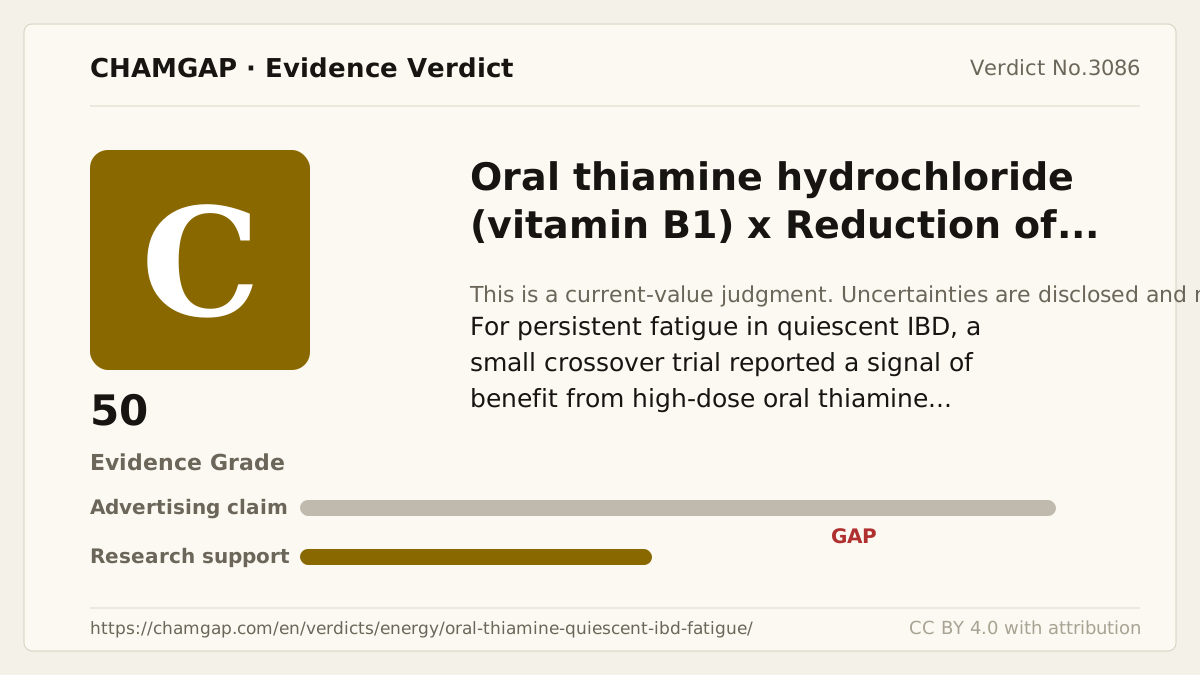
research showsFor persistent fatigue in quiescent IBD, a small crossover trial reported a signal of benefit from high-dose oral thiamine hydrochloride. The current judgment is C·50. Short active exposure and limits in verifying the precise treatment magnitude prevent extending this to all fatigue conditions or durable benefit.
ads claimAdvertising and mechanistic claims were not used as grade bonuses or direct clinical evidence.
Four separate assessment dimensions
| Effect direction and size | For persistent fatigue in quiescent IBD, a small crossover trial reported a signal of benefit from high-dose oral thiamine hydrochloride. The current judgment is C·50. Short active exposure and limits in verifying the precise treatment magnitude prevent extending this to all fatigue conditions or durable benefit. |
|---|---|
| Evidence certainty | The endpoint is patient-reported (P), replication is R1, and disclosed public/nonprofit support gives I2. Short active exposure and a small sample give B2. Reported mean changes are retained, but adjusted crossover effects, paired dispersion and effective analysis denominators were not fully verified, giving EX and CX. The supplied calculator returns C, with the 1 I2 strength axis mapping to the fixed score of 50. |
| Applicability | Adults with quiescent IBD and persistent fatigue after alternative explanations were excluded; not general wellness or all fatigue disorders |
| Safety | The accessed abstract reported only mild side effects, but arm-level event counts and long-term safety were not verified. Findings in quiescent IBD are not automatically applied to pregnancy, children, active disease or other conditions. The high-dose study is not presented as a self-dosing instruction. |
Not official GRADE or treatment-success probability; ? has no score.
Useful facts when choosing a product
- The salt was identified as thiamine hydrochloride. This is a selected quiescent-IBD fatigue question, not a general claim about correcting deficiency. Total dietary intake and treatment effects across all nutrient-deficiency strata remain unconfirmed.
Chamgap Semantic Classification Code
Permanent code issued
S.thiamine-hydrochloride.oral.quiescent-ibd-persistent-fatigue.reduce.placeboSupplements > Thiamine hydrochloride > Oral > Persistent fatigue in quiescent inflammatory bowel disease > Reduction claim > Placebo
Technically bound to the current-value claim boundary fixed by ChatGPT. Unconfirmed dose, duration, study details, and evidence grade remain in verdict fields and revision history rather than the permanent semantic code. The code identifies the intervention and claim; it never contains the evidence grade, score, or safety result.
Exact Claim Classification
These independent facets prevent evidence from different forms, routes, populations, effects, and comparators from being mixed.
| Intervention class | S · Supplement or nutraceutical |
|---|---|
| Canonical ingredient or intervention | Oral thiamine hydrochloride (vitamin B1) |
| Source or part used | Synthetic/fermentation/other production origin unconfirmed; plant-part classification not applicable |
| Formulation or processing | Single-ingredient oral thiamine hydrochloride; detailed dosage form and manufacturer unconfirmed |
| Route | Oral (page question; see observed_evidence for study-route verification) |
| Dose | 600–1800 mg/day according to sex and weight; research regimen |
| Duration | 4 weeks of active treatment; crossover design with 4-week washout |
| Population | Adults with quiescent IBD and persistent fatigue after alternative explanations were excluded; not general wellness or all fatigue disorders |
| Effect or condition | Reduction of persistent fatigue in quiescent inflammatory bowel disease |
| Primary endpoint | Improvement in IBD-F fatigue; distinguish individual response threshold from treatment contrast |
| Comparator | Oral placebo within the same crossover trial |
| Duplicate-detection key | thiamine-hydrochloride|oral|600-1800mg-day|4weeks-crossover|quiescent-ibd-persistent-fatigue|ibd-f-fatigue-scale|placebo |
What the research actually shows
The trial reported a mean fatigue reduction of 4.5 points on thiamine and an increase of 0.75 points on placebo. The arithmetic difference between signed mean changes is −5.25 points, but it is not labeled the paper’s adjusted treatment estimate or its interval. The within-person 3-point response threshold is not a between-group MCID, and crossover observations are not analyzed as independent groups.
Why this is classified as C (50)
The endpoint is patient-reported (P), replication is R1, and disclosed public/nonprofit support gives I2. Short active exposure and a small sample give B2. Reported mean changes are retained, but adjusted crossover effects, paired dispersion and effective analysis denominators were not fully verified, giving EX and CX. The supplied calculator returns C, with the 1 I2 strength axis mapping to the fixed score of 50.
Counterpoint. Vitamer analyses and follow-up from TARIF are not counted as independent replication. Fatigue research in primary biliary cholangitis concerns a different disease, and a B-vitamin–magnesium combination is a different intervention. These are not assembled into repeated refutation or independent multiple replication in IBD.
Rejudgment record. For persistent fatigue in quiescent IBD, a small crossover trial reported a signal of benefit from high-dose oral thiamine hydrochloride. The current judgment is C·50. Short active exposure and limits in verifying the precise treatment magnitude prevent extending this to all fatigue conditions or durable benefit. — The endpoint is patient-reported (P), replication is R1, and disclosed public/nonprofit support gives I2. Short active exposure and a small sample give B2. Reported mean changes are retained, but adjusted crossover effects, paired dispersion and effective analysis denominators were not fully verified, giving EX and CX. The supplied calculator returns C, with the 1 I2 strength axis mapping to the fixed score of 50.
| Endpoint | P | Symptom or function itself is the target - including patient reports and performance tests Case application: P: patient-reported IBD-F fatigue |
| Replication | R1 | Single confirmatory trial Case application: R1: TARIF family counted once |
| Independence | I2 | Decisive evidence is publicly or non-profit funded Case application: I2: identified public/nonprofit foundations, no reported funder role |
| Effect size | EX | The clinical size of the effect could not be judged Case application: EX: raw changes known; current paired/adjusted magnitude verification incomplete; no hypothetical Cohen d used |
| Precision | CX | No pooled confidence interval could be confirmed Case application: CX: interval for the actual paired treatment contrast not verified |
Stored derived and displayed grades match; this is not a current recalculation or validity check (C).
Review performed and remaining limitations
Formal crossover model, paired dispersion and effect interval unconfirmed Full statistical section and supplement of the main paper not obtained Validated between-group MCID in this setting unconfirmed Native databases worldwide were not exhaustively searched; the current judgment is published with that limitation.
Search scope and limitations. tasks/R01-003/search_log.json
Evidence Table
| Study | Design | Sample | Funding | Endpoint | Result | Weight |
|---|---|---|---|---|---|---|
| Bager et al. — oral thiamine and fatigue in quiescent IBD (2021) | Randomized double-blind placebo-controlled crossover trial | 40 enrolled; effective denominator for the crossover analysis unconfirmed | Disclosed public/nonprofit support verified | IBD-F fatigue in quiescent IBD; distinguish response threshold from change magnitude | Mean fatigue reduction 4.5 points, versus increase 0.75 points on placebo; not interpreted as an adjusted treatment-contrast interval | Decisive included result |
| B-vitamins and metabolites in quiescent IBD with fatigue treated with oral thiamine (2023) | Same-trial identity/population support; not independent replication | Only verified denominators are recorded in numeric_evidence.json; assignment totals are not substituted for unknown endpoint analysis counts. | Unconfirmed or not used in this page grade | B-vitamer and fatigue analyses in participants in a B1 trial; not a B2 supplementation contrast | The trial intervention was oral thiamine hydrochloride. B2-related vitamer analyses belong to the same TARIF family and are not a B2 supplementation trial. | Same-trial identity/population support; not independent replication |
| Thiamine follow-up in patients with quiescent IBD and fatigue | Same-trial contextual report; not independent replication | Only verified denominators are recorded in numeric_evidence.json; assignment totals are not substituted for unknown endpoint analysis counts. | Unconfirmed or not used in this page grade | Follow-up in the same IBD-fatigue study family; no new effect estimate adopted | Prior bibliography/access record reused; no unverified effect estimate adopted. | Same-trial contextual report; not independent replication |
| High-dose oral thiamine and fatigue in primary biliary cholangitis (2024) | Excluded: different population | Only verified denominators are recorded in numeric_evidence.json; assignment totals are not substituted for unknown endpoint analysis counts. | Unconfirmed or not used in this page grade | Fatigue in primary biliary cholangitis, not IBD | The primary biliary cholangitis trial is a different disease and is not counted as repeated refutation of IBD-fatigue benefit. | Excluded: different population |
| Vitamin B complex plus magnesium and fatigue in IBD (2026) | Excluded: different or confounded intervention | Only verified denominators are recorded in numeric_evidence.json; assignment totals are not substituted for unknown endpoint analysis counts. | Unconfirmed or not used in this page grade | IBD fatigue with a B-vitamin–magnesium combination, not isolated B1/B2 | The combination intervention contains B1, B6, B12 and magnesium. Its results are not assigned to B2 or to isolated B1. | Excluded: different or confounded intervention |
Receipt — 5 References
Evidence access cutoff: 2026-09-15. Each citation states its actual access level (full-text transcription, abstract, index, or other) and remaining limitations. Bibliographic checking does not certify the study results or treatment efficacy.
Technical integration by: Codex · Evidence date: 2026-09-15 · Corrections: 2
Correction log — 2
Corrections applied to this verdict, in chronological order. Changes are logged, not erased.
- 2026-09-15 · current_value_initial_publication — Hypothesis-dependent standardized effects from the earlier work were removed from final effect estimates. −5.25 points is retained only as an arithmetic difference.
- 2026-09-15 · current_value_initial_publication — Individual response thresholds were separated from between-group MCID, and cohort reanalyses from independent replication.
Cite this verdict
[Chamgap] Oral thiamine hydrochloride (vitamin B1) × Reduction of persistent fatigue in quiescent inflammatory bowel disease — Evidence Grade C·50. 5 cited sources checked. Source: https://chamgap.com/en/verdicts/energy/oral-thiamine-quiescent-ibd-fatigue/ · CC BY 4.0CC BY 4.0 — free to use with attribution; do not distort grades, numbers, or verdict meaning.
What this document does and does not do
Chamgap is an information source. It reports what research has and has not confirmed; it does not tell readers what to take or buy. That decision belongs to readers and, when needed, medical or legal professionals. This verdict reflects literature available up to the search date and may change as new research appears. Nothing here is medical advice.