
TASK-1041 / R01-081 — Oral biotin alone and persistent fatigue: an assessment restricted to the actual MS fatigue-scale evidence
research showsIn one oral-biotin trial in progressive MS,12-month MFIS improvement was not superior to placebo (P=0.85). Reported mean changes of1.38 versus1.30 points give a simple difference of+0.08 points, not an improvement, but the unavailable formal CI prevents an equivalence or excluded-clinical-benefit claim. The trial was not selected for persistent fatigue and cannot establish efficacy for general persistent fatigue, ME/CFS or postinfectious fatigue.
ads claimNo specific advertisement or retail product was evaluated or recommended.
Four separate assessment dimensions
| Effect direction and size | In one oral-biotin trial in progressive MS,12-month MFIS improvement was not superior to placebo (P=0.85). Reported mean changes of1.38 versus1.30 points give a simple difference of+0.08 points, not an improvement, but the unavailable formal CI prevents an equivalence or excluded-clinical-benefit claim. The trial was not selected for persistent fatigue and cannot establish efficacy for general persistent fatigue, ME/CFS or postinfectious fatigue. |
|---|---|
| Evidence certainty | D/28 is the supplied-rule rating of the verified progressive-MS12-month MFIS evidence only, not a D rating for all persistent fatigue. It rests on one manufacturer-supported trial secondary endpoint, with analysis and directness limitations. |
| Applicability | The actual trial was not fatigue-selected. Only the restricted MS MFIS evidence is graded; the effect and grade are not generalized to persistent fatigue. |
| Safety | Caution. Some biotin-susceptible assays can produce misleading thyroid or troponin results. Reported adverse events and withdrawals are separated with actual arm denominators; nonsignificant safety comparisons and missing reports are not proof of safety. Research doses are not instructions for use, prescription changes, interruption or replacement of standard treatment. |
Original calculator D; no validate_axes/check_verdict errors; CLI0. Zero qualifying strength axes select the supplied D-row anchor28. The legacy E0 label is restricted here to non-demonstrated superiority, not a true zero, equivalence or excluded MCID-level benefit.
Useful facts when choosing a product
- The verified source is MS-SPI using stated100mg biotin capsules three times daily.
- No equivalence between ordinary supplements and high-dose pharmaceutical MD1003 is asserted.
- Exact molecular specification, assayed content, total intake and full placebo composition are unverified.
- Research doses are not personal dosing or prescription-change instructions.
Chamgap Semantic Classification Code
Permanent code issued
S.biotin-sole-added-active-md1003.oral.progressive-ms-not-fatigue-selected.12-month-mfis21-total-change.matching-placebo-permitted-background-careSupplements and nutraceuticals > Biotin > Adults18–75 with nonactive progressive PPMS/SPMS, EDSS4.5–7; fatigue selection and nutritional status unverified; indirect for general persistent fatigue > Page endpoint: baseline-to-month12 MFIS21 total change between arms; trial secondary endpoint; language version unverified > Matching placebo capsules with permitted background care; exact placebo composition unverified > oral
Original D/28, restricted progressive-MS 12-month MFIS scope, axes, receipts, 44 uncertainties and full bilingual reports preserved without clinical recalculation. The code identifies the intervention and claim; it never contains the evidence grade, score, or safety result.
Exact Claim Classification
These independent facets prevent evidence from different forms, routes, populations, effects, and comparators from being mixed.
| Intervention class | S · Supplement or nutraceutical |
|---|---|
| Canonical ingredient or intervention | Biotin |
| Source or part used | Vitamin nutrient; actual manufacturing/raw-material origin unverified |
| Formulation or processing | Oral sole-added active pharmaceutical-grade MD1003 biotin capsules; stereoisomer, salt, assayed purity and full excipients unverified |
| Route | oral |
| Dose | Stated100mg per dose three times daily=300mg/day; total dietary intake and assayed active amount unverified |
| Duration | 12-month placebo comparison; baseline-to-month12 MFIS. Both arms active for the next12months |
| Population | Adults18–75 with nonactive progressive PPMS/SPMS, EDSS4.5–7; fatigue selection and nutritional status unverified; indirect for general persistent fatigue |
| Effect or condition | Whether sole-added biotin improves a fatigue scale relative to control in the verified MS cohort; general persistent-fatigue effect unverified |
| Primary endpoint | Page endpoint: baseline-to-month12 MFIS21 total change between arms; trial secondary endpoint; language version unverified |
| Comparator | Matching placebo capsules with permitted background care; exact placebo composition unverified |
| Duplicate-detection key | R01|biotin|oral|sole-added-MD1003|progressive-MS_fatigue-selection-unverified|MFIS21-total|baseline-month12|placebo-background-care |
What the research actually shows
# TASK-1041 / R01-081 — Oral biotin alone and persistent fatigue: an assessment restricted to the actual MS fatigue-scale evidence
Evidence snapshot: **2026-09-17T18:22:29+09:00**. Actual research/self-review date: **2026-09-17T18:46:56+09:00**. New publication ID, URL, semantic code and first-publication date remain unassigned null values.
## Thirty-second answer
**In one oral-biotin trial in progressive MS,12-month MFIS improvement was not superior to placebo (P=0.85). Reported mean changes of1.38 versus1.30 points give a simple difference of+0.08 points, not an improvement, but the unavailable formal CI prevents an equivalence or excluded-clinical-benefit claim. The trial was not selected for persistent fatigue and cannot establish efficacy for general persistent fatigue, ME/CFS or postinfectious fatigue.** [S01, Table3; S02, fatigue measure and eligibility]
**The efficacy rating D / 28 points is restricted to the claim of improved 12-month MFIS in the progressive-MS study.** The exact effect in general adults selected for persistent fatigue remains unverified; neither D nor a no-effect conclusion is assigned to that entire broader population. Manuscript quality **A** is a same-model assessment of traceability, complete bilingual content and disclosed limits, not efficacy grade A or external certification.
## 1. The requested question is not the same as the verified study
The requested contrast is **oral biotin as the sole added active ingredient**, compared with an actual control, on a validated fatigue scale at a defined time in adults with persistent fatigue. Placebo, adequate intake and FSS are proposed conditions until verified. The core accessible evidence is the MS-SPI MFIS result, narrowed as follows.
| Dimension | Verified scope | | --- | --- | | Population | Adults aged18–75 with nonactive progressive PPMS/SPMS, spastic paraparesis and EDSS4.5–7; no fatigue-duration or minimum-fatigue-score enrollment requirement. | | Formulation/additional ingredient | Pharmaceutical-grade MD1003 capsules, stated biotin100mg three times daily. Sole added active ingredient does not mean absence of background treatment. | | Actual comparator | Matching tasteless-powder placebo capsules with permitted background care; exact placebo excipients remain null. | | Time and scale | Baseline-to-month12 change in the21-item MFIS total, range0–84; higher scores indicate greater fatigue impact. | | Nutritional status | A pharmacological high-dose study rather than a deficiency-correction study, but baseline biotin status, adequate intake and total dietary exposure were not verified. | | Directness | Intervention, comparator and fatigue-scale contrast verified within this MS cohort; indirect for fatigue-selected populations and other etiologies. |
Both primary progressive (PPMS) and secondary progressive (SPMS) disease were included, but separate fatigue estimates were not supplied; no synthetic subtype effects are created. ME/CFS, postinfectious or long-COVID fatigue, anemia/endocrine causes, depression/sleep disorders, inherited metabolic disease and deficiency correction cannot be represented by this MS result. Vitality, sleepiness, pain, depression, quality of life, disability and blood markers are not pooled with a fatigue total. [S01–S02; S06–S08]
## 2. Duplicate boundary and reuse
The full **3156-entry index** was screened with the biotin synonyms and MD1003, and **11 complete candidate originals** were read. No completed exact fatigue-scale contrast matched. Existing1639 concerns **walking/disability reversal in MS**, not this MFIS endpoint. Its study identification, formulation, search and safety map were reused; the missing fatigue table and supplement details were newly extracted. Earlier efficacy ratings and scores were not copied.
| Reused ID | Existing independent boundary | | --- | --- | | 009 | Hair/hair loss | | 866 | Nail thickness | | 1639 | Progressive-MS walking/disability reversal, not fatigue score | | 3103 | Diagnosed androgenetic-alopecia hair density | | 3104 | Brittle-nail breakage frequency | | 3105 | Type 2 diabetes HbA1c | | 3106 | Falsely low TSH in susceptible immunoassays | | 3153 | Atopic-dermatitis severity | | 3154 | Painful diabetic neuropathy pain | | 3155 | Diagnosed MCI cognitive scales | | 3156 | Fasting TG in hypertriglyceridemia |
Original candidate what_research values are preserved exactly in `reuse/what_research_originals.json` and immutable input copies. This new claim has no earlier original summary, so `what_research_original=null` has an explicit reason. Records76–78 belong to an earlier closed conversation; only79 and80 were previously complete in this conversation. Original pre-publication/null manifest values and later supplied deployment receipts are historical layers, not contradictions to overwrite. The original Korean-report aliases, six-route receipts, task80 display receipt and recent ten-record hub audit are retained. They are not represented as new live-server checks by this execution.
## 3. Evidence table
| Study | Design and denominator | Intervention, endpoint and result | Funding and use | | --- | --- | --- | --- | | MS-SPI, Tourbah et al.2016; S01–S03; PMID27589059. | 12-month2:1 randomized double-blind placebo phase, then12months of active treatment for all; fatigue is a reported secondary endpoint. Randomized/overallITT103 versus51; MFIS-specific analysis and missing counts are null. | MFIS21 total0–84, higher=worse; baseline-to-month12 change. Administered language version is null. Mean(SD) change1.38(16.04) versus1.30(15.69); between-groupP=.85. Simple difference+0.08 points; formal CI null. | MedDay funding/product supply; CEO/shareholder author. Core single MS fatigue-scale report. Indirect for general persistent fatigue because enrollment was not fatigue-selected; no numerical weight. | | SPI2, Cree et al.2020 and officialSAP; S04–S05. | Oral MD1003 placebo-controlled progressive-MS trial. 642; not added to the current direct MFIS sample. | Disability/walking and separate quality-of-life assessments; no verified validated-fatigue-scale contrast in this access. Negative disability findings are not repeated refutation of a fatigue benefit. | MedDay-supported study in the reused source map; not independent fatigue replication. Endpoint boundary/opposing-disability source map only; not R2/RX evidence. | | Ferorelli et al.2021; S06; DOI10.3390/medsci9030052. | Citozym/Ergozym multi-nutrient intervention versus control for70days; conflicting design terminology retained. Design states50 women withRRMS,25/25; conflicting count wording is not silently resolved or pooled. | FSS and MFIS, kept separate. Reported mixture-associated fatigue improvement cannot be attributed to biotin alone.200mg/100g is a component concentration, not a verified daily dose. | Not used for sole-biotin independence; complete supply arrangements unverified. Positive related human evidence retained but excluded for multiple active ingredients. | | Menon et al.16-week open-label CFS pilot andANZCTR; S07–S08. | Open-label multi-nutrient single group, without an actual control. Not adopted as a direct sole-biotin analysis denominator. | Registered Chalder fatigue scale and20-week plan; kept separate from the16-week report. The registered mixture includes biotin600µg and other active nutrients; plans are not assumed to be administered facts or effects. | Not added to the independence of the core controlled study. Related ME/CFS source map, not a between-group effect of oral biotin alone. |
This is not a weighted meta-analysis. S01/S02/S03 represent one MS-SPI trial; S04/S05 represent one SPI2 trial; S07/S08 link one combination program and its plan/report. Articles, registry pages, reviews and translations are not extra participants or independent replication.
## 4. Numerical verification: within-arm changes, between-arm inference and SD versus CI
MS-SPI Table3 reports **baseline-to-month12 within-arm changes** of **+1.38 (SD16.04)** for biotin and **+1.30 (SD15.69)** for placebo. Neither individual change is a placebo-adjusted effect. The separately reported **between-group Mann–Whitney U P value is0.85**. [S01, Table3 and statistical methods]
The executed arithmetic is **1.38 − 1.30 = +0.08 MFIS points**. With biotin minus placebo, a positive difference is in the worse direction. This is a difference of reported mean changes, not an author-reported adjusted coefficient, a Mann–Whitney location-shift estimate or a confidence interval. It uses two-decimal reported values and does not claim precision beyond the source.
Exact MFIS-specific analysis denominators, observed/LOCF-imputed counts and a formal treatment CI are unavailable. The **103/51 randomized headers were not silently inserted as complete-case MFIS denominators**. SDs were not converted into invented SEs, CIs, standardized effects, responder rates, ARR or NNT. The table footnote refers to patients evaluated at a specified visit, whereas the methods describe overall ITT and LOCF in supportive analyses; those denominator levels remain distinct. [S01]
The supplement defines the MFIS as21 items summed across physical, cognitive and psychosocial domains, total0–84. The administered language version and domain-specific effects remain unknown. The diagram's FIS shorthand and the indexed registry's U-FIS22-item wording were not silently treated as the same instrument. Without complete version history, this is not declared a proven outcome switch either. [S02–S03]
A separate MS important-difference paper was checked, but it is not automatically a validated **between-group** MCID for this trial. With no formal contrast CI, C1 cannot be assigned. Nonsignificance does not establish equivalence or a true effect of zero. [S09; supplied rubric]
### Time points and distinct endpoints
The supplement's M0/M6/M12/M24 schedule is a plan; a month6 effect was not invented. The reported24-month changes, **−0.40 (SD13.49) versus+0.79 (SD13.88), P=0.97**, cover baseline to month24. Both arms received active treatment after month12. These are not an ongoing placebo comparison, a balanced crossover estimate, an independent replication or month12-to24 changes. [S01–S02]
SF-36 energy/fatigue, global impressions, EDSS/walking and MFIS are different outcomes. A positive disability primary endpoint does not prove fatigue benefit. SPI2 disability findings likewise cannot create repeated refutation of a fatigue claim. [S01, S04–S05]
## 5. Design, baseline condition, co-treatment, missingness and bias
MS-SPI used a2:1 parallel allocation at16 French centers. Computer-generated block allocation and allocation-service details in the supplement, matching capsules and12-month patient/investigator masking were verified. Lack of blinding was not invented. Sample-size calculations addressed disability, not fatigue. Table3 lists secondary endpoints in a stated protocol rank, but fatigue-specific multiplicity control and complete prospective registration history remain unverified. [S01–S03]
Randomized totals were **103/51**; mean age (SD) **51.8(9.1)/50.7(8.4)** years; women **53/30**; PPMS **42/13**; SPMS **61/38**. Mean baseline EDSS (SD) was **5.98(0.75)/6.20(0.52)**. These values do not establish baseline fatigue balance. [S01, Table1]
Concomitant disease-modifying therapy was reported for **42/20**, fampridine or amifampridine for **45/28**, and physical therapy for **19/10** participants. Medications generally had to be established for3months before enrollment, or1month for fampridine; intravenous methylprednisolone for relapse was permitted. This does not imply identical fixed doses in both arms. Disability subgroups by co-treatment are not fatigue subgroups. [S01]
During12months, treatment discontinuations were **12/103(11.7%) versus9/51(17.6%)**, including **6 versus7** due to adverse events. The small total sample (<200) is one confirmed B1 item. Overall discontinuation is21/154=13.6%, and exact MFIS missing counts are unknown. The placebo-arm17.6% is disclosed, but the rubric does not explicitly require an any-arm threshold interpretation, so a second definite attrition item was not added. Sponsorship is assessed separately as I0 and absent formal CI as CX; neither is counted again as bias. Centers are not participants and center stratification is not cluster randomization. [S01; supplied rubric]
Baseline nutrition, total dietary intake, additional supplements, actual eGFR and achieved adherence remain null. Exclusion of uncontrolled renal disease or alcoholism, and scheduled compliance checks, do not establish adequate intake, normal measured renal function or high achieved adherence. [S02]
## 6. Opposing and positive related evidence; limits of applicability
Combination-supplement FSS/MFIS improvement reports and CFS multi-nutrient studies are retained as real related human evidence. However, other active components or absence of an actual comparator preclude attribution to biotin alone. Product concentrations and registry plans were not converted into actual daily doses. Dietary associations, animal mechanisms and deficiency symptoms remain separate. [S06–S08]
Within the public searches and accessible originals, **an exactly eligible effect in general adults selected for persistent fatigue was not verified**. That is not a universal claim that human studies do not exist. An oral-biotin human MFIS trial does exist, so `no_human_study=false`. Results on different scales and etiologies are not averaged, and failed access is not treated as a negative result.
## 7. Safety is separate from efficacy
**Safety label: Caution.** Caution. Some biotin-susceptible assays can produce misleading thyroid or troponin results. Reported adverse events and withdrawals are separated with actual arm denominators; nonsignificant safety comparisons and missing reports are not proof of safety. Research doses are not instructions for use, prescription changes, interruption or replacement of standard treatment. [S10–S11]
The12-month MS-SPI safety denominators were103/51. Any adverse event occurred in **84/103(81.6%) versus43/51(84.3%)**, and any serious adverse event in **20/103(19.4%) versus12/51(23.5%)**. These descriptive comparisons do not demonstrate safety equivalence. Severe and serious events are not identical categories, and a missing fatigue CI is not replaced with a safety interval. [S01, Table4]
The article links most apparent hyperthyroidism reports to assay interference while distinguishing a confirmed case of Basedow disease. Events were not uniformly relabeled as either true disease or false tests. The authors' causal assessment of the suicide death is an individual report, not definitive evidence of protection or harm from biotin. [S01]
NIH/FDA describe falsely high or low results in some susceptible assays, including falsely low troponin. Not every method has the same risk. This may matter when investigating fatigue causes; it does not mean that the self-reported MFIS was measured by an affected immunoassay. Biotin-containing products, doses and time of last use should be disclosed to the testing team. This report does not set an individual withholding interval or prescription change. [S10–S11]
## 8. Original-rule execution and final adoption
| Axis | Adopted value and rationale | | --- | --- | | claim_type | B: A clinical fatigue-benefit claim, not a physicochemical fact or a grade for assay interference. | | endpoint | P: Reported21-item MFIS total change from baseline to month12; higher is worse. It is not pooled with FSS, vitality, depression or disability. | | replication | R1: MS-SPI is the one verified controlled study for this endpoint. The legacy single-confirmatory-trial label does not certify fatigue as a primary, powered, prospectively registered confirmatory endpoint. Noncomparable studies and SPI2 disability results do not establish R2 or RX under the replication gates. | | independence | I0: MedDay funded and supplied the core intervention, with a CEO/shareholder author. Independent ethics, monitoring or randomization services are not independent funding or replication. | | effect | E0: The legacy calculator labels this code no effect. Here it means only that improved MFIS relative to placebo was not demonstrated in MS-SPI (P=.85). It does not mean a true zero effect, equivalence, excluded clinical benefit or ineffectiveness for every fatigue etiology. E+ is not used and no validated MCID fulfillment is claimed. | | precision | CX: The formal contrast CI and exact MFIS analysis denominators are unverified. C1 is not assigned, and an external MID such as4points is not promoted to a validated between-group threshold. | | bias | B1: The small sample154<200 is one confirmed checklist item. Placebo discontinuation9/51=17.6% is disclosed as a concern, but overall discontinuation is21/154=13.6% and MFIS missing denominators are unknown, so a second confirmed ≥15% attrition item is not counted. Randomization/blinding failures or duplicate penalties for funding/precision are not invented. | | flags | Not a large hard-endpoint trial. MS-SPI had a successful disability primary endpoint and a nonsignificant fatigue secondary endpoint, so primary_failed_secondary_positive=false and coprimary_split=false. SPI2 results do not set these flags. |
The unchanged supplied calculator was actually executed on these inputs: **validate_axes=[] → derive_grade=D → check_verdict=[]; CLI exit0**. Its pre/post SHA-256 was unchanged. The original program derives grades, not scores. The supplied rubric was therefore separately applied: none of H/R2/I2/E+/C1/B0/large-hard-endpoint flags qualified as a strength, giving **zero strengths and the D-row anchor28**. Zero qualifying strengths is not an invented zero efficacy score or an imputation for unknown independence.
**The legacy E0 wording and the adopted meaning are distinct.** Here E0 records non-demonstrated superiority in the verified MS MFIS contrast, not a true zero effect, equivalence or exclusion of clinical benefit. R1 does not certify prospective confirmatory design for fatigue. These explanations are preserved in bilingual `assessment_profile.axis_notes` and the final-adoption receipt. E+, C1 and RX were not adopted. Policy gaps from77–79, C/54 from80 and the prior1639 disability score were not inherited.
## 9. Explicit unresolved-value ledger
All **44 values below are null**. Not reported means unavailable in the accessed material; it is not a universal no-study assertion or a numerical zero. Not applicable refers to a design-inapplicable contrast; inaccessible/conflicting mark separate access or mapping issues.
| Field | Information status | Reason for null | | --- | --- | --- | | persistent_fatigue_entry_duration | not_reported | MS-SPI eligibility does not specify a persistent-fatigue duration. | | persistent_fatigue_entry_threshold | not_reported | No minimum fatigue score or diagnosed fatigue syndrome is specified for enrollment. | | baseline_mfis_mean_by_arm | not_reported | The accessible table gives changes, not arm-specific baseline MFIS means. | | final_mfis_mean_by_arm | not_reported | Separate month12 MFIS means were not reported. | | mfis_language_version | not_reported | A French setting does not establish the administered language version or its validation. | | mfis_exact_analysis_n_by_arm | not_reported | The103/51 headers are randomized/ITT totals; MFIS-specific observed/imputed denominators are not supplied. | | mfis_missing_count_by_arm | not_reported | MFIS missing and LOCF-imputed counts are not separately given. | | mfis_adjusted_between_group_coefficient | not_reported | The report supplies arm mean changes and a Mann–Whitney test, not an adjusted treatment coefficient. | | mfis_between_group_standard_error | not_reported | Exact analysis denominators are unavailable for converting change SDs into a treatment SE. | | mfis_between_group_confidence_interval | not_reported | No formal contrast CI or sufficient data for a test-consistent reconstruction are available. | | mfis_validated_between_group_mcid | not_reported | A separate MS important-difference study is not promoted to a validated trial-specific between-group threshold. | | mfis_responder_definition | not_reported | No fatigue responder criterion is supplied; disability response thresholds are not substituted. | | mfis_responder_counts | not_reported | Fatigue responder counts are unavailable; no ARR or NNT is constructed. | | mfis_domain_effects | not_reported | Physical, cognitive and psychosocial MFIS treatment contrasts are not supplied. | | mfis_effect_ppms_separate | not_reported | A PPMS-specific fatigue estimate is not supplied. | | mfis_effect_spms_separate | not_reported | An SPMS-specific fatigue estimate is not supplied. | | mfis_six_month_contrast | not_reported | The scheduled month6 visit is not converted into an observed contrast. | | mfis_baseline_change_correlation | not_reported | Baseline/follow-up pairing correlations or covariances are not reported. | | mfis_repeated_measure_model | not_reported | A fatigue-specific repeated-measures model and covariance structure are unverified. | | mfis_multiplicity_adjusted_p | not_reported | A multiplicity-adjusted MFIS P value among multiple secondary endpoints is unverified. | | prospective_fatigue_registration_history | inaccessible | The complete registry history and original MS-SPI protocol/SAP were not obtained. | | registry_mfis_ufis_reconciliation | conflicting | Paper MFIS21, diagram FIS and indexed registry U-FIS22 cannot be reconciled without full version history. | | biotin_stereoisomer_salt_certificate | not_reported | No administered stereoisomer/salt certificate beyond biotin/MD1003 was verified. | | manufacturing_origin | not_reported | Synthetic, fermentation or raw-material origin is unverified. | | assayed_active_amount | not_reported | The100mg amount is stated content; assayed active content is unverified. | | full_active_capsule_excipients | not_reported | Lactose is mentioned, but the complete active-capsule excipient list is unverified. | | full_placebo_composition | not_reported | Identical appearance and tasteless powder do not establish exact placebo composition. | | baseline_biotin_status | not_reported | Baseline biotin concentration, functional markers and deficiency classification are not supplied. | | adequate_intake_confirmed | not_reported | A non-deficiency treatment aim does not prove nutritional sufficiency. | | total_dietary_biotin | not_reported | Total biotin from diet and other supplements is unverified. | | other_supplement_exposure | not_reported | Permitted concomitant medication does not establish equal exposure to other supplements. | | actual_adherence_by_arm | not_reported | Compliance checks were scheduled, but achieved arm-specific adherence is unverified. | | actual_renal_function_by_arm | not_reported | Excluding uncontrolled renal disease does not establish actual arm-specific eGFR. | | diet_alcohol_changes_by_arm | not_reported | Actual dietary/alcohol changes are unverified despite the alcoholism exclusion. | | fatigue_effect_by_concomitant_treatment | not_reported | Disability subgroups by fampridine or other therapy are not fatigue-effect subgroups. | | fatigue_effect_by_deficiency | not_reported | Deficiency-stratified fatigue effects are unavailable. | | long_term_placebo_fatigue_effect | not_applicable | After month12 both groups received active treatment; month24 is not an ongoing placebo comparison. | | long_term_special_population_safety | not_reported | Comparative long-term and pregnancy, pediatric or severe hepatic/renal safety is unverified. | | me_cfs_sole_biotin_contrast | not_reported | No eligible sole-added oral-biotin ME/CFS scale contrast was verified in the searched material. | | postinfectious_fatigue_sole_biotin_contrast | not_reported | No eligible sole-biotin contrast for postinfectious or long-COVID fatigue was verified. | | anemia_endocrine_fatigue_contrast | not_reported | No eligible sole-biotin fatigue contrast for anemia or endocrine etiologies was verified. | | deficiency_correction_fatigue_scale_contrast | not_reported | Deficiency or inherited-metabolic treatment is not merged into this supplementation effect. | | general_persistent_fatigue_exact_effect | not_reported | A directly eligible contrast in general adults selected for persistent fatigue is unverified. | | fss_fis_ufis_facit_chalder_sole_biotin_effects | not_reported | Eligible sole-biotin effects on other scales are not converted from MFIS. |
## 10. Self-review, completion and revision conditions
This completed manuscript was self-reviewed by the same model for sources, numbers, scope, grading, safety and both full languages. It is not independent external review, journal certification or an error-free guarantee. Translations, copies of one paper and technical tests are not independent clinical replication.
The review covered all62 input files and JSON structures, the3156-entry index,11 complete biotin candidates, records76–80 with Korean-report aliases and supplied deployment/display receipts, and the recent ten-record technical audit. It checked new fatigue-gap searches, original articles, supplements, tables/diagrams, official safety sources, original-calculator execution and bilingual correspondence. No server work, deployment, new chat, subagent, next task82 or independent external review was performed. Exact searches, failed accesses, numerical checks and pre-submission changes are recorded in the verification report and JSON receipts. No exhaustive paid-database search, author contact, participant-level reanalysis, independent external review or user-server access was performed. Search snippets were not counted as total database yields.
Content status is `completed_with_uncertainty` / `completed_with_declared_scope`, with manuscript readiness `ready_with_uncertainty`. Technical publication status is **needs_id_assignment**: new ID/slug/URL/semantic code/first publication remain null. The sole representative ingredient tag uses the existing canonical Biotin entry. Kind=S preserves the supplied nutrient-claim classification; it does not assert that the high-dose pharmaceutical MD1003 is equivalent to ordinary retail supplements or is authorized. Category=energy is a retrieval category, not an efficacy assurance.
Verified exact MFIS denominators/data/CI, actual fatigue-entry requirements, registration/protocol history, language version/MCID, new direct comparisons, corrections/retractions, formulation/dose/safety information or changed classification boundaries would trigger a traceable revision while retaining a subsequently assigned ID. Clinical review is complete here with **clinical_todo=[]**. The technical recipient handles formatting, IDs, list links, builds and deployment, not renewed clinical searches or calculator reruns.
Initial `corrections=[]` means there is no public post-publication correction history. Pre-submission changes are a separate audit. Roles and executed checks for the input, frozen completion, exact restoration, separate recompression and delivery wrapper are documented in external integrity/execution receipts. Technical checks are not independent clinical verification. This completion brings the current conversation's content total to79,80 and81, **FULL 3/5**. Task82 was not started.
## Sources
- **S01**. Tourbah et al. 2016. MD1003 (high-dose biotin) for the treatment of progressive multiple sclerosis: a randomised, double-blind, placebo-controlled study. DOI: 10.1177/1352458516667568. PMID: 27589059. [Source](https://journals.sagepub.com/doi/10.1177/1352458516667568). - **S02**. MS-SPI supplementary materials: eligibility, randomization, assessment definitions and Figure S1. DOI: 10.1177/1352458516667568. [Source](https://journals.sagepub.com/doi/suppl/10.1177/1352458516667568/suppl_file/suppl-material.pdf). - **S03**. ClinicalTrials.gov study NCT02220933 (MS-SPI). [Source](https://clinicaltrials.gov/study/NCT02220933). - **S04**. Cree et al. 2020. Safety and efficacy of MD1003 in progressive multiple sclerosis (SPI2). DOI: 10.1016/S1474-4422(20)30347-1. PMID: 33222767. [Source](https://pubmed.ncbi.nlm.nih.gov/33222767/). - **S05**. SPI2 Statistical Analysis Plan, MD1003CT2016-01/SPI2, version7.0. [Source](https://cdn.clinicaltrials.gov/large-docs/37/NCT02936037/SAP_001.pdf). - **S06**. Ferorelli et al. 2021. Reduction in Fatigue Symptoms Following the Administration of Nutritional Supplements in Patients with Multiple Sclerosis. DOI: 10.3390/medsci9030052. [Source](https://www.researchgate.net/publication/353387883_Reduction_in_Fatigue_Symptoms_Following_the_Administration_of_Nutritional_Supplements_in_Patients_with_Multiple_Sclerosis). - **S07**. Menon et al. Mitochondrial modifying nutrients in treating chronic fatigue syndrome: a16-week open-label pilot study. [Source](https://australianrotaryhealth.org.au/wp-content/uploads/2020/02/10.-Mitochondrial-modifying-nutrients-in-treating-chronic-fatigue-syndrome.pdf). - **S08**. ANZCTR trial record: mitochondrial modifying nutrients for chronic fatigue syndrome. [Source](https://www.anzctr.org.au/Trial/Registration/TrialReview.aspx?id=370610). - **S09**. Rooney et al. 2019. Minimally important difference of the fatigue severity scale and modified fatigue impact scale in people with multiple sclerosis. DOI: 10.1016/j.msard.2019.07.028. PMID: 31400557. [Source](https://pubmed.ncbi.nlm.nih.gov/31400557/). - **S10**. NIH Office of Dietary Supplements: Biotin, Health Professional Fact Sheet. [Source](https://ods.od.nih.gov/factsheets/Biotin-HealthProfessional/). - **S11**. FDA: Biotin interference with troponin lab tests—assays subject to biotin interference. [Source](https://www.fda.gov/medical-devices/in-vitro-diagnostics/biotin-interference-troponin-lab-tests-assays-subject-biotin-interference).
Source use: direct links, locations, factual extractions and original appraisal are provided. Complete publisher articles and figures are not redistributed. The open-access MS-SPI HTML, PDF and supplement are representations of the same study. Historical originals are preserved only as immutable user-supplied reference material.
Why this is classified as D (28)
Original calculator D; no validate_axes/check_verdict errors; CLI0. Zero qualifying strength axes select the supplied D-row anchor28. The legacy E0 label is restricted here to non-demonstrated superiority, not a true zero, equivalence or excluded MCID-level benefit.
Counterpoint. Positive multi-nutrient fatigue reports are not sole-biotin effects; MS disability findings are also separate.
| Claim type | B | B: A clinical fatigue-benefit claim, not a physicochemical fact or a grade for assay interference. |
| Endpoint | P | Symptom or function itself is the target - including patient reports and performance tests Case application: P: Reported21-item MFIS total change from baseline to month12; higher is worse. It is not pooled with FSS, vitality, depression or disability. |
| Replication | R1 | Single confirmatory trial Case application: R1: MS-SPI is the one verified controlled study for this endpoint. The legacy single-confirmatory-trial label does not certify fatigue as a primary, powered, prospectively registered confirmatory endpoint. Noncomparable studies and SPI2 disability results do not establish R2 or RX under the replication gates. |
| Independence | I0 | Evidence comes only from manufacturer studies Case application: I0: MedDay funded and supplied the core intervention, with a CEO/shareholder author. Independent ethics, monitoring or randomization services are not independent funding or replication. |
| Effect size | E0 | E0: The legacy calculator labels this code no effect. Here it means only that improved MFIS relative to placebo was not demonstrated in MS-SPI (P=.85). It does not mean a true zero effect, equivalence, excluded clinical benefit or ineffectiveness for every fatigue etiology. E+ is not used and no validated MCID fulfillment is claimed. |
| Precision | CX | No pooled confidence interval could be confirmed Case application: CX: The formal contrast CI and exact MFIS analysis denominators are unverified. C1 is not assigned, and an external MID such as4points is not promoted to a validated between-group threshold. |
| Risk of bias | B1 | B1: The small sample154<200 is one confirmed checklist item. Placebo discontinuation9/51=17.6% is disclosed as a concern, but overall discontinuation is21/154=13.6% and MFIS missing denominators are unknown, so a second confirmed ≥15% attrition item is not counted. Randomization/blinding failures or duplicate penalties for funding/precision are not invented. |
| Additional flags | Not a large hard-endpoint trial. MS-SPI had a successful disability primary endpoint and a nonsignificant fatigue secondary endpoint, so primary_failed_secondary_positive=false and coprimary_split=false. SPI2 results do not set these flags. |
Review performed and remaining limitations
Persistent-fatigue selection, administered MFIS language version, baseline/final means, endpoint-specific analysis/missing denominators, formal contrast CI, validated between-group MCID, registry history and MFIS/U-FIS mapping, nutritional status, total intake, exact molecular specification, full placebo composition, achieved adherence, other fatigue etiologies and long-term/special-population safety remain unverified.
Evidence Table
| Study | Design | Sample | Funding | Endpoint | Result | Weight |
|---|---|---|---|---|---|---|
| MS-SPI, Tourbah et al.2016; S01–S03; PMID27589059. | 12-month2:1 randomized double-blind placebo phase, then12months of active treatment for all; fatigue is a reported secondary endpoint. | Randomized/overallITT103 versus51; MFIS-specific analysis and missing counts are null. | MedDay funding/product supply; CEO/shareholder author. | MFIS21 total0–84, higher=worse; baseline-to-month12 change. Administered language version is null. | Mean(SD) change1.38(16.04) versus1.30(15.69); between-groupP=.85. Simple difference+0.08 points; formal CI null. | Core single MS fatigue-scale report. Indirect for general persistent fatigue because enrollment was not fatigue-selected; no numerical weight. |
| SPI2, Cree et al.2020 and officialSAP; S04–S05. | Oral MD1003 placebo-controlled progressive-MS trial. | 642; not added to the current direct MFIS sample. | MedDay-supported study in the reused source map; not independent fatigue replication. | Disability/walking and separate quality-of-life assessments; no verified validated-fatigue-scale contrast in this access. | Negative disability findings are not repeated refutation of a fatigue benefit. | Endpoint boundary/opposing-disability source map only; not R2/RX evidence. |
| Ferorelli et al.2021; S06; DOI10.3390/medsci9030052. | Citozym/Ergozym multi-nutrient intervention versus control for70days; conflicting design terminology retained. | Design states50 women withRRMS,25/25; conflicting count wording is not silently resolved or pooled. | Not used for sole-biotin independence; complete supply arrangements unverified. | FSS and MFIS, kept separate. | Reported mixture-associated fatigue improvement cannot be attributed to biotin alone.200mg/100g is a component concentration, not a verified daily dose. | Positive related human evidence retained but excluded for multiple active ingredients. |
| Menon et al.16-week open-label CFS pilot andANZCTR; S07–S08. | Open-label multi-nutrient single group, without an actual control. | Not adopted as a direct sole-biotin analysis denominator. | Not added to the independence of the core controlled study. | Registered Chalder fatigue scale and20-week plan; kept separate from the16-week report. | The registered mixture includes biotin600µg and other active nutrients; plans are not assumed to be administered facts or effects. | Related ME/CFS source map, not a between-group effect of oral biotin alone. |
Receipt — 11 References
Evidence access cutoff: 2026-09-17T18:46:56+09:00. Each citation states its actual access level (full-text transcription, abstract, index, or other) and remaining limitations. Bibliographic checking does not certify the study results or treatment efficacy.
Technical integration by: Codex · Evidence date: 2026-09-17T18:46:56+09:00 · Corrections: none
Cite this verdict
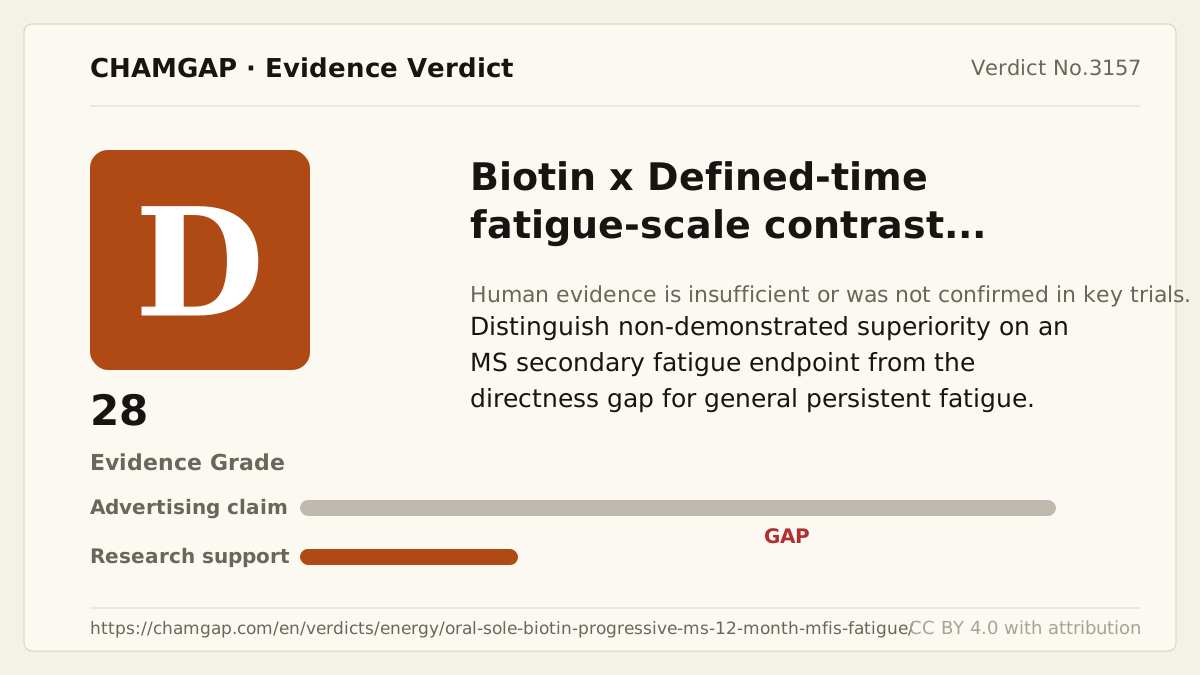
[Chamgap] TASK-1041 / R01-081 — Oral biotin alone and persistent fatigue: an assessment restricted to the actual MS fatigue-scale evidence — Evidence Grade D·28. 11 cited sources checked. Source: https://chamgap.com/en/verdicts/energy/oral-sole-biotin-progressive-ms-12-month-mfis-fatigue/ · CC BY 4.0CC BY 4.0 — free to use with attribution; do not distort grades, numbers, or verdict meaning.
What this document does and does not do
Chamgap is an information source. It reports what research has and has not confirmed; it does not tell readers what to take or buy. That decision belongs to readers and, when needed, medical or legal professionals. This verdict reflects literature available up to the search date and may change as new research appears. Nothing here is medical advice.