
Alternate-day versus daily oral iron,
does it really help with Improved eight-week hemoglobin response versus daily dosing?
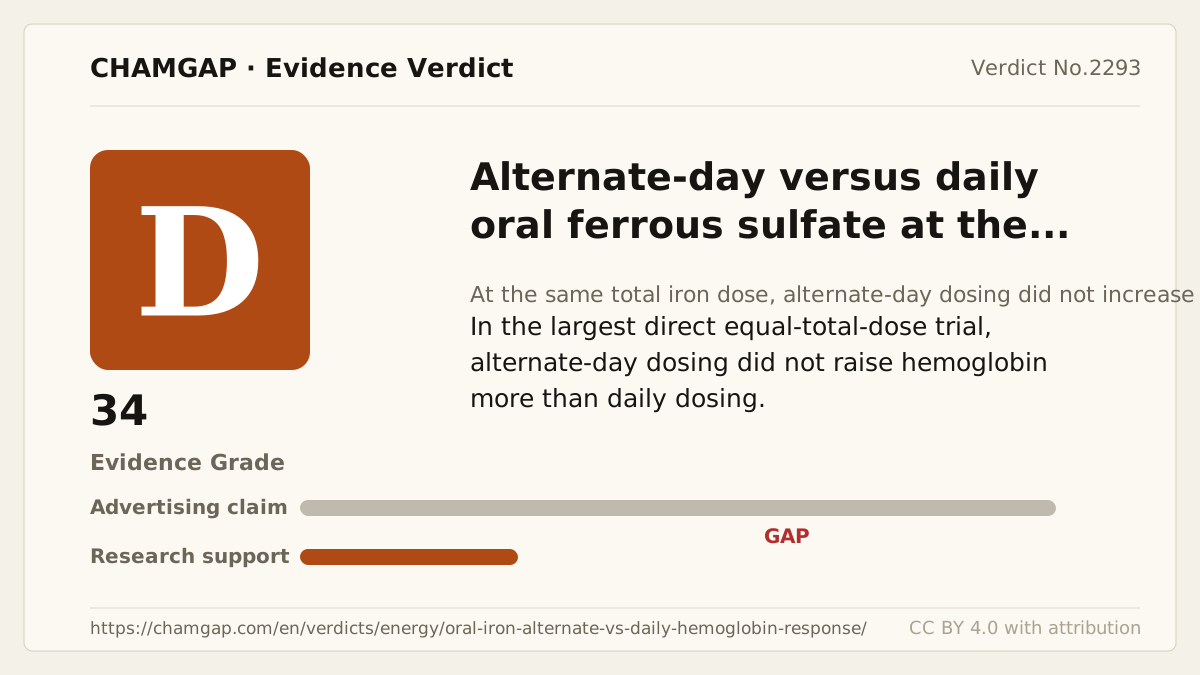
research showsThe grade is D with 28 points. A 200-adult trial compared 120 mg on alternate days with 60 mg daily for eight weeks, giving a nominal cumulative 3,360 mg in each arm. Hemoglobin rose by 1.05±1.34 versus 1.36±1.51 g/dL, P=.47, so alternate-day superiority was not shown. The approximate standardized difference was 0.22 in favor of daily dosing, a small and nonsignificant difference.
ads claimVerdict 421 is A with 92 points for oral iron treating iron-deficiency anemia. This is the separate question of whether alternate-day administration produces a better hemoglobin response than daily administration.
Useful facts when choosing a product
- Nominal cumulative elemental iron was 3,360 mg in each arm.
- Hemoglobin is a surrogate; fatigue, function, and hospitalization were not directly tested.
- Absorption, hepcidin, and ferritin were kept separate from hemoglobin superiority.
- A no-competing-interests declaration is not a no-funding declaration; funding was not stated.
Chamgap Semantic Classification Code
Candidate index · review held
UNK.alternate-day-versus-oral-ferrous-sulfate-at-the-same-cumulative-elemental-iron-dose.oral.hemoglobin-response.improve.activeUnknown > Alternate-day versus oral ferrous sulfate at the same cumulative elemental-iron dose > Oral > hemoglobin response > Improvement claim > Active comparator
An automated migration candidate, not an issued permanent code; exact claim scope remains under review. This machine-generated migration candidate helps retrieval but is not a permanent assignment. The original verdict ID and URL remain authoritative.
What the research actually shows
Pasupathy and colleagues randomized 200 adults aged at least 16 years with iron-deficiency anemia and hemoglobin no greater than 10 g/dL in a double-blind active-control trial. Alternate-day participants received 120 mg every other day and daily participants received 60 mg daily for eight weeks, nominally 3,360 mg per arm. The primary outcome was eight-week mean hemoglobin change: 1.05±1.34 versus 1.36±1.51 g/dL, P=.47. Ferritin and reticulocyte outcomes also did not differ. Week-four nausea was 10.3% versus 2.0%, P=.015, and no participant stopped for adverse effects. The paper declared no competing interests but did not state the funding source.
Why this is classified as D (28)
The equal-total-dose 200-person trial was null for alternate-day hemoglobin superiority and had no clinical exclusion threshold, giving D with 28 points.
Counterpoint. Alternate-day dosing may still be practical for tolerability or convenience. Failure to show superiority is not a prohibition on alternate-day prescribing.
Rejudgment record. Cross-check applied — Equal nominal cumulative dose, change means and standard deviations from the 200-person trial, separation of hemoglobin from ferritin and absorption, adverse events, and unstated funding were applied
| Endpoint | S | Surrogate marker - laboratory or imaging measures |
| Replication | R1 | Single confirmatory trial |
| Independence | I1 | Mixed funding sources |
| Effect size | E0 | Null |
| Precision | C0 | The confidence interval leaves room for benefit |
Stored derived and displayed grades match; this is not a current recalculation or validity check (D).
Sub-claim grades by effect
This ingredient is marketed for several effects. A single overall grade blends strong and weak claims together, so each effect is graded separately here. The overall grade reflects the strongest disconfirming or core claim.
| Effect (sub-claim) | Grade | Basis |
|---|---|---|
| Alternate-day dosing raises hemoglobin more than daily dosing at the same total dose | D | The eight-week comparison was null in the 200-person trial. |
| Alternate-day dosing increases fractional iron absorption | C | Small absorption studies were positive, but this is a different surrogate endpoint. |
Cross-check — AI research and Codex final gate
Evidence Table
| Study | Design | Sample | Funding | Endpoint | Result | Weight |
|---|---|---|---|---|---|---|
| Pasupathy E et al. 2023 | Double-blind active-control randomized trial | 200 randomized and analyzed by intention to treat: 100 alternate-day and 100 daily | Funding source not stated; no competing interests declared | Mean change in hemoglobin at eight weeks | Alternate-day +1.05±1.34 versus daily +1.36±1.51 g/dL, P=.47; approximate standardized difference about -0.22. | Pivotal direct equal-total-dose trial |
Receipt — 2 References
All 2 cited sources were verified for existence at the original page (as of 2026-08-05).
Final verification and publication gate: Codex · Evidence date: 2026-08-05 · Corrections: none
Cite this verdict
[Chamgap] Alternate-day versus daily oral iron x hemoglobin response — Evidence Grade D·28. 2 cited sources checked. Source: https://chamgap.com/en/verdicts/energy/oral-iron-alternate-vs-daily-hemoglobin-response/ · CC BY 4.0CC BY 4.0 — free to use with attribution; do not distort grades, numbers, or verdict meaning.
What this document does and does not do
Chamgap is an information source. It reports what research has and has not confirmed; it does not tell readers what to take or buy. That decision belongs to readers and, when needed, medical or legal professionals. This verdict reflects literature available up to the search date and may change as new research appears. Nothing here is medical advice.