
Nitrate-rich beetroot juice,
does it really help with Improved exercise tolerance, walking or cycling endurance, and dyspnea in patients with COPD?
research showsNitrate-rich beetroot juice in COPD is rated D because the pooled evidence for the key exercise endpoints is null. A 2021 meta-analysis of eight trials found no significant effect on six-minute walk distance, cycle-ergometer endurance time, or peak oxygen uptake, with improvement only in subjective measures such as Borg perceived exertion. Acute crossover trials of 11 and 15 participants reported longer shuttle-walk distance or high-intensity cycling time, but the samples are very small and the findings were not reproduced. Prioritizing the repeatedly null pooled exercise endpoints gives 38 points; evidence in healthy adults for blood pressure and exercise performance is graded separately.
ads claimClaims may combine athlete studies with COPD evidence and describe reliable gains in oxygen efficiency, breathlessness, and walking capacity. In the pooled COPD evidence, most major exercise tests were not significant and dyspnea or perceived-exertion signals were more consistent.
Useful facts when choosing a product
- Study products standardized nitrate content and commonly used nitrate-depleted beetroot juice as the control, unlike ordinary unstandardized beet juice.
- Beet pigments can cause red urine or stool and can stain teeth and oral surfaces.
- Dietary nitrate can lower blood pressure, so hypotension and concurrent antihypertensive or nitrate medicines can alter symptomatic blood-pressure effects.
- Oral bacteria participate in the nitrate-to-nitrite pathway, and strong antibacterial mouthwash can change conversion relative to trial conditions.
Chamgap Semantic Classification Code
Candidate index · review held
S.standardized-nitrate-rich-beetroot-juice.UNK.exercise-tolerance-walking-or-cycling-endurance-and-dyspnea-with-copd.improve.placeboSupplements and nutraceuticals > Standardized nitrate-rich beetroot juice > Unknown > exercise tolerance, walking or cycling endurance, and dyspnea with COPD > Improvement claim > Placebo
An automated migration candidate, not an issued permanent code; exact claim scope remains under review. This machine-generated migration candidate helps retrieval but is not a permanent assignment. The original verdict ID and URL remain authoritative.
What the research actually shows
Alshafie et al. pooled eight COPD trials and found no significant placebo-adjusted effect on six-minute walk distance, cycle-ergometer endurance, or maximal oxygen uptake, while the Borg perceived-exertion score improved. In an 11-person double-blind crossover trial, Kerley et al. found that change in incremental shuttle-walk distance favored the high-nitrate drink by 39 meters over the low-nitrate control. A 15-person single-blind crossover trial by Berry et al. reported longer endurance at 75% of maximal work capacity. Small samples and different tests keep endurance, six-minute walk, and dyspnea claims separately limited to C.
Why this is classified as D (38)
Multiple direct randomized crossover trials exist in COPD, but the eight-trial meta-analysis was null for six-minute walk distance, cycling endurance, and peak oxygen uptake, and positive signals were limited to small samples and subjective measures. Prioritizing the null key endpoints gives D with 38 points.
Counterpoint. A change in Borg dyspnea or perceived exertion can matter to patients but does not establish improved lung function, exacerbations, hospitalization, or survival.
Rejudgment record. Cross-check applied — At cross-check the C draft was lowered to D (38 points) by prioritizing the eight-trial meta-analysis in which six-minute walk distance, cycling endurance, and peak oxygen uptake were all null, while acknowledging small-trial positive signals and improvement in subjective measures such as Borg.
Sub-claim grades by effect
This ingredient is marketed for several effects. A single overall grade blends strong and weak claims together, so each effect is graded separately here. The overall grade reflects the strongest disconfirming or core claim.
| Effect (sub-claim) | Grade | Basis |
|---|---|---|
| Improved exercise endurance time | D | Some small crossover trials were positive, but pooled cycling endurance time was not significant. |
| Improved six-minute or shuttle-walk performance | D | A positive shuttle-walk trial exists, but pooled six-minute walking was null and test methods were heterogeneous. |
| Reduced dyspnea | D | The Borg perceived-exertion signal favored treatment but is a subjective surrogate based on small trials. |
Cross-check — AI research and Codex final gate
Evidence Table
| Study | Design | Sample | Funding | Endpoint | Result | Weight |
|---|---|---|---|---|---|---|
| Alshafie S et al. 2021 | Systematic review and meta-analysis | Eight COPD trials | No external funding reported | Six-minute walking, cycling endurance, maximal oxygen uptake, and Borg perceived exertion | Major exercise outcomes were not significant, while the Borg measure favored nitrate-rich juice. | Key conflicting synthesis |
| Kerley CP et al. 2015 | Acute double-blind randomized placebo-controlled crossover trial | 11 participants with stable COPD | Academic study as reported | Incremental shuttle-walk distance | Distance increased by 25 m after the high-nitrate drink and decreased by 14 m after the low-nitrate drink, a significant difference in change. | Very small positive direct trial |
| Berry MJ et al. 2015 | Randomized single-blind crossover trial | 15 participants with COPD | Wake Forest academic study; product supply reported | Constant-work-rate endurance at 75% of maximal work capacity | Nitrate-rich beetroot juice increased endurance time compared with placebo. | Small positive direct trial |
Receipt — 3 References
All 3 cited sources were verified for existence at the original page (as of 2026-07-23).
Final verification and publication gate: Codex · Evidence date: 2026-07-23 · Corrections: none
Cite this verdict
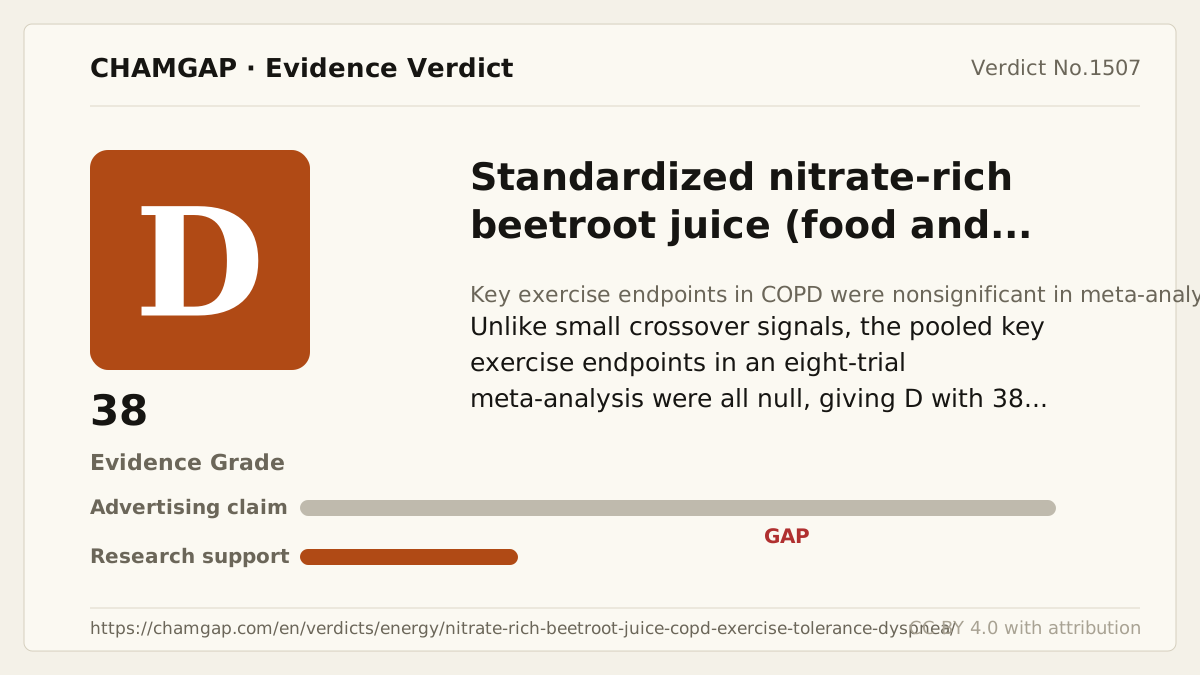
[Chamgap] Nitrate-rich beetroot juice x exercise tolerance and dyspnea in COPD — Evidence Grade D·38. 3 cited sources checked. Source: https://chamgap.com/en/verdicts/energy/nitrate-rich-beetroot-juice-copd-exercise-tolerance-dyspnea/ · CC BY 4.0CC BY 4.0 — free to use with attribution; do not distort grades, numbers, or verdict meaning.
What this document does and does not do
Chamgap is an information source. It reports what research has and has not confirmed; it does not tell readers what to take or buy. That decision belongs to readers and, when needed, medical or legal professionals. This verdict reflects literature available up to the search date and may change as new research appears. Nothing here is medical advice.