
Nicotinamide riboside,
does it really help with Improved subjective fatigue and daily vitality in adults through increased cellular energy?
research showsNicotinamide riboside is rated D because it raises NAD+ metabolites in blood or muscle but has not demonstrated improvement in subjective fatigue or everyday vitality. In a crossover trial of 30 healthy middle-aged and older adults, 1,000 mg/day stimulated NAD+ metabolism but did not improve fatigue, exercise capacity, energy expenditure, or overall motor function versus placebo. In a 2025 randomized trial of 58 adults with long COVID, 2,000 mg/day raised NAD+ 2.6- to 3.1-fold but did not significantly improve fatigue versus placebo (p=0.59). A surrogate increase and felt vitality are not the same outcome, giving D with 27 points. NMN verdict 031, nicotinamide verdict 386, and NR aging verdict 314 address different molecules or efficacy axes.
ads claimMarketing translates increased NAD+, mitochondrial support, and cellular energy directly into less fatigue and all-day vitality. Blood or muscle metabolites are surrogate outcomes; the claim requires better fatigue, vitality, and functional results than placebo.
Useful facts when choosing a product
- Human trials have commonly used nicotinamide riboside chloride at 500 to 2,000 mg/day for several weeks to months, and blood NAD+-related metabolites increase with dose.
- Nicotinamide riboside, nicotinamide mononucleotide, and nicotinamide all enter NAD+ biology but are different compounds, so clinical results cannot be transferred automatically among them.
- Short human trials generally found acceptable tolerability, although mild gastrointestinal symptoms such as nausea, abdominal discomfort, or diarrhea can occur.
- Long-term safety and disease-specific optimal dosing are not established, and persistent fatigue warrants evaluation for sleep disorders, anemia, thyroid disease, depression, and postinfectious illness.
Chamgap Semantic Classification Code
Candidate index · review held
S.nicotinamide-riboside.UNK.subjective-fatigue-and-daily-vitality-through-increased-cellular-energy.increase.placeboSupplements and nutraceuticals > Nicotinamide riboside > Unknown > subjective fatigue and daily vitality through increased cellular energy > Increase claim > Placebo
An automated migration candidate, not an issued permanent code; exact claim scope remains under review. This machine-generated migration candidate helps retrieval but is not a permanent assignment. The original verdict ID and URL remain authoritative.
What the research actually shows
Martens and colleagues in 2018 exposed 30 healthy adults aged 55 to 79 years to NR at 500 mg twice daily and placebo for six weeks each in a crossover trial. NAD+ metabolism increased, but total energy expenditure, maximal oxygen uptake, treadmill time to exhaustion, motor function, and fatigue-related outcomes did not improve. Elhassan and colleagues in 2019 gave 12 older men 1 g/day for 21 days and found muscle NAD+ metabolomic and transcriptomic changes without improved mitochondrial bioenergetics. Wu and colleagues in 2025 used a 24-week design in 58 adults with long COVID. NAD+ rose 2.6- to 3.1-fold after five to ten weeks, but fatigue severity, sleep, mood, and cognition were not significantly better than placebo. NMN and nicotinamide are different molecules, so verdicts 031 and 386 were not treated as direct NR evidence, and aging verdict 314 addresses a separate efficacy axis.
Why this is classified as D (27)
Blood and muscle NAD+ metabolites repeatedly rise, but fatigue and exercise function in healthy middle-aged and older adults and fatigue in long COVID did not improve versus placebo. Separating the biochemical surrogate from the patient-experienced vitality endpoint gives D with 27 points. Mild short-term gastrointestinal symptoms and limited long-term data are separate safety considerations.
Counterpoint. Future benefit in a specific NAD+-depleted state or disease population remains possible. At present, evaluation of sleep, nutrition, medicines, endocrine or hematologic disease, and mental health is more useful than using a supplement to mask persistent fatigue.
Rejudgment record. New verdict — Accepted reproducible increases in blood and muscle NAD+ metabolites, but assigned D because fatigue, exercise capacity, and energy expenditure did not improve in healthy middle-aged and older adults and the 2025 placebo-controlled long-COVID trial also found no fatigue benefit, requiring separation of surrogate and clinical outcomes
Sub-claim grades by effect
This ingredient is marketed for several effects. A single overall grade blends strong and weak claims together, so each effect is graded separately here. The overall grade reflects the strongest disconfirming or core claim.
| Effect (sub-claim) | Grade | Basis |
|---|---|---|
| Improvement in subjective fatigue in adults | D | Fatigue scales in healthy middle-aged and older adults and fatigue severity in long COVID did not improve versus placebo. |
| Improvement in everyday vitality and physical function in adults | D | Energy expenditure, maximal exercise capacity, and overall motor function did not improve, and no large trial has used everyday vitality as a primary endpoint. |
| Increase in felt energy resulting from higher NAD+ | D | Blood and muscle NAD+ metabolite increases are reproducible surrogates that have not translated into fatigue or vitality benefits. |
Cross-check — AI research and Codex final gate
Evidence Table
| Study | Design | Sample | Funding | Endpoint | Result | Weight |
|---|---|---|---|---|---|---|
| Martens CR et al. 2018 | Randomized double-blind placebo-controlled crossover trial | 30 healthy adults aged 55 to 79 years | Support from the U.S. NIH and Glenn/AFAR, plus partial funding and study product from ChromaDex | Blood NAD+ metabolites, fatigue scales, energy expenditure, maximal exercise capacity, and motor function | NR at 1,000 mg/day increased NAD+ metabolism but did not improve fatigue, energy expenditure, maximal exercise capacity, or motor function versus placebo. | Key evidence separating the surrogate from clinical function in healthy adults |
| Elhassan YS et al. 2019 | Randomized double-blind placebo-controlled crossover trial | 12 older men | Academic support including the UK MRC and NIHR; one coauthor disclosed ChromaDex patent, stock, and advisory relationships | Muscle NAD+ metabolome, transcriptome, and mitochondrial bioenergetics | After 1 g/day for 21 days, muscle NAD+-related metabolites increased but mitochondrial bioenergetics did not change. | Mechanistic surrogate without improved bioenergetics |
| Wu CY et al. 2025 | Twenty-four-week randomized double-blind placebo-controlled trial | 58 adults with long COVID | Support from Niagen Bioscience, Massachusetts General Hospital programs, the Alzheimer's Association, and others | NAD+, cognition, fatigue severity, sleep, depression, and anxiety | NAD+ increased 2.6- to 3.1-fold, but fatigue did not improve significantly versus placebo (p=0.59). | Direct null fatigue endpoint |
Receipt — 4 References
All 4 cited sources were verified for existence at the original page (as of 2026-07-21).
Final verification and publication gate: Codex · Evidence date: 2026-07-21 · Corrections: none
Cite this verdict
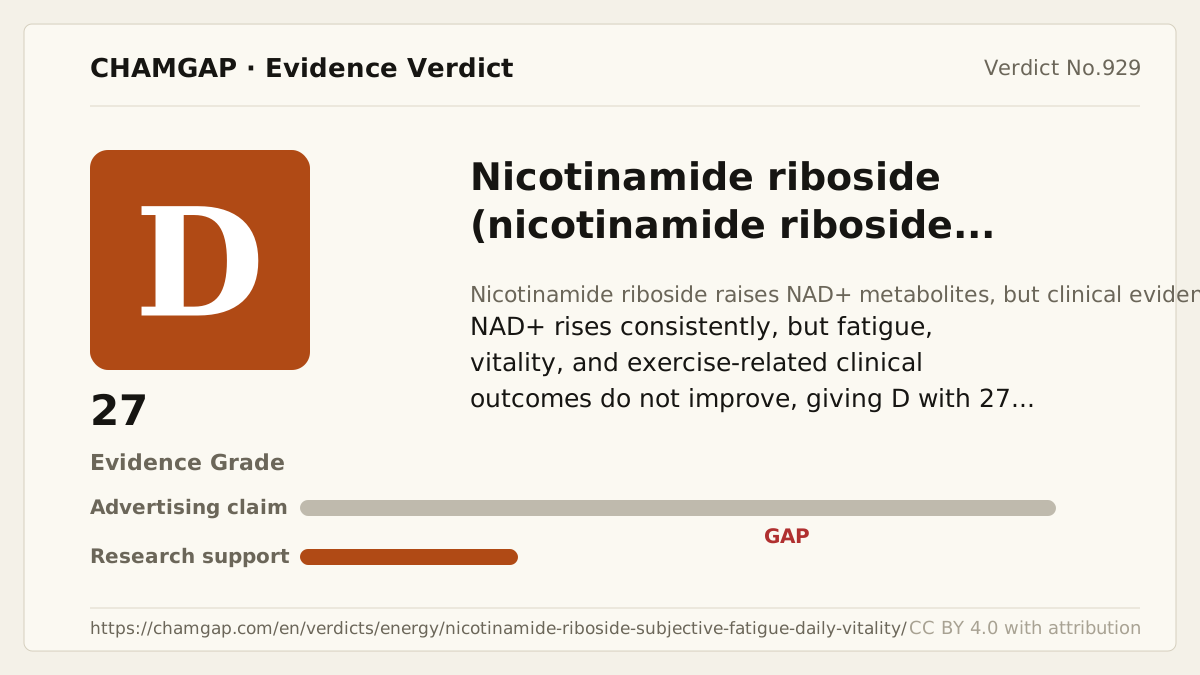
[Chamgap] Nicotinamide riboside x improved fatigue and daily vitality in adults — Evidence Grade D·27. 4 cited sources checked. Source: https://chamgap.com/en/verdicts/energy/nicotinamide-riboside-subjective-fatigue-daily-vitality/ · CC BY 4.0CC BY 4.0 — free to use with attribution; do not distort grades, numbers, or verdict meaning.
What this document does and does not do
Chamgap is an information source. It reports what research has and has not confirmed; it does not tell readers what to take or buy. That decision belongs to readers and, when needed, medical or legal professionals. This verdict reflects literature available up to the search date and may change as new research appears. Nothing here is medical advice.