
Molecular hydrogen,
does it really help with Reduced perceived fatigue and blood lactate during exercise with improved endurance?
research showsMolecular hydrogen supplementation is rated C because it has small but statistically significant positive signals for rating of perceived exertion and blood lactate during exercise. A 2024 systematic review and meta-analysis of 27 publications and 597 participants reported an SMD of -0.37 for perceived exertion (P=.009, I-squared=58%) and -0.37 for blood lactate (P=.001, I-squared=22%). In contrast, maximal oxygen uptake, aerobic endurance, 30-second anaerobic endurance, and muscular strength were all nonsignificant with trivial effects. Most studies were small and often crossover designs, while delivery method, hydrogen concentration, training status, and duration varied. The positive small signal therefore satisfies the C-versus-D rule, but it cannot be generalized to actual endurance improvement.
ads claimMarketing claims that hydrogen instantly clears lactate, prevents fatigue, markedly raises oxygen efficiency and endurance, or guarantees recovery by expanding small fatigue and surrogate-marker signals into actual record improvement. Current pooled evidence does not support improved VO2max or aerobic and anaerobic endurance.
Useful facts when choosing a product
- Molecular-hydrogen supplements include prefilled hydrogen-rich water, generating tablets or sticks added to water, and powders. Generating products can contain reactive ingredients such as magnesium or calcium, so non-hydrogen ingredients and amounts matter.
- Dissolved hydrogen can escape after a container is opened, and actual concentration varies with manufacturing, storage, packaging, and time after opening. A labeled concentration is not necessarily the exposure present at exercise.
- No standard dose, concentration, or timing has been established for reliable exercise enhancement. Studies have used methods ranging from a single 500-mL serving to repeated intake and inhalation.
- Short human trials generally report no major adverse effects, but participant numbers are small and long-term, product-specific safety data and additive quality remain limited. These products do not replace hydration, electrolytes, training, sleep, or nutrition.
Chamgap Semantic Classification Code
Candidate index · review held
S.molecular-hydrogen-or-hydrogen-rich-water-and-generating-tablets.UNK.perceived-fatigue-and-blood-lactate-during-exercise-with-improved-endurance.reduce.placeboSupplements and nutraceuticals > Molecular hydrogen or hydrogen-rich water and generating tablets > Unknown > perceived fatigue and blood lactate during exercise with improved endurance > Reduction claim > Placebo
An automated migration candidate, not an issued permanent code; exact claim scope remains under review. This machine-generated migration candidate helps retrieval but is not a permanent assignment. The original verdict ID and URL remain authoritative.
What the research actually shows
Zhou 2024 qualitatively reviewed 29 studies and quantitatively synthesized 27 studies involving 597 participants. Most were small randomized crossover experiments, and delivery ranged from water and tablets to calcium powder and inhalation. The pooled analysis found small reductions of SMD -0.37 for both perceived exertion and blood lactate and a small positive SMD of 0.30 for lower-limb explosive power, while VO2max, aerobic and anaerobic endurance, and strength were null. Aoki 2012 was a double-blind crossover pilot in 10 male soccer players who drank 1.5 L of hydrogen-rich or placebo water; it reported attenuation of lactate elevation and early peak-torque decline. Jebabli 2023 gave 500 mL of hydrogen-rich water or placebo to 22 male amateur middle-distance runners 30 minutes before exercise and reported some improvement in time to exhaustion and perceived exertion, but no difference in jumping performance. Training status, acute versus repeated dosing, dissolved concentration, and measurement timing limit reproducibility.
Why this is classified as C (47)
A meta-analysis of 27 publications and 597 participants found small significant reductions in perceived exertion and blood lactate, both SMD -0.37. This is a positive small signal under the specified C-versus-D rule. The outcomes are subjective or surrogate, perceived-exertion heterogeneity was I-squared 58%, formulations and populations varied, and actual aerobic and anaerobic endurance outcomes were null. The result is lower-mid C at 47 points.
Counterpoint. A small perceptual difference may be noticeable to an individual, but it does not guarantee better performance. Anyone testing it should compare objective training outcomes and should not replace hydration, carbohydrate and electrolyte planning, or evaluation of a medical cause of fatigue.
Rejudgment record. Cross-check applied — Applied C under the specified C-versus-D rule because the 2024 meta-analysis found small significant signals of SMD -0.37 for perceived exertion and blood lactate, while limiting the score to 47 because these are subjective or surrogate outcomes, actual aerobic and anaerobic endurance and strength were null, and studies and formulations were heterogeneous
Sub-claim grades by effect
This ingredient is marketed for several effects. A single overall grade blends strong and weak claims together, so each effect is graded separately here. The overall grade reflects the strongest disconfirming or core claim.
| Effect (sub-claim) | Grade | Basis |
|---|---|---|
| Reduction in perceived fatigue or exertion during exercise | C | Meta-analysis found a small positive SMD of -0.37, P=.009, but the outcome was subjective and I-squared was 58%. |
| Reduction in blood lactate during exercise | C | Meta-analysis found a small positive SMD of -0.37, P=.001, but lactate is a physiological surrogate. |
| Improvement in aerobic and anaerobic endurance and actual performance | D | Pooled effects on VO2max, aerobic endurance, and 30-second anaerobic endurance were trivial and nonsignificant. |
Cross-check — AI research and Codex final gate
Evidence Table
| Study | Design | Sample | Funding | Endpoint | Result | Weight |
|---|---|---|---|---|---|---|
| Zhou K et al. 2024 | Systematic review and random-effects meta-analysis | 27 publications and 597 participants; 27 studies in quantitative synthesis | Supported by a Chinese Ministry of Science and Technology research project; no commercial conflicts reported | VO2max, aerobic and anaerobic endurance, strength and explosive power, perceived exertion, blood lactate, and average heart rate | Perceived exertion and lactate each decreased significantly by SMD -0.37 and lower-limb explosive power showed a small positive SMD of 0.30, while VO2max, aerobic and anaerobic endurance, and strength were nonsignificant. | Key synthesis showing a positive small signal but null endurance |
| Aoki K et al. 2012 | Double-blind randomized crossover pilot trial | 10 male soccer players | Inadequately reported; used magnesium hydrogen-generating sticks | Lactate, oxidative stress, peak torque, and muscle activity after intense exercise | Hydrogen-rich water attenuated lactate elevation and early peak-torque decline, but oxidative-injury markers and creatine kinase did not differ. | Very small direct positive pilot |
| Jebabli N et al. 2023 | Randomized double-blind placebo-controlled crossover trial | 22 male amateur middle-distance runners | No external funding and no conflicts reported | Maximal aerobic speed, time to exhaustion, jumping, perceived exertion, and peak heart rate | After 500 mL of hydrogen-rich water, time to exhaustion and some perceived-exertion measures improved, but squat, countermovement, and five-jump performance did not. | Small direct study with mixed results |
Receipt — 3 References
All 3 cited sources were verified for existence at the original page (as of 2026-07-24).
Final verification and publication gate: Codex · Evidence date: 2026-07-24 · Corrections: none
Cite this verdict
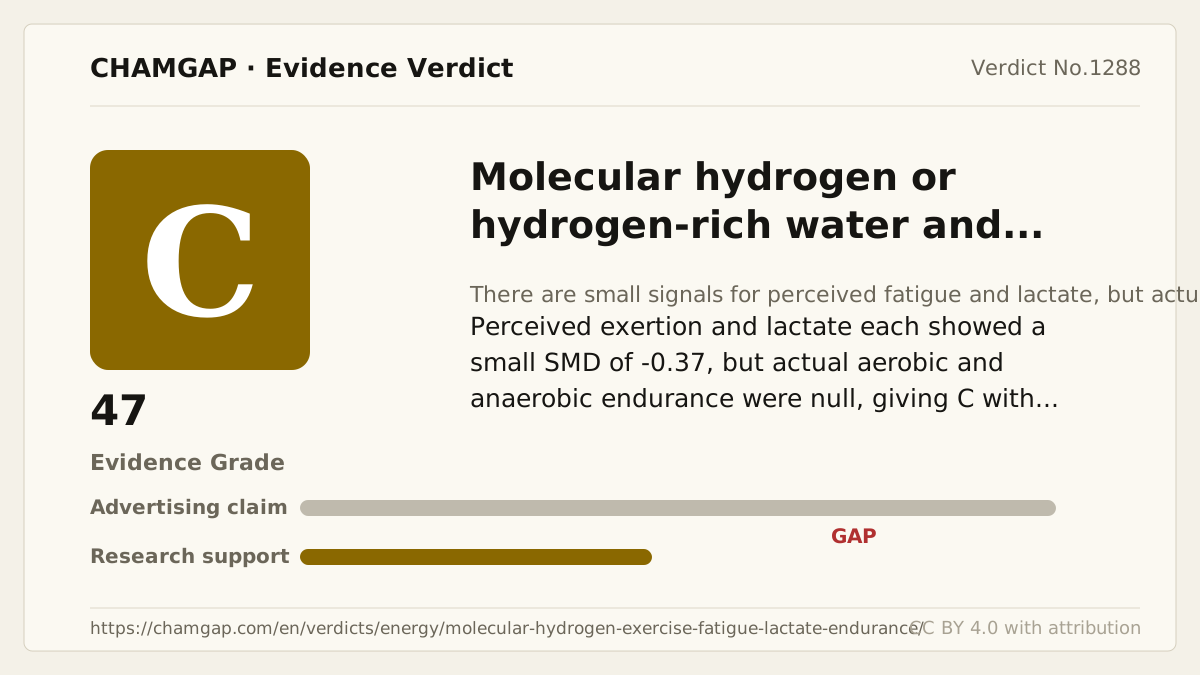
[Chamgap] Molecular hydrogen x perceived fatigue, blood lactate, and endurance during exercise — Evidence Grade C·47. 3 cited sources checked. Source: https://chamgap.com/en/verdicts/energy/molecular-hydrogen-exercise-fatigue-lactate-endurance/ · CC BY 4.0CC BY 4.0 — free to use with attribution; do not distort grades, numbers, or verdict meaning.
What this document does and does not do
Chamgap is an information source. It reports what research has and has not confirmed; it does not tell readers what to take or buy. That decision belongs to readers and, when needed, medical or legal professionals. This verdict reflects literature available up to the search date and may change as new research appears. Nothing here is medical advice.