
Modified-release hydrocortisone,
does it really help with Improved weight and metabolism in adrenal insufficiency?
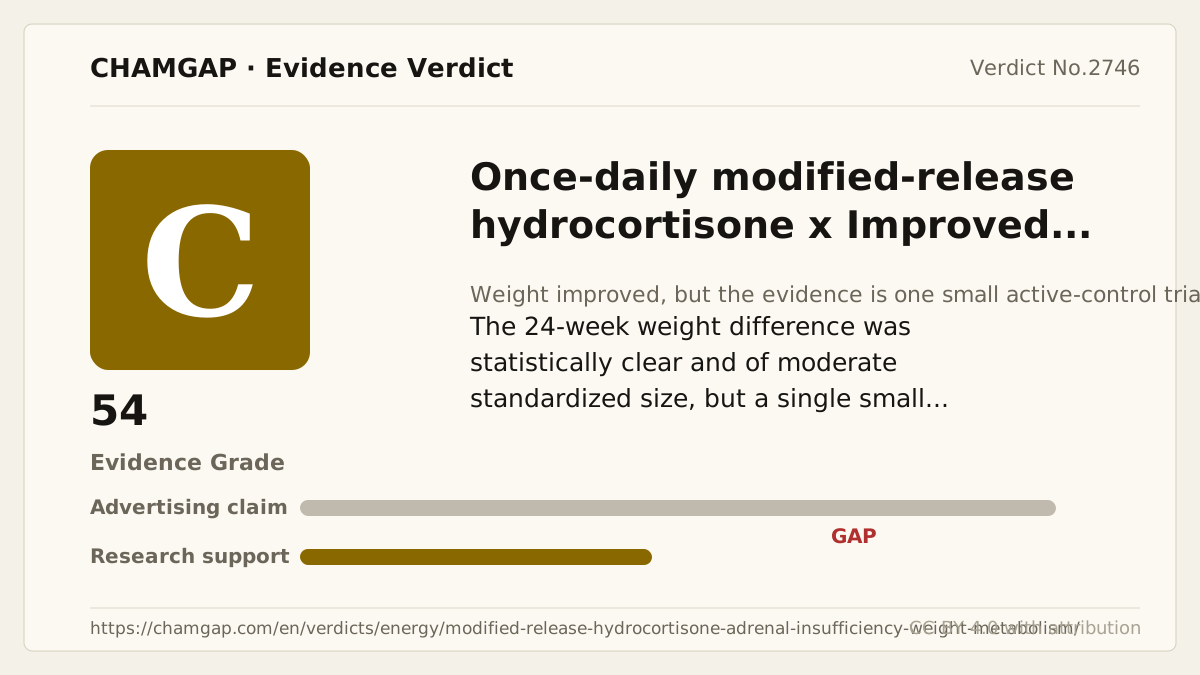
research showsThe grade is C. In an 89-participant publicly funded Italian randomized trial, 24-week weight changed by -2.1 kg with modified release versus +1.9 kg with standard therapy, a between-group difference of -4.0 kg (95% CI -6.9 to -1.1; P=0.008). It remains one confirmatory trial with fewer than 200 participants and an active standard-therapy comparator rather than placebo.
ads claimThe need to replace deficient cortisol is separate from the claim that a different release pattern improves weight beyond standard replacement. This is a 24-week average weight difference, not evidence of fewer long-term cardiovascular events.
Useful facts when choosing a product
- The trial compared multiple-daily-dose standard glucocorticoid therapy with once-daily modified-release hydrocortisone.
- The primary endpoint was 24-week body-weight change, with a -4.0 kg between-group difference.
- Deficiency correction and formulation-specific metabolic benefit are separate clinical claims.
Chamgap Semantic Classification Code
Candidate index · review held
UNK.once-modified-release-hydrocortisone.UNK.weight-and-metabolism-in-adrenal-insufficiency.improve.activeUnknown > Once- modified-release hydrocortisone > Unknown > weight and metabolism in adrenal insufficiency > Improvement claim > Active comparator
An automated migration candidate, not an issued permanent code; exact claim scope remains under review. This machine-generated migration candidate helps retrieval but is not a permanent assignment. The original verdict ID and URL remain authoritative.
What the research actually shows
DREAM used a computer-generated sequence stratified by adrenal-insufficiency type and BMI at two Italian university hospitals. Eighty-nine participants were randomized: 43 continued standard therapy and 46 switched to an equivalent once-daily modified-release dose. Outcome assessors were masked, but patients were not. Efficacy included everyone who received at least one study dose. The article names the Italian Ministry of University and Research as funder and contains no company-funding statement. From the -4.0 kg difference and 95% CI -6.9 to -1.1, the reconstructed pooled SD is about 7.0 kg and standardized difference about 0.57.
Why this is classified as C (54)
A publicly funded randomized trial found a moderate-sized weight difference, but two design limitations—a single 89-participant trial and active control without placebo—limit the result to C with 54 points.
Counterpoint. Weight change does not establish long-term event benefit, and infection and quality-of-life findings should remain identified as secondary outcomes.
Rejudgment record. Cross-check applied — Recognizes a moderate between-group weight effect and public funding while accounting for the single 89-participant active-control design
| Endpoint | S | Surrogate marker - laboratory or imaging measures |
| Replication | R1 | Single confirmatory trial |
| Independence | I2 | Decisive evidence is publicly or non-profit funded |
| Effect size | E+ | Meets the clinically important threshold |
Stored derived and displayed grades match; this is not a current recalculation or validity check (C).
Sub-claim grades by effect
This ingredient is marketed for several effects. A single overall grade blends strong and weak claims together, so each effect is graded separately here. The overall grade reflects the strongest disconfirming or core claim.
| Effect (sub-claim) | Grade | Basis |
|---|---|---|
| Improved weight at 24 weeks | C | The between-group difference was -4.0 kg, but evidence is one 89-participant active-control trial. |
| Reduced recurrent upper respiratory infections | C | Counts were significantly lower, 17 versus 38, but this was secondary. |
| Reduced long-term cardiovascular events | ? | This trial did not test that event benefit. |
Cross-check — AI research and Codex final gate
Evidence Table
| Study | Design | Sample | Funding | Endpoint | Result | Weight |
|---|---|---|---|---|---|---|
| Isidori AM et al. 2018 DREAM | Outcome-assessor-masked randomized active-control trial at two Italian centers | 89 randomized, 43 standard therapy and 46 modified release; efficacy included participants receiving at least one dose | Italian Ministry of University and Research (2015ZTT5KB and RBAP109BLT) | Change in body weight from baseline to 24 weeks | -2.1 kg (95% CI -4.0 to -0.3) versus +1.9 kg (-0.1 to 3.9); between-group -4.0 kg (-6.9 to -1.1), P=0.008; recurrent upper respiratory infections 17 versus 38, P=0.016 | Single publicly funded trial; body-weight primary endpoint; small active-control design |
Receipt — 1 References
All 1 cited sources were verified for existence at the original page (as of 2026-08-18).
Final verification and publication gate: Codex · Evidence date: 2026-08-18 · Corrections: none
Cite this verdict
[Chamgap] Modified-release hydrocortisone x weight and metabolism in adrenal insufficiency — Evidence Grade C·54. 1 cited sources checked. Source: https://chamgap.com/en/verdicts/energy/modified-release-hydrocortisone-adrenal-insufficiency-weight-metabolism/ · CC BY 4.0CC BY 4.0 — free to use with attribution; do not distort grades, numbers, or verdict meaning.
What this document does and does not do
Chamgap is an information source. It reports what research has and has not confirmed; it does not tell readers what to take or buy. That decision belongs to readers and, when needed, medical or legal professionals. This verdict reflects literature available up to the search date and may change as new research appears. Nothing here is medical advice.