
Modafinil,
does it really help with Reduction of excessive daytime sleepiness and maintenance of wakefulness in adults with narcolepsy?
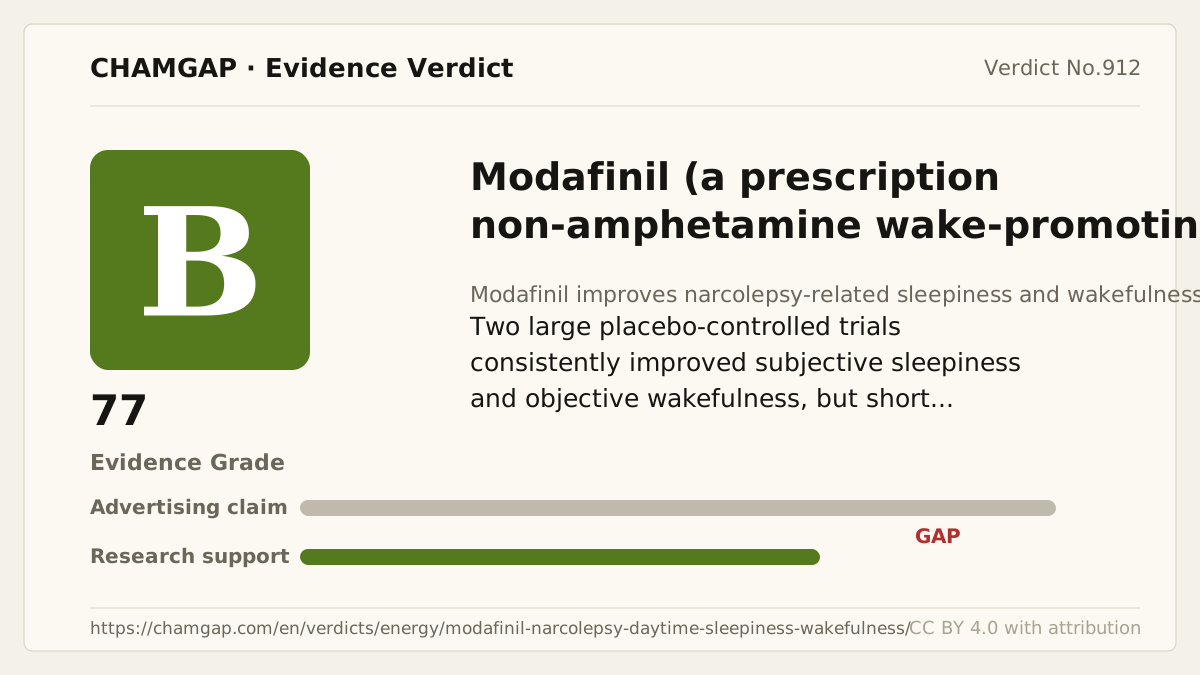
research showsModafinil is rated B because it reduces excessive daytime sleepiness and improves maintenance of wakefulness in adults with narcolepsy. Multicenter nine-week placebo-controlled trials involving 283 and 271 participants improved subjective Epworth Sleepiness Scale scores together with objective Maintenance of Wakefulness and Multiple Sleep Latency tests, and the 2021 American Academy of Sleep Medicine guideline strongly recommended modafinil for adult narcolepsy. These symptom outcomes matter directly to patients, but the pivotal evidence consists largely of older short product-development trials and long-term accident or occupational-function data are limited, precluding A. This disease-treatment axis differs from the existing C-rated verdict 617 on cognitive enhancement in healthy people.
ads claimWake promotion can be expanded into claims that sleep is no longer needed, narcolepsy is cured, or anyone will gain focus and productivity. The direct evidence concerns prescription treatment of excessive sleepiness in diagnosed adult narcolepsy, not cognitive enhancement in healthy people or replacement of sleep.
Useful facts when choosing a product
- For adult narcolepsy, modafinil is commonly prescribed once each morning, with dose and timing individualized by the clinician for liver function, comorbidity, and residual sleepiness.
- Headache, nausea, nervousness, and insomnia can occur, and sleepiness may persist despite treatment, so the ability to drive or perform hazardous work must be assessed individually.
- Rare serious skin reactions, including Stevens-Johnson syndrome, and multiorgan hypersensitivity have been reported; an unexplained rash warrants immediate contact with the prescriber.
- Modafinil can reduce the effectiveness of steroidal oral contraceptives, requiring alternative or additional contraception during treatment and for a defined period after discontinuation, and other enzyme-mediated interactions require medication review.
Chamgap Semantic Classification Code
Candidate index · review held
M.modafinil.UNK.excessive-daytime-sleepiness-and-maintenance-of-wakefulness-with-narcolepsy.reduce.placeboMedicinal interventions > Modafinil > Unknown > excessive daytime sleepiness and maintenance of wakefulness with narcolepsy > Reduction claim > Placebo
An automated migration candidate, not an issued permanent code; exact claim scope remains under review. This machine-generated migration candidate helps retrieval but is not a permanent assignment. The original verdict ID and URL remain authoritative.
What the research actually shows
The 1998 18-center trial in 283 participants and the 2000 21-center trial in 271 participants compared modafinil 200 mg, 400 mg, and placebo for nine weeks. Both favored modafinil on Epworth scores, Maintenance of Wakefulness and Multiple Sleep Latency tests, and global clinical improvement; return of sleepiness toward baseline after withdrawal showed symptomatic control. A 1997 crossover trial in 75 participants increased mean wakefulness latency by 40% with 200 mg and 54% with 400 mg versus placebo. The guideline recommendation was treated as synthesis and clinical interpretation, not as a new efficacy trial or an automatic reason for grade A.
Why this is classified as B (77)
Multicenter placebo-controlled nine-week trials in 283 and 271 participants repeatedly improved Epworth, wakefulness, sleep-latency, and clinician-global outcomes, with a strong guideline recommendation reinforcing interpretation. Concordant direct symptoms and objective testing, a broader evidence base, and longer use history support B with 77 points, slightly above solriamfetol and pitolisant at 74. The concentration in older short sponsor-development studies and the gap in long-term accident and functional outcomes prevent A. Serious rash and contraceptive interaction are separate safety issues.
Counterpoint. Response varies, and persistent sleepiness despite adequate sleep should lead to reassessment of diagnosis, adherence, comorbid sleep disorders, and other sedating medicines rather than unsupervised dose escalation. The drug does not replace planned sleep or safety precautions.
Rejudgment record. New verdict — Recognized consistent improvement in the direct subjective Epworth outcome, objective wakefulness and sleep-latency tests, and global ratings across two large multicenter placebo-controlled trials, reinforced by a strong guideline recommendation, while accounting for concentration in short sponsor-development trials, limited long-term accident and functional outcomes, and corpus parity with solriamfetol and pitolisant at B74
Sub-claim grades by effect
This ingredient is marketed for several effects. A single overall grade blends strong and weak claims together, so each effect is graded separately here. The overall grade reflects the strongest disconfirming or core claim.
| Effect (sub-claim) | Grade | Basis |
|---|---|---|
| Reduction of excessive daytime sleepiness in adults with narcolepsy | B | Two large placebo-controlled trials repeatedly improved Epworth scores, without implying complete normalization or a cure. |
| Objective maintenance of wakefulness in adults with narcolepsy | B | Wakefulness and sleep-latency tests improved versus placebo, but sleepiness returned after treatment withdrawal. |
| Global clinical improvement in adults with narcolepsy | B | Global clinical ratings repeatedly improved, although long-term accident and occupational-function outcomes remain limited. |
Cross-check — AI research and Codex final gate
Evidence Table
| Study | Design | Sample | Funding | Endpoint | Result | Weight |
|---|---|---|---|---|---|---|
| US Modafinil Study Group trial. 1998 | Eighteen-center randomized double-blind placebo-controlled parallel-group nine-week trial | 283 adults with narcolepsy | Multicenter product-development trial; funding not stated in the PubMed abstract | Epworth Sleepiness Scale, Maintenance of Wakefulness Test, Multiple Sleep Latency Test, and Clinical Global Impression of Change | Modafinil 200 and 400 mg significantly improved all sleepiness measures and global clinical status versus placebo. | Key direct subjective and objective randomized evidence |
| US Modafinil Study Group trial. 2000 | Twenty-one-center randomized double-blind placebo-controlled nine-week trial with a two-week withdrawal phase | 271 participants in the main trial and 240 in the withdrawal phase | Multicenter product-development trial; funding not stated in the PubMed abstract | Maintenance of Wakefulness Test, Multiple Sleep Latency Test, Epworth score, global change, and sleepiness after withdrawal | Objective and subjective sleepiness and global change improved, while sleepiness returned toward baseline after withdrawal. | Replicated pivotal randomized evidence confirming symptomatic control |
| Maski K et al. 2021 AASM guideline | Systematic evidence review and clinical practice guideline for central disorders of hypersomnolence | Drug-specific randomized evidence base | American Academy of Sleep Medicine | Daytime sleepiness, wakefulness, quality of life, and harms in narcolepsy | Strongly recommended modafinil for treatment of narcolepsy in adults. | Clinical interpretation support, not a new efficacy trial |
Receipt — 3 References
All 3 cited sources were verified for existence at the original page (as of 2026-07-21).
Final verification and publication gate: Codex · Evidence date: 2026-07-21 · Corrections: none
Cite this verdict
[Chamgap] Modafinil x reduced excessive daytime sleepiness and maintained wakefulness in adults with narcolepsy — Evidence Grade B·77. 3 cited sources checked. Source: https://chamgap.com/en/verdicts/energy/modafinil-narcolepsy-daytime-sleepiness-wakefulness/ · CC BY 4.0CC BY 4.0 — free to use with attribution; do not distort grades, numbers, or verdict meaning.
What this document does and does not do
Chamgap is an information source. It reports what research has and has not confirmed; it does not tell readers what to take or buy. That decision belongs to readers and, when needed, medical or legal professionals. This verdict reflects literature available up to the search date and may change as new research appears. Nothing here is medical advice.