
Calcium carbonate supplements with meals,
does it really help with Long-term iron deficiency or anemia?
research showsThe grade is D. Among 109 healthy premenopausal women who completed 12 weeks, calcium carbonate 1,000 mg/day with meals did not significantly change ferritin, hemoglobin, serum iron, or transferrin saturation versus control. Across 13 longer-term studies, the pooled ferritin difference was -1.21 micrograms/L (95% CI -5.47 to 3.05). The claim was unsupported, but high-risk groups and clinical anemia were not precisely excluded, giving D with 30 points.
ads claimThe pivotal longer-term intervention was a calcium carbonate supplement, not milk. These data therefore cannot be presented as proof that drinking milk leaves iron status unchanged. Acute calcium-related absorption inhibition also does not establish iron deficiency or anemia months later.
Useful facts when choosing a product
- The pivotal intervention added calcium carbonate 1,000 mg/day with meals.
- There were 57 calcium and 52 control completers.
- Pooled ferritin was -1.21 micrograms/L, 95% CI -5.47 to 3.05, with 97% heterogeneity.
Chamgap Semantic Classification Code
Candidate index · review held
S.calcium-carbonate-supplement.oral.long-term-iron-deficiency-or-anemia.assess.UNKSupplements and nutraceuticals > calcium carbonate supplement > Oral > Long-term iron deficiency or anemia > Association or change assessment > Unknown
An automated migration candidate, not an issued permanent code; exact claim scope remains under review. This machine-generated migration candidate helps retrieval but is not a permanent assignment. The original verdict ID and URL remain authoritative.
What the research actually shows
Sokoll and Dawson-Hughes analyzed 109 healthy premenopausal completers: 57 received calcium carbonate 500 mg with each of two meals and 52 were controls for 12 weeks. No iron-status measure differed significantly. The paper is indexed as receiving US government non-PHS support, while the original randomized denominator was not available in the public abstract. A 2021 review pooled 13 longer-term ferritin studies, but calcium dose, duration, and concurrent timing differed, so they were not counted as direct replication; it also emphasized limited evidence in pregnant and other high-risk populations.
Why this is classified as D (30)
Randomized longer-term iron-status evidence did not support the claim, but clinically important worsening in high-risk groups was not excluded, giving D with 30 points.
Counterpoint. People being treated for iron deficiency or taking prenatal supplements should follow their prescribed timing instructions.
Rejudgment record. Cross-check applied — Null longer-term iron-status evidence in healthy premenopausal women with remaining uncertainty for high-risk populations and clinical anemia
| Endpoint | S | Surrogate marker - laboratory or imaging measures |
| Replication | R1 | Single confirmatory trial |
| Independence | I2 | Decisive evidence is publicly or non-profit funded |
| Effect size | E0 | Null |
| Precision | C0 | The confidence interval leaves room for benefit |
Stored derived and displayed grades match; this is not a current recalculation or validity check (D).
Sub-claim grades by effect
This ingredient is marketed for several effects. A single overall grade blends strong and weak claims together, so each effect is graded separately here. The overall grade reflects the strongest disconfirming or core claim.
| Effect (sub-claim) | Grade | Basis |
|---|---|---|
| Worsened 12-week iron status in healthy premenopausal women | D | No significant difference was found among 109 completers. |
| Clinical anemia in high-risk iron-deficient populations | ? | Direct event evidence is insufficient. |
Cross-check — AI research and Codex final gate
Evidence Table
| Study | Design | Sample | Funding | Endpoint | Result | Weight |
|---|---|---|---|---|---|---|
| Sokoll and Dawson-Hughes 1992 | 12-week randomized controlled trial with completer analysis | 109 completers (57/52); original randomized denominator not confirmed | Indexed as US government non-PHS research support | Changes in ferritin, hemoglobin, serum iron, and transferrin saturation | No significant between-group difference in any iron-status measure | Pivotal longer-term randomized evidence |
| Abioye et al. 2021 | Systematic review and meta-analysis of randomized and crossover studies | 13 ferritin trials and 6 hemoglobin trials | Authors declared no organizational support for the submitted work | Longer-term ferritin and hemoglobin | Ferritin -1.21 micrograms/L (-5.47 to 3.05), I²=97%; hemoglobin 0.44 g/L (-0.90 to 1.78) | Synthesis of longer-term evidence |
Receipt — 2 References
All 2 cited sources were verified for existence at the original page (as of 2026-08-04).
Final verification and publication gate: Codex · Evidence date: 2026-08-04 · Corrections: none
Cite this verdict
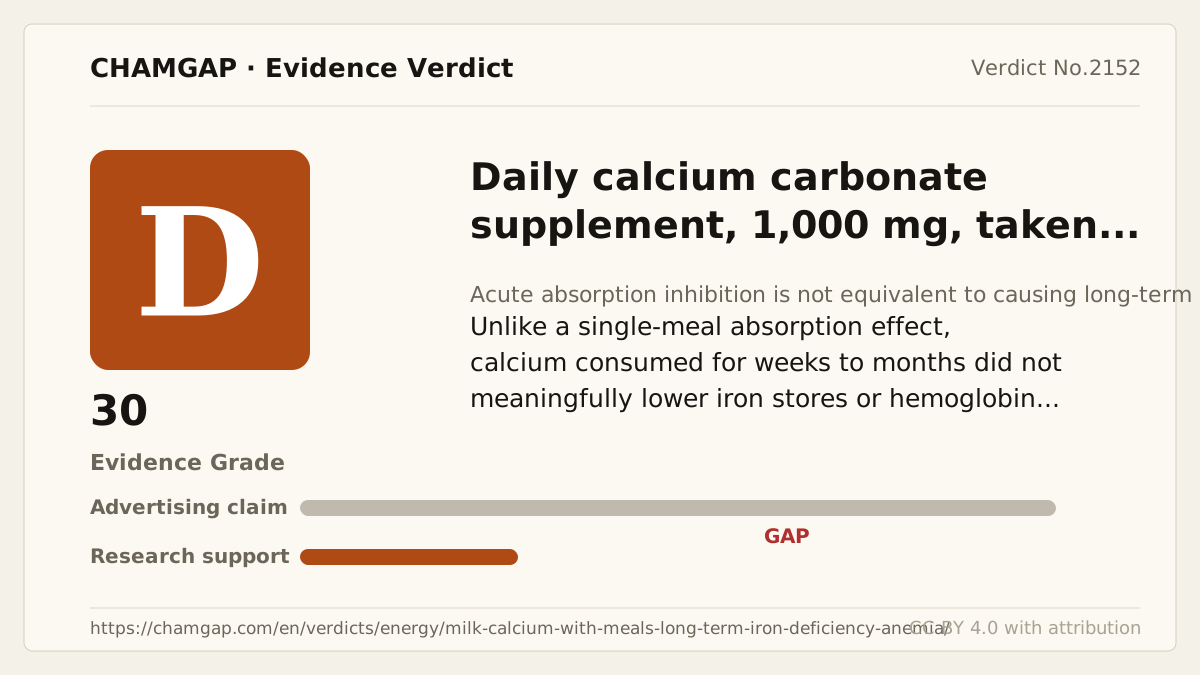
[Chamgap] Calcium carbonate supplements with meals x long-term iron deficiency or anemia — Evidence Grade D·30. 2 cited sources checked. Source: https://chamgap.com/en/verdicts/energy/milk-calcium-with-meals-long-term-iron-deficiency-anemia/ · CC BY 4.0CC BY 4.0 — free to use with attribution; do not distort grades, numbers, or verdict meaning.
What this document does and does not do
Chamgap is an information source. It reports what research has and has not confirmed; it does not tell readers what to take or buy. That decision belongs to readers and, when needed, medical or legal professionals. This verdict reflects literature available up to the search date and may change as new research appears. Nothing here is medical advice.