
Low-tidal-volume lung-protective ventilation,
does it really help with Reduced 28-day and hospital mortality in adult acute respiratory distress syndrome?
research showsLung-protective ventilation using lower tidal volumes based on predicted body weight and limited inspiratory pressure reduces short-term mortality in adult ARDS, supporting grade B. Across six randomized trials and 1,297 participants in the Cochrane review, 28-day mortality had an RR of 0.74 (95% CI 0.61 to 0.88) and hospital mortality an RR of 0.80 (95% CI 0.69 to 0.92). The core Cochrane review did not present a modern GRADE table, but the GRADE-based 2017 ATS/ESICM/SCCM guideline rated confidence in the effect estimate as moderate, and a 2022 meta-analysis also rated certainty as moderate. Clinical heterogeneity, high plateau pressures in some control arms, and reliance on the pivotal ARDS Network trial impose the moderate-certainty B ceiling.
ads claimLung-protective ventilation may be presented as the efficacy of a single drug or device, or reduced to a claim that a lower number is always better. The studied intervention is an intensive-care strategy combining predicted-body-weight tidal volume, plateau-pressure limitation, PEEP and oxygenation management, and management of respiratory acidosis.
Useful facts when choosing a product
- The pivotal protocol centres on a tidal volume near 6 mL/kg predicted body weight and a plateau pressure below 30 cmH2O.
- This is a procedural operating protocol for invasively ventilated patients with ARDS, not a medicine.
- Lower tidal volume can permit carbon-dioxide elevation and respiratory acidosis, and patient-ventilator dyssynchrony can increase sedation requirements.
- Tidal volume is based on predicted body weight calculated from height and sex rather than actual body weight.
Chamgap Semantic Classification Code
Candidate index · review held
P.low-tidal-volume-lung-protective-ventilation.procedural.and-hospital-mortality-acute-respiratory-distress-syndrome.reduce.UNKProcedures, devices and tests > Low-tidal-volume lung-protective ventilation > Procedural > and hospital mortality acute respiratory distress syndrome > Reduction claim > Unknown
An automated migration candidate, not an issued permanent code; exact claim scope remains under review. This machine-generated migration candidate helps retrieval but is not a permanent assignment. The original verdict ID and URL remain authoritative.
What the research actually shows
The ARDS Network 2000 trial compared a 6-mL/kg predicted-body-weight strategy with 12 mL/kg and reported mortality of 31.0% versus 39.8% (P=0.007) and 12±11 versus 10±11 ventilator-free days through day 28 (P=0.007). The 2013 Cochrane review by Petrucci and De Feo pooled six trials and 1,297 participants, finding RR 0.74 for 28-day mortality and RR 0.80 for hospital mortality. It identified clinical heterogeneity and high plateau pressure in two control arms as central limitations and found long-term outcomes uncertain. The 2017 official guideline by Fan and colleagues strongly endorsed 4 to 8 mL/kg predicted body weight and plateau pressure below 30 cmH2O while rating confidence in effect estimates as moderate.
Why this is classified as B (75)
Across six randomized trials with 1,297 participants, RR was 0.74 for 28-day mortality and 0.80 for hospital mortality, but official GRADE certainty was moderate and plateau-pressure and protocol heterogeneity remain, giving B with 75 points.
Counterpoint. The large ARDS Network effect must be interpreted with its high-tidal-volume comparator, while long-term mortality, function, and the optimal lower volume remain uncertain.
Rejudgment record. New verdict — Randomized synthesis directly supports reduced 28-day and hospital mortality, but GRADE-based official guidance and a later meta-analysis rate certainty as moderate, with heterogeneity in control plateau pressure and protocols, imposing the B ceiling
Sub-claim grades by effect
This ingredient is marketed for several effects. A single overall grade blends strong and weak claims together, so each effect is graded separately here. The overall grade reflects the strongest disconfirming or core claim.
| Effect (sub-claim) | Grade | Basis |
|---|---|---|
| Reduced 28-day mortality in adult ARDS | B | Three trials with 1,030 participants found RR 0.74 (95% CI 0.61 to 0.88), with overall certainty judged moderate. |
| Reduced hospital mortality in adult ARDS | B | Five trials with 1,181 participants found RR 0.80 (95% CI 0.69 to 0.92), with heterogeneity in comparators and protocols. |
| Increased ventilator-free days through day 28 | C | The ARDS Network trial found 12 versus 10 days, but the Cochrane quantitative synthesis did not establish a significant difference in ventilation duration. |
Cross-check — AI research and Codex final gate
Evidence Table
| Study | Design | Sample | Funding | Endpoint | Result | Weight |
|---|---|---|---|---|---|---|
| Petrucci N and De Feo C. 2013 | Cochrane systematic review and meta-analysis | Six randomized trials with 1,297 participants | Cochrane academic review | 28-day mortality, hospital mortality, and long-term outcomes | RR 0.74 (95% CI 0.61 to 0.88) for 28-day mortality and RR 0.80 (95% CI 0.69 to 0.92) for hospital mortality; long-term outcomes were uncertain. | Core mortality synthesis; no modern GRADE table |
| The Acute Respiratory Distress Syndrome Network. 2000 | Multicentre randomized controlled trial | 861 patients with acute lung injury or ARDS | Supported by the United States NHLBI within NIH | Death before discharge home and ventilator-free days through day 28 | Mortality was 31.0% versus 39.8% (P=0.007), and ventilator-free days were 12±11 versus 10±11 (P=0.007). | Pivotal single large randomized trial |
| Fan E et al. 2017 official guideline | GRADE-based multisociety clinical practice guideline | Synthesis of randomized evidence for mechanical ventilation in ARDS | ATS, ESICM, and SCCM guideline | Mortality and major clinical outcomes | Strongly supported lower tidal volume and inspiratory pressure while rating confidence in effect estimates as moderate. | GRADE certainty assessment |
Receipt — 3 References
All 3 cited sources were verified for existence at the original page (as of 2026-07-23).
Final verification and publication gate: Codex · Evidence date: 2026-07-23 · Corrections: none
Cite this verdict
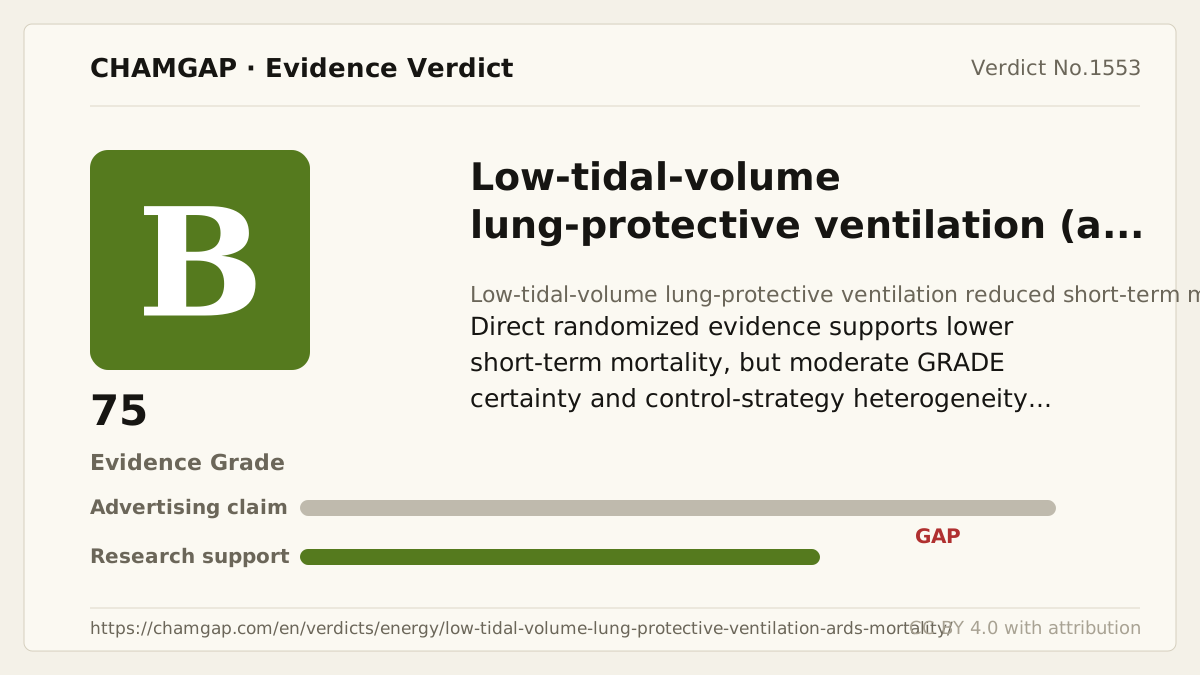
[Chamgap] Low-tidal-volume lung-protective ventilation x reduced 28-day and hospital mortality in adult ARDS — Evidence Grade B·75. 3 cited sources checked. Source: https://chamgap.com/en/verdicts/energy/low-tidal-volume-lung-protective-ventilation-ards-mortality/ · CC BY 4.0CC BY 4.0 — free to use with attribution; do not distort grades, numbers, or verdict meaning.
What this document does and does not do
Chamgap is an information source. It reports what research has and has not confirmed; it does not tell readers what to take or buy. That decision belongs to readers and, when needed, medical or legal professionals. This verdict reflects literature available up to the search date and may change as new research appears. Nothing here is medical advice.